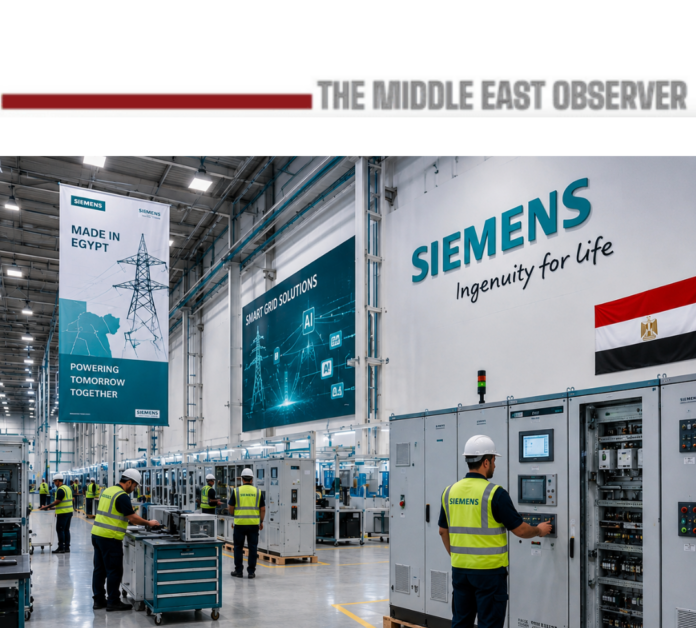
New manufacturing facility advances Egypt’s industrial localization strategy while supporting smart infrastructure, export growth and regional supply-chain integration.
CAIRO — Siemens has deepened its industrial presence in Egypt by opening its first factory dedicated to electrification and industrial automation products, reinforcing the government’s strategy to localize advanced manufacturing and position the country as a regional production and export hub for high-value industrial technologies.
The first phase of the project represents an investment of approximately EGP350 million (US$6.9 million), according to Siemens Egypt. The facility was inaugurated by Industry Minister Khaled Hashem, Electricity and Renewable Energy Minister Mahmoud Esmat, German Ambassador Jürgen Schulz, and senior Siemens executives. Production will initially serve the domestic market before expanding exports across the Middle East and Africa, reflecting Siemens’ strategy of manufacturing closer to key growth markets.
The factory will manufacture electrical distribution panels, medium- and low-voltage switchgear, protection and control systems, substation automation equipment, and digital monitoring solutions for industrial facilities and critical infrastructure. Global demand for digitally enabled electrification and automation technologies continues to rise as utilities modernize electricity networks to integrate renewable energy, improve grid resilience and support increasingly automated industrial operations. By combining protection, communications, automation and cybersecurity technologies, the facility is expected to enhance operational efficiency, strengthen power network reliability and facilitate the deployment of smart electricity infrastructure.
Industry Minister Khaled Hashem said the investment supports Egypt’s updated industrial strategy to raise industrial exports to US$100 billion by 2030 through technology localization, higher domestic value addition and stronger integration into global manufacturing value chains. He added that the project will contribute to developing skilled workers, strengthening domestic suppliers and increasing the local content of Siemens products manufactured in Egypt.
Siemens said locally sourced components currently account for around 40% of production, with the share expected to increase as Egyptian suppliers expand their manufacturing capabilities. Company executives also cited Egypt’s strategic geographic location, extensive network of free trade agreements and expanding industrial base as key factors supporting the decision to establish local manufacturing capacity.
Industry analysts expect investment in grid automation and digital power infrastructure to accelerate across emerging markets as electricity demand grows and governments expand renewable energy capacity, creating stronger demand for advanced electrification technologies and localized manufacturing.
The factory builds on Siemens’ 125-year presence in Egypt, where the company has delivered major energy, transport and healthcare projects, including three combined-cycle power plants with a combined generation capacity of 14.4 gigawatts and the country’s high-speed electric rail network. The new facility represents a strategic expansion of Siemens’ manufacturing footprint while supporting Egypt’s ambition to strengthen its role as a regional centre for advanced industrial production and technology-intensive exports.
Related news:Does Egypt Need Its Own Broadway?
Egypt–Russia Maritime Deal Signals Strategic Shift Toward Integrated Logistics Power
Read also:Egypt’s Averroes Ventures Targets $50 Million Waste-to-Value Fund
Aeolus to Invest $395 Million in Egypt Tyre Manufacturing Expansion