
About The Middle East Observer
The story of The Middle East Observer begins in Alexandria in the 1940s, when the city was one of the Mediterranean’s most active commercial centres.
Its port connected Egypt with Europe and the wider region. Ships arrived carrying goods into a market shaped by Egyptian, Greek, Italian, French and Spanish trading communities. Cotton remained central to the economy, while merchants depended on timely information about shipping movements, market prices, new regulations, tenders and commercial agreements.
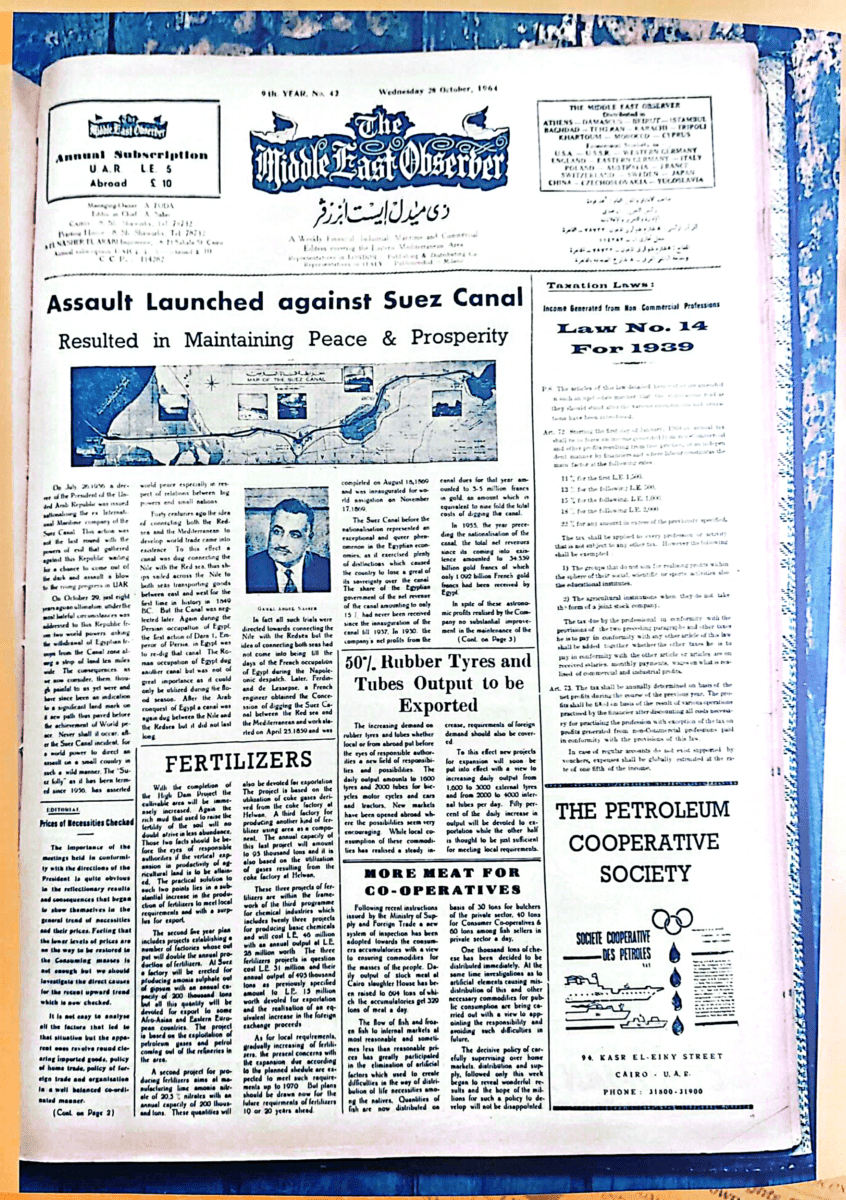
It was in this environment that Edward and Edgar Deblac founded L’Observatour.
The publication was built around a practical idea: provide the market with the information it needed to conduct business.
L’Observatour reported the arrival and departure of vessels, cargoes on board, stock-market prices, laws and decrees affecting commerce, tenders, agreements and other developments relevant to Egypt’s trading economy. Published in Greek, French and English, it developed a network of correspondents across the country.
Among them was Ahmed Fouda, an Alexandrian whose career became closely linked to the publication.
Fouda rose to become its principal correspondent in Cairo and took responsibility for the English-language edition, The Middle East Observer. His approach reflected the publication’s original purpose: journalism was most useful when it connected an event to its commercial consequence.
From L’Observatour to The Middle East Observer
In the mid-1950s, L’Observatour’s original owners decided to sell the publication’s licence.
Ahmed Fouda acquired it for EGP250—a substantial sum at the time, when the Egyptian pound traded at roughly the value of a gold sovereign. He would later recall that years of saving enabled him to complete the purchase.
The acquisition left limited resources. Fouda therefore concentrated the business on a single publication: The Middle East Observer, developing it as an English-language economic newspaper focused principally on Egypt, the Middle East and North Africa.
He also looked beyond Egypt for ideas about how such a publication should operate.
During a visit to the United Kingdom, Fouda toured the Financial Times publishing operation, studying the editorial, production and organisational methods of an established financial newspaper. He returned to Cairo intending to adapt those lessons to an Egyptian and regional publication.
The Middle East Observer subsequently received its Egyptian publishing licence through the Ministry of Guidance, then responsible for media affairs, under Minister Hatem Abdel Kader.
What followed was not simply the development of a newspaper but the gradual building of an institution.
Reporting a Region in Transformation
For decades, The Middle East Observer chronicled the economic changes reshaping Egypt and the wider region.
Its pages followed legislation, companies, markets, government decisions, commercial agreements, tenders, industrial projects and international trade.
The publication also witnessed a succession of much larger transformations: wars and peace agreements; nationalisation and economic liberalisation; the rise of the Gulf economies; successive periods of Egyptian economic reform; the development of new financial markets; expanding African trade; and profound changes in energy, infrastructure and technology.
MEO approached these developments from a consistent perspective.
The question was never only what happened, but what the development meant for commerce, investment and economic activity.
That focus remains central to the publication today.
A New Generation
Ahmed Fouda remained closely associated with The Middle East Observer until his death in 2015.
Responsibility for the institution subsequently passed to a new generation under the management of Mahmoud Fouda, his son, and Mazen Fouda, his grandson, with the task of preserving its editorial heritage while adapting the publication to a fundamentally different information environment.
The newspaper industry had changed almost beyond recognition.
Markets that once depended on the morning paper now move continuously. Ships can be monitored in real time. Corporate disclosures cross borders within seconds. Digital publishing has removed the geographical limits that once defined a newspaper’s readership.
For MEO, that transformation has changed the means of delivering information, but not the underlying purpose.
The same principle that made shipping movements, cotton prices and commercial decrees valuable to an Alexandrian merchant remains relevant to the investor, executive or policymaker of today:
Information becomes valuable when it improves understanding and informs a decision.
The Middle East Observer Today
Today, The Middle East Observer publishes news, reports, features and analysis covering the economic and commercial developments shaping Egypt, the Middle East and Africa.
Its principal areas of coverage include:
Investment & Capital Markets
Foreign direct investment, financing, the Egyptian Exchange, transactions and developments affecting capital allocation.
Companies & Industry
Corporate strategy, industrial expansion, manufacturing, major projects and business investment.
Energy & Commodities
Oil, gas, electricity, renewables, mining and the commodity markets shaping regional economies.
Trade & Logistics
Shipping, ports, the Suez Canal, supply chains, exports and changing regional trade corridors.
Economic Policy
Fiscal and monetary policy, regulation, economic reform and government decisions affecting businesses and investors.
Middle East & Africa
Investment, infrastructure and commercial developments across two increasingly interconnected economic regions.
Technology & Artificial Intelligence
The technologies changing companies, industries, investment and economic competitiveness.
Tenders & Business Opportunities
Commercial opportunities, procurement activity and developments relevant to organisations operating across the region.
Alongside daily reporting, MEO provides specialist analysis, market intelligence, Egyptian Exchange coverage, tender information, business opportunities and Premium Subscription services for individual and institutional readers.
Its audience includes business leaders, investors, policymakers, diplomats, financial institutions, researchers, academics and organisations seeking to understand the forces influencing regional economies and investment decisions.
From Information to Intelligence
The world in which The Middle East Observer operates is very different from the Alexandria in which L’Observatour first appeared.
The cotton exchange has disappeared. The ships are larger. Capital moves faster. Information travels almost instantly.
Yet the underlying requirement has changed surprisingly little.
Markets still need reliable information. Companies still need to understand regulation. Investors still need to distinguish an announcement from its economic significance. Decision-makers still need to know not merely what has happened, but what may follow.
That is the continuity connecting the origins of L’Observatour with The Middle East Observer today.
Our editorial approach is therefore built around a simple principle:
To report what happened, explain why it matters and identify the consequences for business, investment and decision-makers.
With roots extending back to Alexandria’s trading economy of the 1940s and more than seven decades under The Middle East Observer name, MEO continues to develop as a source of economic and business intelligence for Egypt, the Middle East, Africa and an international readership.
The Middle East Observer — Reporting the development. Explaining the consequence.