

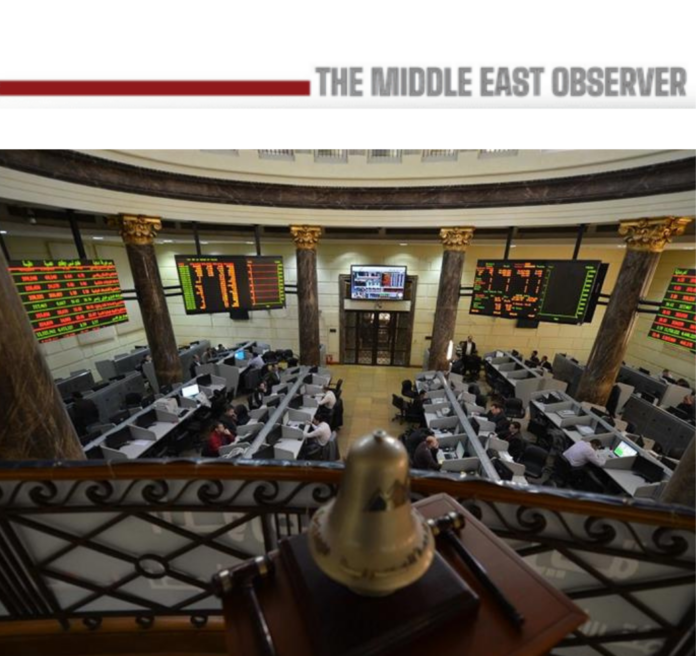
Egyptian equities suffered their broadest setback since reaching record territory on Tuesday, as institutional profit-taking spread from blue chips into smaller stocks. But the cross-market signal was more nuanced than a conventional risk-off session: foreign and Arab investors simultaneously bought about $380mn of government debt, while Egypt advanced preparations for a larger pipeline of state-owned listings.
The EGX30 fell 0.80% on September 8 to 56,174.30 points, after trading as high as 56,909.93 and closing at its session low — evidence that selling pressure strengthened into the close.
The decline was broad. EGX70 dropped 1.24% to 21,400.52 and EGX100 fell 0.98% to 28,015.70, while EGX33 Shariah lost 0.72%. Market capitalisation declined by about EGP26.5bn to EGP 4.424 tn.
Breadth confirmed the weakness: 152 stocks declined against 58 gainers, while equity turnover remained substantial at about EGP13.4bn.
Tuesday therefore marked a genuine broad-based correction.
The Rally Has Lost Momentum — Not Yet Its Structure
EGX30 opened the week with a 0.72% record-setting gain on Sunday, slipped 0.09% on Monday and fell 0.80% on Tuesday.
Yet the benchmark remains only about 0.17% below last Thursday’s close, while EGX70 and EGX100 are still modestly higher over the same period.
That distinction matters.
Tuesday erased Sunday’s benchmark advance but has not yet reversed the broader improvement that began last week.
The warning is broad. EGX70’s 1.24% fall removed much of Sunday’s small-cap rebound in a single session.
The key question is therefore whether Tuesday represents controlled profit-taking after a roughly 35% year-to-date rally or the beginning of sustained deterioration in market participation.
The Selling Was Institutional — Not Simply Foreign
Investor flows provide the most important correction to the day’s conventional narrative.
Egyptian institutions were the largest sellers, recording about EGP816mn of net sales, compared with roughly EGP203mn from foreign institutions. Arab institutions sold only about EGP6mn.
Domestic retail moved in the opposite direction: Egyptian individuals bought approximately EGP1.04bn net, absorbing a large share of institutional supply.
Aggregated by nationality, Egyptians remained net buyers of about EGP220mn, while foreigners sold roughly EGP201mn and Arabs about EGP19mn.
The more informative divide was therefore institutional versus retail, not simply domestic versus foreign.
Domestic retail has acted as an important liquidity buffer throughout the rally. On Tuesday, however, it was no longer sufficient to prevent a broad decline.
That makes the session a more meaningful test of the domestic-liquidity resilience that has supported the EGX near record levels.
Debt Investors Were Buying While Equity Institutions Sold
The sovereign-debt market sent almost the opposite signal.
Foreign and Arab investors recorded combined net purchases of about $380mn in secondary-market government securities, almost entirely Treasury bills.
Arab investors bought roughly $343.5mn net of T-bills, while foreigners bought about $39.2mn. Foreign investors simultaneously sold a small amount of longer-duration Treasury bonds.
Tuesday was therefore not a wholesale foreign retreat from Egyptian assets.
International and regional investors were reducing equity exposure while remaining willing to buy Egypt’s high-yielding short-term sovereign paper.
That reinforces the two-speed investment story visible in recent sessions:
Government debt continues to attract capital for yield, while equities face a higher hurdle after a powerful rally.
The Pound Weakens Despite Debt Inflows
The dollar rose to about EGP50.98 for buying and EGP 51.12 for selling, moving back above EGP51.
The coexistence of a weaker pound and substantial T-bill buying shows why neither market should be interpreted in isolation. Debt inflows were not enough by themselves to produce currency appreciation, while the pound’s weakness should not automatically be attributed to foreign portfolio exits.
For equity investors, FX is becoming increasingly important to stock selection and hard-currency returns, particularly for exporters, import-intensive businesses and companies carrying foreign-currency liabilities.
Tuesday Was Not Simply a Regional Sell-Off
Geopolitical pressure remained elevated, with oil trading near $99 a barrel amid continued Middle East tensions.
Yet most major Gulf markets finished higher while Egypt declined, suggesting the EGX correction reflected domestic profit-taking and market-specific positioning rather than regional risk alone.
Energy and basic resources outperformed while real estate and construction weakened, reinforcing the view that investors were differentiating between sectors even within a broadly negative session.
The IPO Pipeline Moves Closer to Market
The more important structural development came from the government’s privatisation programme.
Egypt has selected 10 independent financial advisers to prepare fair-value studies for 18 state-owned companies already temporarily listed on the EGX, while advisers are still being appointed for five additional companies.
This represents genuine progress, but the project stage must be classified carefully.
Valuation work does not mean 18 IPOs are imminent. The companies still require final listing procedures, regulatory approvals, transaction structuring and suitable market conditions before offerings can proceed.
Nevertheless, the development is strategically important.
With Egypt’s investor base and trading liquidity expanding rapidly, the market increasingly needs new investable supply rather than simply higher prices for existing shares.
Successful offerings could convert today’s liquidity into deeper capital formation, broader market depth and greater capacity for institutional investment.
A Healthy Correction — Until Breadth Says Otherwise
Tuesday changed the tone of the week without yet breaking the rally.
EGX30 fell 0.8%, closed at its daily low and lost Sunday’s record close. EGX70 and EGX100 declined more sharply, while market breadth deteriorated substantially.
Those are real warning signs.
But the correction remains orderly rather than systemic. The benchmark is still close to last week’s record levels, broader indices remain modestly higher than last Thursday, domestic retail continued supplying liquidity, and foreign and Arab investors were substantial buyers of Treasury bills.
Three tests now matter:
whether breadth stabilises, whether institutional selling persists, and whether the accelerating IPO pipeline can transform abundant liquidity into deeper market structure.
The EGX’s recent strength has shown that domestic capital can absorb volatile foreign flows.
Tuesday exposed the limitation of that resilience:
liquidity can cushion selling, but it cannot indefinitely substitute for earnings, institutional conviction and new investable supply.
The next phase of the rally will therefore be decided less by whether EGX30 revisits 57,000 than by whether breadth, earnings and new listings can justify the market’s move into record territory.
Related news:
EGX30 Pauses Below 57,000 as Rally Rotates Into Smaller Stocks
EGX Ends Week Higher as Smaller Stocks Rebound
Read also:
Gulf Investors Build Sectoral Clusters Across Syria’s Reconstruction
Jordan Broadens China Partnership, but $1bn Energy Pipeline Awaits Capital