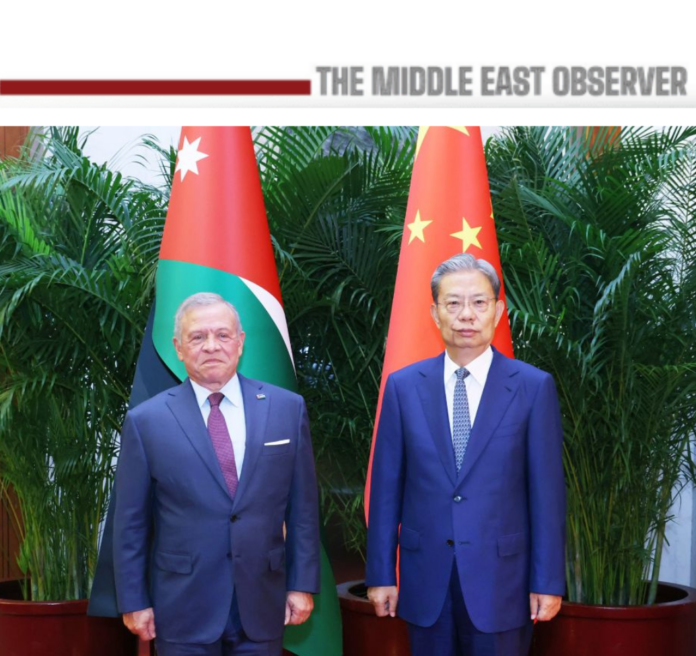
King Abdullah concludes China visit with agreements spanning energy, digital trade, supply chains and aviation, but the $14.7mn grant remains the principal newly disclosed monetary commitment
Jordan and China signed a broad package of agreements spanning energy, mining, digital trade, industrial supply chains and aviation during King Abdullah II’s state visit, but the only newly quantified financial commitment disclosed in the official signing announcement was a $14.7mn Chinese grant, while Jordan’s $1bn-plus renewable-energy and storage pipeline remains without announced Chinese financing.
King Abdullah and Chinese President Xi Jinping witnessed the August 24 signing ceremony in Beijing, concluding a week-long visit aimed at shifting the relationship towards greater investment, technology transfer and Jordanian exports. The two countries also issued a joint statement committing to deeper cooperation across trade, investment, energy and minerals, agriculture, tourism and emerging sectors including the digital economy, artificial intelligence and green industries.
The agreements substantially broaden the framework for economic cooperation. Whether they generate a corresponding increase in Chinese capital deployed in Jordan remains the central question.
$1bn Energy Pipeline Remains Prospective
Energy was the largest quantified investment opportunity Jordan promoted during the visit.
Amman is seeking investors for nearly 1GW of renewable-generation and energy-storage projects worth more than $1bn, as it works towards raising renewables from about 27 per cent of electricity generation to 40 per cent by 2035.
The final package included MoUs covering energy and mineral resources, while Xi called for expanded cooperation in green energy alongside infrastructure, transport and mining.
But neither energy agreement disclosed a project value, Chinese investor, financing structure or implementation timetable.
Under a project-stage assessment, these remain cooperation frameworks rather than financed investments. The visit strengthened the institutional route for Chinese participation but did not publicly convert Jordan’s $1bn pipeline into committed FDI.
Mining provides a precedent for what deeper investment could look like: China’s State Development and Investment Group previously acquired 28 per cent of Arab Potash Company for $502mn. That transaction predates the visit and should be treated as historical context, not part of the new package.
Trade Imbalance Drives the Investment Push
China’s ambassador to Jordan said bilateral trade exceeded $6.7bn in 2025, rising more than 25 per cent, while Jordanian exports to China increased 80 per cent in the first five months of 2026 to nearly $300mn. He also put accumulated Chinese investment in Jordan at more than $3bn.
The figures illustrate the economic logic behind Abdullah’s strategy: Jordan wants Chinese companies not simply to sell into its market, but to invest, manufacture locally and use the kingdom as an export platform.
The new industrial and supply-chain MoU supports that objective by creating a coordination platform intended to encourage industrial cooperation, economic growth and employment. Separate agreements covering e-commerce and the digital economy provide frameworks for regulatory exchange, digital infrastructure, skills and SME trade.
For Jordan, the potential prize is a relationship containing more productive investment and exports rather than simply higher bilateral trade.
For Chinese companies, Jordan offers mineral resources and potential access to regional supply chains and markets reached through the kingdom’s trade relationships, although its relatively small domestic market and regional risks remain constraints.
Aviation Offers a More Actionable Route
Aviation produced one of the more commercially tangible outcomes.
The governments signed an MoU to develop cooperation around an “Air Silk Road” and improve connectivity, while Royal Jordanian and Air China separately signed an agreement aimed at expanding commercial and operational cooperation, including new routes.
The bilateral joint statement called for direct flights between Jordan and China “as soon as possible”, giving the aviation initiative additional political backing.
No financial value, capacity commitment or firm launch date was announced.
Its economic significance will therefore depend on implementation and route economics. Direct connectivity could support tourism, cargo, investment and business travel, but political endorsement alone does not establish commercial viability.
$14.7mn Grant Is the Clearest New Financial Commitment
The governments signed a development cooperation agreement providing a Chinese grant estimated at $14.7mn for humanitarian assistance and development projects.
China also committed to 800 training opportunities for Jordanian government personnel during 2026.
Beyond that grant, the official signing announcement did not attach monetary values to the energy, mining, industrial, digital or aviation agreements.
The wider package also covered science and technology, tourism promotion, film, media, environmental and climate cooperation, agriculture and quarantine arrangements, social affairs and institutional exchanges.
Their breadth is diplomatically significant, but MoUs, cooperation frameworks and training programmes should not be aggregated into an implied investment total.
That distinction is essential to assessing the visit’s economic outcome.
Financing Is Now the Test
The next stage will depend on whether Chinese companies and financial institutions attach capital to the frameworks signed in Beijing.
Key information remains absent: prospective project sponsors, equity commitments, lenders, financing structures, government guarantees where applicable, financial-close targets and construction schedules.
Without those details, the probability and fiscal implications of the larger investment opportunities cannot yet be assessed reliably.
The same test applies sector by sector.
Renewable projects must secure financing and economically integrate with Jordan’s electricity system. Manufacturing requires competitive costs and sustainable export demand. Digital and technology cooperation must progress from knowledge exchange to commercial deployment, while direct aviation links must attract sufficient passenger and cargo traffic.
China has signalled interest in precisely these areas. Premier Li Qiang identified green energy, electric vehicles and the digital economy as areas for deeper industrial and technological cooperation, while Xi highlighted digital economy, AI and green energy as potential new growth drivers.
Interest, however, remains distinct from committed investment.
Conversion Will Determine the Economic Legacy
The August 18-24 visit materially broadened the architecture of Jordan-China relations ahead of the 50th anniversary of diplomatic ties in 2027. The final joint statement extends cooperation across traditional industries and emerging technologies, while the signing package establishes mechanisms through which future projects can be developed.
But MEO’s assessment should distinguish diplomatic outcome from capital outcome.
The diplomatic outcome was substantial: Jordan secured a wide cooperation package and stronger Chinese political backing for deeper economic engagement.
The disclosed capital outcome was more limited: a $14.7mn grant, alongside frameworks whose eventual investment value has yet to be established.
Jordan’s $1bn-plus renewable-energy and storage portfolio remains the clearest test.
If the agreements signed in Beijing lead to named investors, financing, financial close and construction, the visit could mark the beginning of a deeper Chinese investment cycle.
Until then, the most defensible conclusion is narrower: King Abdullah’s visit significantly broadened Jordan’s economic partnership with China, but the conversion from agreements to large-scale committed investment has only begun.
Related news:
US-Jordan Trade Deal Unlocks Strategic Mining and Energy Investment
Jordan’s Exports Rise 9% as Industry and Logistics Drive Trade Recovery
Read also:
Egyptian Short Film Khufu Brings Contemporary Egyptian Storytelling to the Global Stage
AfDB Approves €100mn Loan for Morocco’s First EV Battery Gigafactory