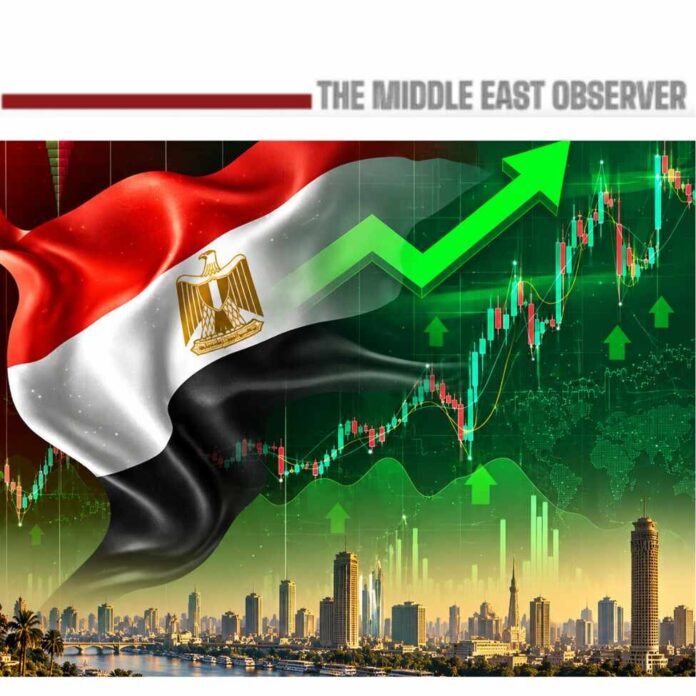
Egypt is preparing a 2027–2030 foreign direct investment strategy aimed at attracting not only more foreign capital, but investment capable of expanding production, transferring technology, deepening industrial localization and generating exports, as private investment assumes a larger role in the country’s economic recovery.
Prime Minister Mostafa Madbouly reviewed the strategy on October 5 with Investment and Foreign Trade Minister Mohamed Farid, GAFI Chief Executive Mohamed Awad and senior officials. The framework is expected to identify approximately 16 priority sectors, shifting promotion from broadly marketing Egypt toward matching specific investment opportunities with targeted international investors.
The strategy maintains the objective of increasing overall FDI through 2030, but adds a clearer emphasis on its economic impact: local manufacturing, technology transfer, productive capacity, exports and stronger private-sector participation. World Bank and International Finance Corporation specialists participated in consultations alongside industry federations, business organizations and investment companies.
Private Investment Strengthens the Growth Case
The shift comes as the World Bank has sharply upgraded its assessment of Egypt’s recent economic performance. It now estimates real GDP expanded 5.1% in FY2025/26, compared with the 4.3% projected in April and 4.4% growth in FY2024/25, supported by lower inflation, stronger private consumption and investment and a recovery in extractive industries.
For the current FY2026/27, the Bank raised its growth forecast to 4.3% from 4%, although that represents moderation from last year’s stronger expansion. Average inflation is projected to edge up to 14.2% from 13.3%, while tighter financial conditions are expected to constrain investment and continue weighing on household purchasing power.
That combination makes the composition of incoming investment increasingly important. Sustaining growth will require more capital directed toward productive sectors rather than relying heavily on consumption, portfolio flows or exceptional asset transactions.
From FDI Volume to Economic Value
Egypt remained Africa’s largest FDI destination in 2025, attracting about $15 billion of the continent’s roughly $70 billion total, according to UNCTAD. This followed the exceptional $46.6 billion recorded in 2024, when the Ras El-Hekma transaction dramatically lifted the headline figure.
The experience reinforces the rationale behind the new strategy. UNCTAD has itself warned that rising headline FDI does not necessarily translate into factories, employment or technological upgrading; development gains depend on whether capital expands productive capacity, jobs, skills and technology transfer.
Egypt’s next investment cycle will therefore be judged increasingly by what foreign capital builds, what technology it brings and what exports it generates. The strategic objective is no longer simply to rank among the largest FDI recipients, but to convert foreign investment into a durable engine of industrialization, private-sector growth and external competitiveness.
Related news:
Saudi Arabia, France Turn Strategic Pact Into Multibillion-Dollar Investment Pipeline
Morocco Overtakes South Africa in Industrial Competitiveness Ranking
Read also:
Egypt’s Private Sector Strained by Cost Pressures as Stabilisation Becomes Imperative
El-Sisi, Bin Zayed Endorse US-Iran Deal as Region Seeks Post-Conflict Reset