

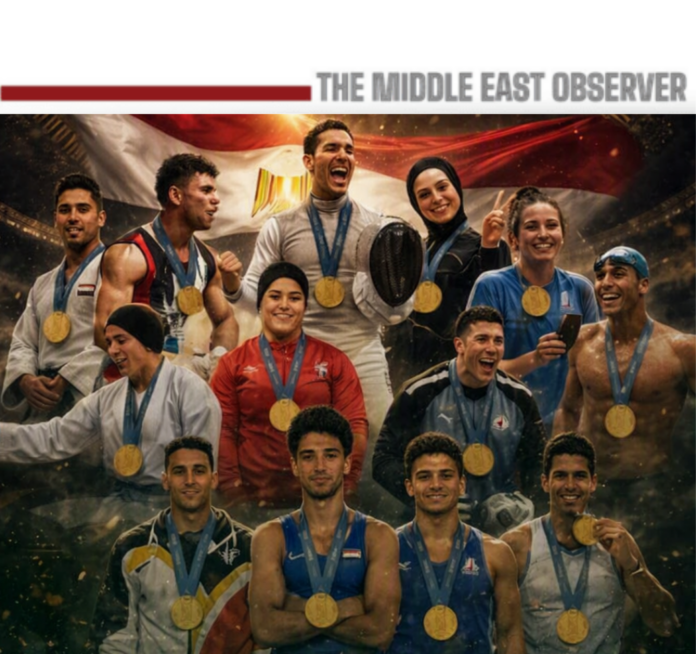
Egypt finished fifth at the Taranto 2026 Mediterranean Games with 58 medals, including a record 23 golds under the Egyptian flag, sharpening the question of how much of that regional success can be converted into world and Olympic competitiveness.
Egypt won fewer medals than Spain at Taranto — 58 against 81 — yet finished one place higher because 23 of its medals were gold, compared with Spain’s 18.
That distinction captures the strongest feature of Egypt’s Mediterranean Games performance.
The delegation did not simply accumulate more podium finishes. It produced a substantially higher proportion of victories.
Egypt ended the Games with 23 gold, 16 silver and 19 bronze medals, placing behind Italy, Türkiye, Greece and France in the final standings and finishing as the highest-ranked Arab nation.
At the previous Mediterranean Games in Oran in 2022, Egypt won 51 medals, including 13 golds. Four years later, its total medal count increased by seven, while the number of gold medals rose by 10.
The result gave Egypt a markedly higher gold-medal conversion rate than in Oran and its strongest Mediterranean Games gold performance while competing solely under the Egyptian flag.
The 23-gold total also matched the figure recorded by the United Arab Republic at Beirut in 1959, when Egypt and Syria competed together under one political federation.
Concentration and Breadth
Egypt’s success in Taranto combined strength in core disciplines with broader medal production across the delegation.
Weightlifting was the clearest concentration of competitive advantage, accounting for seven gold medals and 10 medals overall, making Egypt the leading nation in the discipline.
The remaining titles were distributed across fencing, wrestling, karate, judo, swimming, table tennis, finswimming and men’s handball.
That breadth matters because national sports systems are more resilient when success is produced across several disciplines rather than depending on a single champion or federation.
Men’s handball provided one of the strongest team performances, with Egypt completing the competition unbeaten before defeating Greece 31-29 in the final.
Egypt also finished ahead of Morocco and Algeria in the Arab standings, reinforcing its regional position across a range of individual and team sports.
But Taranto’s greater value lies in what the results reveal about Egypt’s competitive pipeline rather than in regional ranking alone.
A Performance Audit Before Los Angeles
Mediterranean success cannot be mechanically translated into Olympic expectations.
The strength of competition varies substantially by discipline, national teams do not always field their strongest athletes, and some Mediterranean events provide a much clearer indication of global competitiveness than others.
Taranto should therefore be treated as a performance audit, not an Olympic forecast.
The central question is no longer how many medals Egypt won, but which of them represent transferable international competitiveness.
That requires separating Mediterranean success into different categories.
A gold medal in an Olympic discipline against globally competitive opposition carries a different strategic value from a victory in an event where the performance gap to world level remains significant.
The same applies to age, development trajectory and depth.
A younger silver medalist approaching world-class standards may offer greater Los Angeles 2028 potential than an established regional champion already near the end of a competitive cycle.
For policymakers and federations, the implication is clear: the next stage should be based on evidence-led allocation rather than uniform support.
From Medals to Investment Decisions
Egypt’s 23 gold medals now provide sports authorities with a clearer map of where further investment could generate the highest international return.
The priority should be to identify athletes and disciplines where additional spending on stronger international competition, coaching, sports science, injury prevention and preparation is most likely to narrow the gap with world leaders.
That is ultimately a capital-allocation question.
Sports funding is finite. Treating every federation, every medal and every athlete as equally likely to produce an Olympic return risks diluting resources across too many programmes.
The more efficient approach is to identify where Egypt already possesses measurable competitive proximity to world and Olympic standards and concentrate additional support there.
Taranto offers evidence for that process.
Weightlifting clearly demonstrated depth. Combat sports remain an established Egyptian strength. Fencing has produced athletes capable of competing at the highest international level. Team handball demonstrated tournament resilience. Other disciplines supplied emerging medal pathways that can now be tested against stronger fields.
The task over the next two years is to determine which of those pathways are genuinely scalable.
The Harder Medal Table Comes Next
Taranto established that Egypt can produce champions across a broad Mediterranean field.
It also showed a significant improvement in the colour of its medals: only seven more podium finishes than in Oran, but 10 more golds.
That is a meaningful performance signal.
It is not yet proof of a structural transformation in Egyptian sport.
That judgment will depend on whether Taranto’s strongest athletes can remain competitive at world championships, whether federations can build depth beneath their leading performers and whether funding decisions become increasingly tied to measurable international potential.
The Mediterranean Games have therefore given Egypt something more useful than a record medal haul.
They have produced a clearer set of investment choices ahead of the next Olympic cycle.
Taranto has established Egypt’s Mediterranean strength. Whether it marks a genuine advance in Egyptian sport will be measured somewhere harder — at world championships and, ultimately, at Los Angeles 2028.
Related news:
Egypt’s Handball Success Shows the Cost of Looking Only at Football
Egypt Wins World Fencing Bronze After Golden-Touch Victory Over Israel
Read also:
US-Venezuela Oil Pact Links 65bn Barrels to $100bn Investment Push