Washington would benefit from cheaper financing as federal debt rises, but persistent inflation is limiting the Federal Reserve’s room to lower interest rates. The tension is increasingly visible in the Treasury market — and because US borrowing costs help set the price of money worldwide, the consequences extend far beyond America.
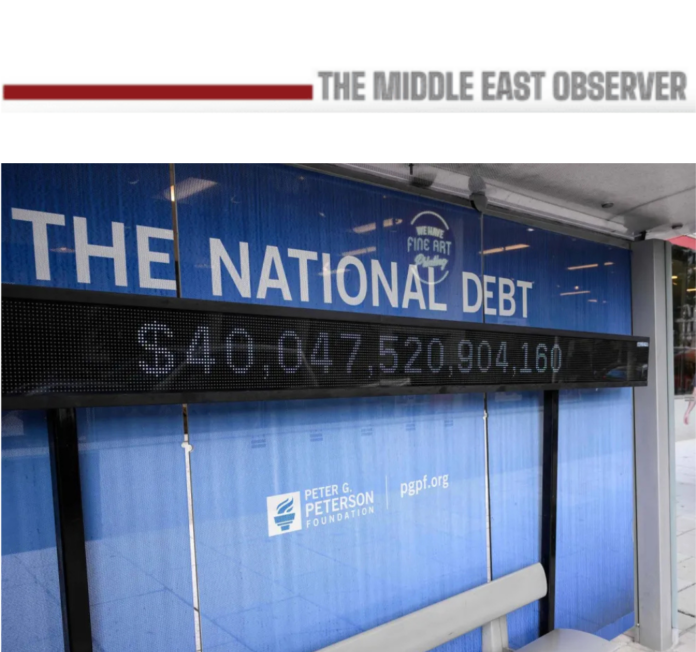
US federal debt has crossed $40 trillion for the first time, drawing attention to a deeper problem: America is carrying a growing debt burden at a time when borrowing has become more expensive.
Total federal debt reached about $40.05 trillion, including roughly $32.3 trillion held by the public. The total has more than doubled since Donald Trump began his first presidency in January 2017, reflecting pandemic borrowing, policy choices under both Trump and Joe Biden, and longer-running pressures from Social Security, Medicare and persistent budget deficits.
The imbalance has accumulated over decades as federal spending commitments have grown faster than the revenue base needed to finance them.
For investors, the more meaningful measures are debt held by the public relative to the economy and the cost of servicing it. Both are projected to rise. The Congressional Budget Office projects a $1.9 trillion deficit in fiscal 2026 and debt held by the public reaching 120% of GDP by 2036.
The more important question is therefore how much Washington must pay to finance its growing debt.
The fiscal-monetary squeeze
Long-term Treasury yields have risen as investors demand higher returns amid persistent inflation, heavy government borrowing and concern over the fiscal outlook. The 30-year Treasury yield reached about 5.34% this week, its highest since 2007, before retreating.
Washington would benefit from lower financing costs. The Federal Reserve, however, is still fighting inflation.
At its July meeting, the Fed voted 9-3 to keep its benchmark rate at 3.50%-3.75%, with three policymakers favouring a quarter-point increase. Minutes released this week showed many officials believed tighter policy could become necessary if inflation failed to move sufficiently towards the Fed’s 2% target.
That creates the central dilemma: rising debt makes cheaper financing increasingly valuable to Washington while persistent inflation may require the Fed to keep money expensive.
Higher rates also feed back into the budget. As existing government debt matures, some must be refinanced at prevailing market rates. Interest has already become the federal government’s second-largest spending category after Social Security.
Against this backdrop, Treasury Secretary Scott Bessent doubled certain planned buybacks of 10- to 30-year securities from $2 billion to at least $4 billion per operation. The announcement helped bring long-term yields lower.
But the buybacks are principally a market-liquidity tool. They do not reduce America’s underlying borrowing requirement or resolve the deficits behind it.
No painless solution
There is no single-policy answer. Fiscal arithmetic points towards some combination of slower spending growth, broader revenues and stronger productivity, while preserving the Fed’s ability to set interest rates according to inflation and economic conditions.
Spending restraint is one route, but cuts concentrated on government departments and other discretionary programmes cannot alone resolve an imbalance increasingly driven by Social Security, healthcare and interest costs. Any substantial long-term spending reform would eventually confront politically sensitive retirement and healthcare programmes.
Raising federal revenue is another option. The Trump administration’s tariffs provide a striking example of both the potential and limitations of that approach.
Tariffs generate customs revenue while pursuing broader trade and industrial-policy objectives. Their fiscal significance became clear after the Supreme Court struck down tariffs imposed under emergency powers in February. CBO estimated that their removal would increase projected federal deficits by about $2 trillion through 2036, including additional interest resulting from greater borrowing.
But tariffs also illustrate the trade-off. They can increase federal revenue and support selected domestic industries while simultaneously raising import costs and contributing to price pressures. That can make it harder for the Fed to lower interest rates — potentially increasing the government’s financing costs.
Faster economic growth offers a third route. Higher productivity, investment and labour-force participation would expand the economy and make existing debt easier to carry relative to GDP. But with deficits projected to remain large, growth alone is unlikely to stabilise the fiscal position.
Lower Fed rates are not, by themselves, a fiscal solution. Cutting rates before inflation is under control could weaken confidence in price stability and leave investors demanding higher yields on longer-term debt.
The challenge is therefore political as much as economic: deciding how much adjustment should come from spending, how much from revenue and how much can realistically be delivered by stronger growth.
Delay increases the risk that accumulating debt and interest costs make those choices more difficult.
Why the world is watching the Fed
The next major test comes at the Federal Reserve’s September 15–16 meeting, when policymakers will also publish updated projections for inflation, economic growth and interest rates.
For global markets, the importance goes well beyond whether the Fed moves rates by a quarter of a percentage point.
US Treasury yields are the reference point for much of global finance. When they rise, governments and companies elsewhere often have to pay more to borrow; the dollar can strengthen; and international capital can move towards higher-yielding US assets.
For emerging economies, this can translate into more expensive government refinancing, higher corporate borrowing costs, pressure on currencies and less room for domestic central banks to reduce their own rates.
The September projections will therefore help markets judge whether US borrowing costs are likely to remain high into 2027 — and, by extension, how expensive capital may remain internationally.
What it means for the Middle East
The Middle East is unusually exposed because the relationship runs in both directions.
Regional conflict and disruption to energy and trade can raise oil, transport and production costs. If those pressures feed into US inflation, they can reduce the Fed’s room to lower rates. Persistently high US rates then feed back into regional financing conditions.
Higher oil prices can support revenues for Gulf producers, but those gains can be partly offset by conflict disruption, higher project costs and tighter financing conditions. Dollar-pegged Gulf economies also generally have limited scope to allow domestic interest rates to diverge substantially from US rates for prolonged periods.
The risks can be greater for energy-importing and highly indebted economies, which may face higher fuel bills and more expensive international refinancing at the same time.
For Egypt, the combination is particularly relevant. The IMF expects inflation to rise to 16.7% in the second half of 2026 as higher energy prices and currency depreciation feed into prices, while regional uncertainty weighs on investment and growth. Higher global financing costs would add another constraint to an economy with substantial public funding requirements.
The relationship therefore works both ways: Middle East instability can complicate America’s inflation outlook, while US interest rates determine an important part of the financing environment confronting Middle Eastern economies.
The global price of $40tn
Crossing $40 trillion does not imply an imminent US debt crisis. The dollar’s reserve role, the scale of the American economy and the depth of Treasury markets still give Washington exceptional financing capacity.
The warning lies in the direction of travel.
Debt and interest costs are rising while inflation limits the Fed’s ability to provide cheaper money. Stabilising the outlook will ultimately require fiscal choices — not simply lower interest rates.
The Treasury can improve market liquidity and the Fed can manage monetary policy. Neither can substitute for a credible long-term fiscal strategy.
That is why America’s $40 trillion milestone has become a global story: the price Washington pays to finance its debt increasingly influences the price of capital everywhere else.
Related news:
Behind Washington’s Yen Intervention: Why Currency Support Cannot Fix the Rate Gap
Trump Faces Economic Fallout at Home as Middle East Deadlocks Deepen
Read also:
Sungrow Starts $50mn Egypt Battery-Storage Plant
Egypt Plans Two More El-Dabaa Reactors, Potentially Lifting Nuclear Capacity to 7.2GW