Egypt sits on one of the world’s most important internet corridors. Turning that geography into a digital-infrastructure industry will depend on fibre, resilient routes, cheap power, data centres — and the capital willing to finance them.
Egypt’s digital economy is usually measured in fintech transactions, internet users and technology companies. But beneath it lies a more capital-intensive business: spectrum, fibre-optic cables, telecom towers, submarine networks, data centres and electricity.
That physical layer is becoming an investment market in its own right.
In February, Egypt allocated 410 MHz of additional spectrum to its four mobile operators in agreements worth nearly $3.5bn — effectively doubling available spectrum capacity in one move.
But spectrum creates capacity, not economic value on its own. The larger question is who will finance, build and own the infrastructure required to use it.
Egypt’s Geography Is an Asset — and a Risk
Egypt’s first advantage is geography.
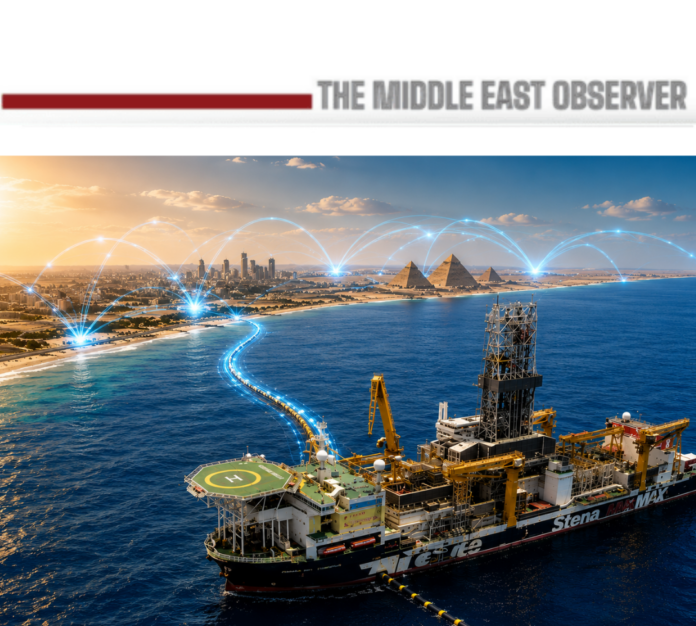
Sitting between the Mediterranean and Red Seas, the country occupies one of the shortest telecommunications routes between Europe and Asia. A 2025 study by the Center for Strategic and International Studies estimated that approximately 17% of global internet traffic passes through Egypt, making the country one of the world’s most strategically important submarine-cable corridors.
That concentration is both a competitive advantage and an infrastructure risk.
Cable disruptions in and around the Red Sea have demonstrated how damage to physical infrastructure can affect connectivity far beyond the immediate location. The International Telecommunication Union says submarine cables carry more than 99% of international data traffic and has elevated route diversity, resilience and faster repair into global policy priorities.
For Egypt, the commercial prize lies not simply in maximising dependence on its chokepoint, but in monetising its geography while reducing the risks created by it.
That means diversified landing points, terrestrial routes and interconnections that make Egypt difficult to bypass — and safer to depend upon.
Telecom Egypt is already moving in that direction. Its Point of Presence at Jordan’s Aqaba Digital Hub, combined with the Coral Bridge subsea cable linking Taba and Aqaba, provides an additional regional interconnection route and illustrates how geography can be converted into network resilience.
5G Turns Fibre Into a Scarce Asset
Egypt’s $3.5bn spectrum deal may attract the headlines, but spectrum alone does not create a 5G economy.
Behind high-capacity mobile networks sit fibre, transmission equipment, towers, power and backhaul. As data consumption rises, those physical connections become more valuable.
The commercial model is already visible.
Telecom Egypt and Vodafone Egypt signed infrastructure agreements in 2024 worth approximately EGP30bn, with varying maturities extending to 2034. The agreements support Vodafone’s network development and 5G rollout while allowing Telecom Egypt to generate long-term revenue from infrastructure it already owns.
The significance extends beyond the two companies. Network ownership can increasingly be separated from the services sold over it: one operator may own the customer relationship while another owns part of the infrastructure underneath it.
That begins to turn fibre and network capacity from internal telecom costs into revenue-producing infrastructure assets.
The physical build-out is also accelerating. The government is targeting around 3,000 additional telecom towers in 2026 and more than 9,000 over three years, while reporting that more than $6bn has been invested in fixed and mobile internet infrastructure since 2019.
The larger investment question is whether those sites remain primarily operator-financed assets or increasingly migrate towards shared and independently financed infrastructure models.
Egypt’s next digital highway will not be built by spectrum alone. It will be built through thousands of physical sites connected by increasingly dense fibre networks.
Moving Up the Digital Value Chain
Moving data through Egypt captures only part of its potential value. Hosting it is the next step.
Egypt’s challenge is to move up the digital-infrastructure value chain: from charging for data transit to earning from interconnection, hosting, cloud services and eventually AI compute.
The government is preparing a national strategy for data centres and cloud computing, including a unified investment framework covering potential locations, renewable-energy resources, infrastructure readiness and incentives.
The involvement of the electricity ministry is revealing.
Data centres are as much an energy business as a technology business. Egypt is therefore beginning to connect digital-infrastructure policy directly with energy policy.
Electricity Minister Mahmoud Esmat has said renewable energy is targeted to reach 45% of the energy mix within two years, while officials are considering long-term electricity arrangements for data-centre investors.
The constraint is already tangible. In June, the Egyptian Electricity Transmission Company signed an MoU with Heca Data to study electricity requirements, grid connections and potential renewable-energy and storage options for a proposed data-centre project.
Investment is also beginning to move beyond government strategy.
In June, Hassan Allam Digital Infrastructure secured a licence to establish and operate data centres and provide cloud-computing services, with an initial investment of $400mn planned in partnership with A15.
The project is intended to serve government entities, financial institutions and domestic and international businesses while addressing growing demand for cloud computing, AI applications and data-intensive services.
Commercial forecasts point to considerable potential, although they remain projections rather than guarantees. Arizton, a market-research firm, estimates that investment in Egypt’s data-centre market could rise from $305mn in 2025 to $865mn by 2031, implying annual growth of almost 19%.
If that trajectory materialises, Egypt would begin moving from a connectivity market into a computing-infrastructure market.
AI Turns the Power Grid Into Digital Infrastructure
Artificial intelligence raises the stakes.
AI-ready data centres require high-density computing, resilient power, sophisticated cooling and high-capacity connectivity. For developers, the scarce asset is increasingly not simply land but powered land — sites where large electricity loads can be connected quickly and predictably.
That changes the competition facing Egypt.
Countries seeking hyperscale and AI infrastructure are effectively competing on a package of electricity cost and availability, land, fibre connectivity, regulation, cooling economics and capital.
Egypt has powerful advantages: location, submarine connectivity, a large domestic market and an expanding telecom backbone.
But it is entering a regional race in which capital is already moving quickly. Saudi Arabia is pursuing gigawatt-scale AI infrastructure through PIF-backed Humain, while the UAE continues to expand hyperscale capacity through partnerships involving Microsoft and G42.
That raises the benchmark. Egypt does not merely need enough data-centre capacity to satisfy domestic demand. It must offer a sufficiently compelling combination of power, connectivity, land, regulation and capital to persuade hyperscalers that workloads should sit in Egypt rather than elsewhere in the region.
Geography gives Cairo an advantage in transit. It does not automatically give Egypt an advantage in computation.
For AI infrastructure, connectivity may get Egypt onto the shortlist; power economics will increasingly determine whether it wins the investment.
When Telecom Infrastructure Becomes an Asset Class
Capital markets are also changing the ownership model.
Telecom networks were traditionally financed largely as internal assets of operators. Increasingly, fibre, towers and data centres can be financed and monetised as infrastructure in their own right.
Globally, that transition is already well advanced. Infrastructure funds, sovereign investors and private capital are competing for data-centre platforms at valuations measured in tens of billions of dollars as demand for computing capacity accelerates.
Egypt is only beginning to develop its local version of that market.
Telecom Egypt has pursued the monetisation of its network infrastructure, while its agreements with Vodafone demonstrate how existing assets can generate long-term wholesale revenues.
Hassan Allam’s move into digital infrastructure takes the logic further by bringing a major infrastructure group into data centres and cloud infrastructure.
The answer to who finances Egypt’s next digital highway is therefore unlikely to be a single telecom operator.
Its next generation of networks could be supported by a broader capital stack: operators owning strategic assets, infrastructure groups building data centres, utilities supplying long-duration power, specialised operators running facilities and private or institutional investors financing assets against recurring wholesale revenues.
Digital infrastructure is consequently becoming less like a technology-sector expense and more like roads, ports and power networks — long-lived physical assets on which other economic activity depends.
Capital Will Follow Execution, Not Announcements
Egypt’s opportunity is considerable, but geography does not guarantee that capital will arrive.
Large data centres require suitable land, rapid permitting, substantial grid capacity and predictable telecom regulation. Fibre expansion requires rights of way and efficient construction approvals. International connectivity requires redundancy rather than dependence on a small number of routes.
For data-centre developers, every month added to permitting or grid connection increases carrying costs and delays revenue, weakening Egypt’s competitiveness against markets where powered land can be brought online faster.
Power may prove particularly decisive.
AI workloads are sharply increasing the electricity requirements of new data centres globally. Egypt must therefore demonstrate not merely that generation capacity exists, but that investors can secure reliable, competitively priced power — increasingly from low-carbon sources — over the long operating lives of these assets.
The Red Sea adds another lesson: redundancy is not an engineering luxury. It has economic value.
A country with one route can sell connectivity. A country offering multiple resilient routes, abundant fibre, dependable power and domestic processing capacity can sell infrastructure security.
And announcements alone will not establish an industry.
Licences, MoUs and investment targets establish direction; operational megawatts, contracted customers and deployed capital will determine whether a new digital-infrastructure market has actually emerged.
The Prize: Capturing More of the Data Economy
Egypt already possesses strategic geography, extensive submarine-cable connectivity, a national telecom backbone, expanding 5G infrastructure and an emerging data-centre industry.
The next challenge is capturing more value from them.
A transit corridor earns money when data passes through it. A digital hub can earn across the chain — landing cables, transporting traffic, leasing fibre, hosting servers, supplying cloud connectivity, storing data and processing AI workloads.
Egypt’s recent infrastructure figures measure different things: spectrum rights, contracted infrastructure services, planned capital investment and network expansion. They should not be treated as additive measures of investment.
Together, however, the $3.5bn spectrum allocation, thousands of planned telecom towers, EGP30bn of long-term infrastructure agreements and Hassan Allam’s planned $400mn initial data-centre investment demonstrate how capital is accumulating around the physical layer of Egypt’s digital economy.
Whether that translates into a globally competitive industry will depend less on how many projects are announced than on whether Egypt can provide the power, regulation, capital and network resilience required to operate them competitively.
Egypt’s advantage is real, but not yet secured. Geography gave the country a place on the world’s digital map; capital, power and execution will determine how much of the economics it captures.
The next phase of Egypt’s digital economy may not be decided by whoever builds its most popular app.
It may be decided by whoever owns the fibre, controls the routes, secures the power, operates the data centres — and finances the physical economy beneath the internet.
Related news:
Building the Middle East’s Digital Resilience Architecture
Telecom Egypt Bets on Data Centres as First-Half Profit Jumps 47%
Read also:
Telecom Egypt and Huawei Deepen Fiber Push as Egypt Accelerates Digital Infrastructure Expansion
Ericsson Sees Sub-Saharan Africa’s 5G Subscriptions Surging from 30m in 2025 to 370m by 2031