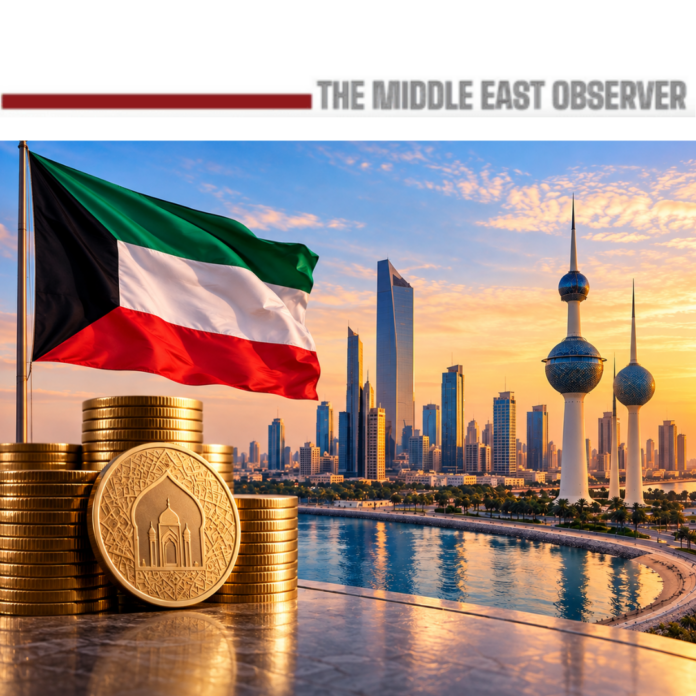
Kuwait is building a sovereign financing system that could offer lessons for governments across the Middle East and North Africa, combining KWD 30 billion ($98 billion) in borrowing authority with a dedicated Islamic sukuk law governing assets, investor rights and Sharia supervision.
The reforms address a problem identified in Kuwait more than 16 years ago: how to convert financial assets and long-term income streams into fresh investment without depending exclusively on government budget allocations.
In October 2010, economist Dr Hassan Mounir Al-Sady proposed mobilising housing-related receivables to support a domestic sukuk and bond market initially approaching KWD 6 billion. His proposals anticipated the importance of structured financing and secondary-market liquidity, although the present legislation was developed separately.
Kuwait’s achievement is not that it has invented a new Islamic financing instrument. Saudi Arabia, the UAE and other Gulf markets already have extensive sukuk experience. What distinguishes the latest reform is the creation of a dedicated statutory framework connecting government borrowing, asset administration and Sharia governance.
Whether that framework becomes a regional model will depend less on the amount Kuwait can borrow than on what its capital markets can finance.
A Financing Vision Takes Shape in 2010
Kuwait’s financial-market ambitions predate the current legislation.
In an interview published by Al-Jarida on 2 October 2010, Al-Sady, then a professor of financing and investment economics at Gulf University for Science and Technology, proposed developing a domestic market for government-backed bonds and sukuk.
The proposal centred on more than KWD 3 billion in outstanding housing loans held by Kuwait’s Credit and Savings Bank. Repayments extended over periods approaching 60 years, leaving substantial financial value tied up in long-term receivables.
Al-Sady argued that appropriately structured financing instruments could mobilise part of that value to finance additional housing without requiring equivalent new capital injections from the government.
He envisaged combining such securities with approximately KWD 2.5 billion in existing debt instruments, creating an initial market approaching KWD 6 billion.
The proposal also called for participation by conventional and Islamic banks and an organised secondary market.
This final element was crucial. Government securities that investors simply purchase and retain until maturity may provide financing, but they do little to establish continuous market prices or enable portfolio adjustments.
An active market could allow financial institutions to trade securities, manage liquidity and establish reference yields for other borrowers.
The economic principle remains relevant: assets generating income over decades may support financing today, provided the resulting obligations are properly valued, legally enforceable and commercially sustainable.
Such transactions do not create free capital. Investors require compensation, and the institution arranging the financing must account for collection risks, transaction costs and any guarantees provided.
March 2025: Borrowing Powers Return
Kuwait’s legislative transformation began on 26 March 2025 with Law No. 60 on Financing and Liquidity.
The legislation authorised public borrowing of up to KWD 30 billion, permitted instruments with maturities extending to 50 years and established a legal framework lasting five decades.
The reform ended a prolonged constraint on sovereign financing that had prevented Kuwait from issuing new international government bonds since 2017.
Then-Finance Minister Noura Al-Fassam said the legislation would improve liquidity management and provide greater flexibility to access domestic and international capital markets.
In May 2025, the Ministry of Finance outlined a five-year funding strategy covering 2025–2030. Public Debt Management Director Faisal Al-Muzaini identified the establishment of a sovereign yield curve as an important objective.
A government yield curve provides reference financing rates across different maturities. Banks and businesses can use those benchmarks when pricing their own borrowing, allowing investors to distinguish the risk associated with a company from that of the sovereign.
In October 2025, Kuwait returned to international markets with an $11.25 billion conventional bond offering across three-, five- and ten-year maturities.
Investor orders reached approximately $28 billion, nearly 2.5 times the amount issued. More than two-thirds of allocations went to investors outside the MENA region.
The offering demonstrated international demand for Kuwaiti sovereign credit, although it did not establish that subsequent Islamic instruments would achieve equivalent pricing or demand.
The borrowing law also carried an important limitation: the capacity to issue debt is not the same as a requirement to finance productive investment.
Government borrowing may support budgetary expenditure, liquidity management and refinancing. Its long-term economic value depends on the cost of capital and the use of the proceeds.
September 2026: A Dedicated Sukuk Framework
Following regulatory changes introduced by Kuwait’s Capital Markets Authority in April 2026, the government published Decree-Law No. 90 on Government Sukuk on 20 September.
The legislation provides a dedicated legal structure for Sharia-compliant sovereign securities alongside conventional government borrowing.
It permits financing based on recognised Islamic contractual arrangements, including ijara, salam, istisna, mudaraba and musharaka.
These structures can involve leasing rights, construction or manufacturing arrangements, trading transactions and investment partnerships.
Unlike conventional bonds, which generally represent direct debt obligations, sukuk are structured around contractual rights associated with specified assets, benefits or investment activities.
That difference has practical implications for how ownership interests, payment obligations, investor remedies and financial risks are organised.
The new law permits government sukuk to be issued in Kuwaiti dinars or foreign currencies, through public or private offerings, and provides for wholly state-owned special-purpose companies to administer the transactions.
It also addresses custodians, investment managers, investor representation, financial reporting and the management of sukuk assets.
Crucially, the 2026 law complements rather than replaces the 2025 Financing and Liquidity Law. Sovereign sukuk operate within the established public financing framework instead of creating a separate, unlimited borrowing authority.
What Makes the Legislation Distinctive?
The principal strength lies in combining financing authority with detailed legal arrangements for implementing Islamic securities.
First, the legislation establishes specific administrative and contractual mechanisms for sovereign sukuk. This reduces reliance on designing an entirely new governance structure for each issuance.
Second, it addresses the treatment of government assets.
The law generally allows specified state-owned private assets, economic benefits and investment rights to support sukuk transactions, while excluding public-use property, natural resources and public facilities from ordinary eligibility.
However, the Council of Ministers may authorise exceptions, making transparent asset selection and independent valuation particularly important.
Third, the law establishes a unified Sharia Fatwa and Supervisory Board.
Article 31 requires at least three scholars specialising in Islamic financial transactions, including at least one member of the Central Bank of Kuwait’s Higher Sharia Supervisory Board.
Article 16 further requires Sharia and ministerial approval of the relevant subscription documentation.
This creates a statutory religious-supervision mechanism, although the board is appointed by the finance minister rather than constituted as a wholly independent external authority.
Finally, the legislation provides for specialised issuing companies and investor representation.
Such arrangements can clarify operational accountability and contractual rights. They do not eliminate investment risk or guarantee that sukuk will be cheaper than conventional bonds.
The distinction between asset-based and genuinely asset-backed sukuk is especially important. Investors must understand whether they possess enforceable rights over underlying assets or primarily depend on contractual payment commitments.
These questions determine how losses, defaults and government obligations would be handled.
Strong Sovereign Wealth, Underdeveloped Debt Markets
Kuwait enters this transition with considerable financial advantages.
In its February 2026 assessment, the International Monetary Fund estimated that assets managed by the Kuwait Investment Authority had reached approximately 640% of GDP at the end of 2025.
Nevertheless, substantial wealth has not automatically produced a developed domestic bond market.
According to the IMF, outstanding local-currency bonds amounted to only about 5% of GDP in 2024.
The prolonged interruption in government debt issuance had constrained the development of a sovereign yield curve, reducing price discovery and limiting the market infrastructure available to corporate borrowers.
The combination of sovereign borrowing powers and specialised sukuk legislation could help address that weakness.
But establishing a functioning market requires more than legal authority.
Regular issuance, competitive auctions, transparent pricing, reliable settlement systems and active secondary trading will be necessary to create instruments that banks, insurers, pension funds and other institutional investors can use effectively.
The IMF has specifically recommended predictable issuance calendars and auction-based mechanisms to strengthen Kuwait’s domestic market.
A deeper securities market could eventually reduce dependence on bank financing for suitable businesses, although the cost advantage would depend on market conditions and individual borrowers’ credit risks.
How Kuwait Compares With Other Gulf Markets
Kuwait’s legal reforms should be assessed against a region that already has substantial Islamic finance experience.
Saudi Arabia operates an established government sukuk programme and has developed a growing domestic debt market supporting sovereign, bank and corporate financing.
Its experience demonstrates the importance of regular issuance, distribution networks, institutional participation and market liquidity.
The UAE benefits from active federal and emirate-level debt markets, established international financial centres and experience with conventional and Islamic securities.
Kuwait’s opportunity is different.
Rather than building an Islamic capital market from the beginning of regional market development, it can use experience accumulated elsewhere to establish a dedicated sovereign framework supported by substantial financial assets.
Its distinctive legislative features include the explicit treatment of eligible government assets, specialised issuing companies and unified Sharia supervision within a broader sovereign financing system.
These provisions deserve regional examination, but they do not establish that Kuwait’s law is categorically superior to those of Saudi Arabia, the UAE or other Gulf countries.
The decisive comparison will concern implementation: borrowing costs, transparency, legal enforceability, investor participation and secondary-market liquidity.
Five Lessons for MENA Governments
The first lesson is that borrowing flexibility requires an institutional foundation.
Governments need durable legislation defining authorised instruments, debt ceilings, maturities, approval responsibilities and reporting requirements.
Kuwait’s borrowing framework provides an example of long-term legal capacity, but its KWD 30 billion ceiling cannot be transferred to economies with substantially different fiscal resources.
For more indebted countries, the priority is reducing refinancing pressure, improving debt transparency and establishing credible medium-term financing strategies.
The second lesson is to mobilise existing financial assets without confusing liquidity with new wealth.
Al-Sady’s housing-receivables proposal illustrates how suitable contractual income streams might support additional financing.
Countries possessing development-finance portfolios, leases or predictable infrastructure revenues could examine comparable structures.
However, asset-backed financing requires rigorous valuation, enforceable investor rights and careful assessment of the ultimate bearer of risk.
A government guarantee remains a potential fiscal liability even when attached to an Islamic financing arrangement.
The third lesson is to integrate Sharia governance with commercial and legal accountability.
Kuwait’s unified supervisory mechanism provides a statutory basis for reviewing government sukuk.
Other MENA markets could improve consistency by using qualified supervisory boards, transparent Sharia opinions and recognised financial documentation standards.
Religious compliance should operate alongside investor disclosure, independent financial auditing and enforceable contractual remedies.
The fourth lesson is to create tradable markets rather than concentrate exclusively on issuance.
A government can raise money by selling securities without creating an active capital market.
The wider benefits emerge when those instruments establish benchmark yields, support portfolio liquidity and help companies access longer-term financing.
This requires institutional investors, reliable market infrastructure and sufficient issuance across different maturities.
The fifth lesson is to match financing structures to economic conditions.
For hydrocarbon exporters, sovereign securities can support liquidity management and capital-market development while reducing the need to sell long-term investments during temporary fiscal pressures.
For Egypt and other more heavily indebted economies, the immediate priorities differ: controlling borrowing costs, managing foreign-currency exposure, limiting refinancing concentrations and directing capital towards activities capable of generating measurable economic returns.
For smaller regional markets, standardised documentation and access to wider investor networks may be more valuable initially than ambitious issuance volumes.
The Cost of Borrowing Still Determines Economic Value
Islamic financing does not automatically provide cheaper capital.
Conventional bonds and sukuk ultimately compete for investor funds, with required returns influenced by sovereign credit quality, maturity, liquidity, currency risk and contractual protections.
Sukuk may attract additional investors seeking Sharia-compliant assets, potentially broadening demand. However, arranging specialised asset transfers, legal structures and supervision can also introduce costs.
Similarly, long maturities reduce refinancing frequency but may require higher yields.
For governments, the relevant calculation is the full financing cost relative to the expected economic return.
This is particularly important where borrowed funds finance recurrent expenditure rather than assets or activities that improve future productive capacity.
A modern securities market can expand financing choices. It cannot substitute for disciplined expenditure, credible fiscal institutions or successful economic diversification.
The Real Test Is What the Market Finances
Sixteen years after Al-Sady proposed mobilising housing receivables to help develop Kuwait’s domestic bond market, the country has established a substantially broader sovereign financing framework.
The 2025 law restored borrowing flexibility. The 2026 sukuk legislation provided detailed structures for Islamic issuance, asset administration and Sharia supervision.
Together, they offer Kuwait the opportunity to develop a more liquid domestic debt market, attract a wider range of investors and establish financial benchmarks for private-sector borrowing.
The remaining challenges are practical: issuing securities regularly, ensuring transparent asset governance, controlling financing costs and establishing an active secondary market.
Other MENA economies can adopt those institutional principles without replicating Kuwait’s borrowing volumes or relying on comparable sovereign wealth.
Related News:
Bonds, Inflation and the New Price of Money Across MENA
Saudi Banks Raise SAR30.75bn in Sukuk as Funding Model Shifts
Read Also:
Kuwait Turns to Future Wealth as Hormuz Tests Treasury Liquidity
Egypt’s Next Challenge Is Turning Financial Resilience Into Productive Growth