

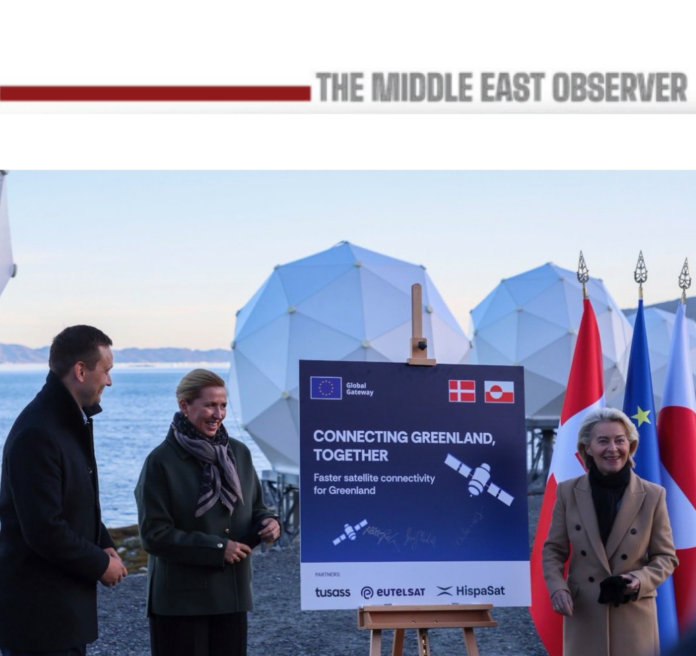
Brussels is moving from political reassurance to economic positioning, linking critical minerals with energy and connectivity as Greenland gains importance in the contest for Arctic influence.
Europe is putting capital behind its Arctic ambitions, committing €200 million to Greenland as it seeks to secure a stronger position across the minerals, energy and communications infrastructure that could shape the region’s economic future.
European Commission President Ursula von der Leyen announced the Global Gateway package in Nuuk on September 7, with investment scheduled across 2026 and 2027. It extends EU-Greenland cooperation into critical raw materials, hydropower and satellite and cable connectivity, alongside fisheries, education, housing, tourism and small businesses.
The strategic significance lies less in the headline amount than in the combination of assets being targeted.
Greenland — a self-governing territory within the Kingdom of Denmark but outside the EU — holds mineral resources sought by industries ranging from renewable energy to advanced manufacturing. Yet geological potential alone does not create supply security. Mines require power, transport, communications, finance and ultimately commercially viable routes into industrial supply chains.
By investing simultaneously in raw materials, hydropower and connectivity, Brussels is beginning to address that wider infrastructure equation.
That matters because Europe is seeking to reduce vulnerabilities in critical-resource supply chains while Greenland itself is looking to broaden a narrowly based economy. Seafood accounts for more than 90% of Greenlandic exports, according to Nordic research, while Denmark’s annual block grant was equivalent to about 19% of GDP in 2021.
Greater investment in resources, energy and infrastructure could therefore serve two interests: giving Europe alternative sources of strategically important materials while giving Greenland greater scope for economic diversification.
Capital Follows Geopolitics
The calculation has acquired greater urgency as Greenland moves towards the centre of Arctic competition.
US President Donald Trump has repeatedly argued that the United States should control Greenland, a position rejected by Nuuk and Copenhagen. Subsequent US-Danish-Greenland talks have yet to produce an agreement. Russia retains significant interests and military capabilities across the Arctic, while China has sought economic access to the region’s resources and infrastructure.
The EU is responding not with a competing territorial claim, but increasingly with economic integration. Brussels has also proposed increasing Greenland support from €225 million under the current EU budget framework to around €530 million for 2028-2034, subject to negotiations.
For Greenland, that competition creates leverage — but also a test. Foreign interest will deliver lasting economic value only if projects generate employment, infrastructure, government revenue and viable export industries while retaining local political support.
For Europe, the test is equally demanding. Securing access to critical minerals is not primarily about identifying deposits; it is about financing the systems that make those deposits economically accessible and connect them to European industry.
That is what makes the €200 million package strategically relevant. Europe is moving beyond political solidarity and beginning to invest in the economic architecture that could bind Greenland more closely to European supply chains.
If mines, power systems and communications networks follow, Greenland could become a material pillar of Europe’s effort to reduce resource dependence, strengthen economic resilience and preserve influence in a rapidly changing Arctic.
The Arctic contest will not be determined by declarations alone. It will increasingly be shaped by who finances the infrastructure that turns geography and natural resources into economic power — and on whose terms.
Related news:
The New Mining Race Is About Control, Not Just Resources
Afghanistan’s Untapped $1-3 Trillion Mineral Wealth Could Reshape Global Supply Chains
Read also:
How Khufu’s Pyramid Could Hold the Key to Buildings That Last a Millennium
Alibaba Plans Record $10bn Hong Kong Share Sale to Fund AI Expansion