

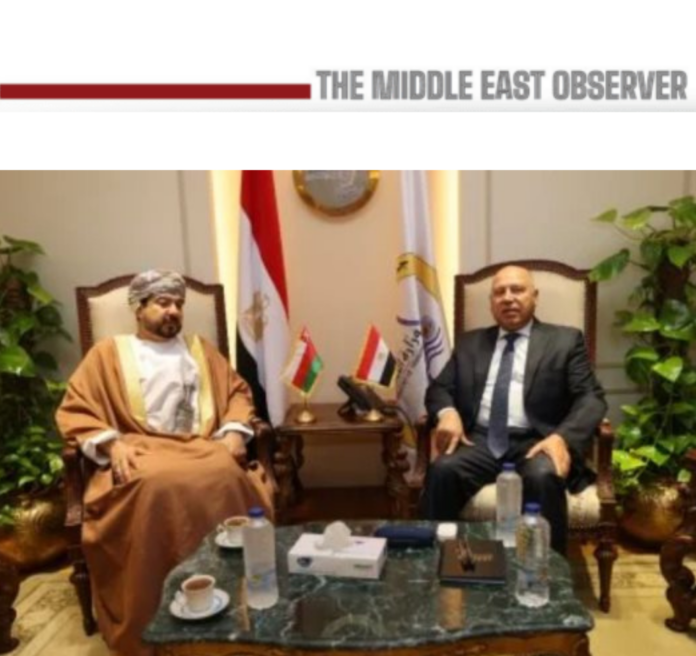
Proposed Duqm-Salalah service would link Omani industrial zones with Egyptian manufacturing and African markets
CAIRO — Egypt and Oman are preparing an executive mechanism for a direct maritime route linking Duqm and Salalah with Egyptian ports, part of a wider effort to build industrial supply chains connecting the Gulf, Africa and Asia.
The service is not yet operational. Participating Egyptian ports, shipping operators, sailing frequencies and a launch date have yet to be announced.
The initiative goes beyond bilateral shipping. Cairo and Muscat are examining value chains in metals, aluminium, plastics and electrical machinery, under which Omani inputs could undergo further processing in Egypt while Egyptian manufacturers use Omani economic zones to serve Gulf and Asian markets.
The geography offers clear complementarities. Salalah, positioned on major Indian Ocean shipping routes, has an annual container capacity of about 6.5mn TEU. Duqm combines deep-water port infrastructure with a large industrial zone outside the Strait of Hormuz. Egypt adds manufacturing capacity, Suez Canal connectivity and potential preferential access to African markets through AfCFTA and COMESA, subject to applicable rules of origin.
The two sides are also exploring cooperation in industrial zones, shipbuilding, ship repair, maritime services and dry-port management. Cruise tourism has been raised as another prospective area of cooperation.
The industrial case, however, depends on more than moving cargo between ports. Preferential access to African markets requires qualifying local value addition, making manufacturing investment and rules-of-origin compliance central to the corridor’s economics.
The next test will be commercial: whether governments can secure competitive freight rates, regular sailings, anchor manufacturers and sufficient two-way cargo volumes.
If those conditions are met, the proposed route could develop from a bilateral shipping service into a broader production and logistics link between the Indian Ocean, Africa and the Mediterranean. If they are not, it risks remaining another regional connectivity framework without the cargo density needed to sustain it.
Related news:
Egyptian Petrojet–Enppi Consortium Wins Place on Oman’s $6bn EPC Framework
Saudi, Omani Logistics Firms Sign Cross-Border Land Freight Deal
Read also:
Egypt’s Food Export Growth Shifts From Volume to Value as Europe Gains Ground
The Missing Middle: Why Egypt’s Capital Markets Still Struggle to Fund Its Unicorns