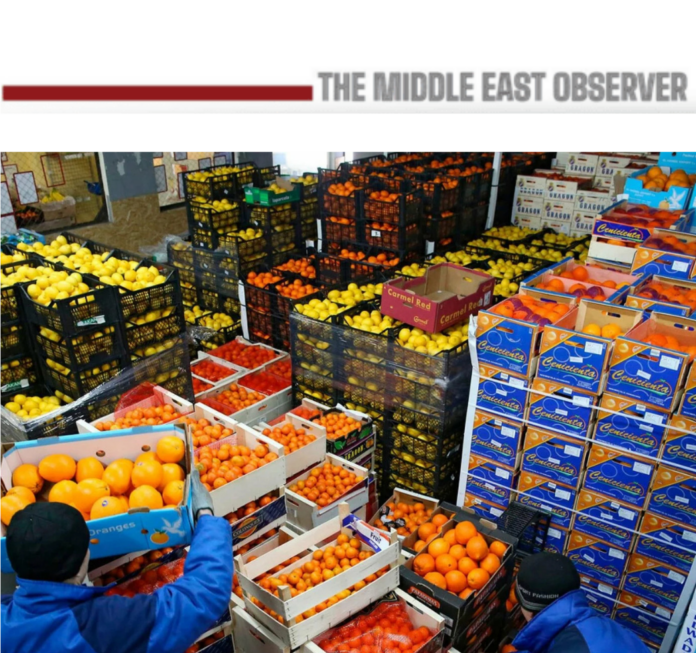
Processed-food exports rose 10.7% to a record $4.47bn in January-July, with Europe and higher-value manufactured products contributing more to growth even as fresh agricultural export volumes remained broadly level with last year.
Egypt’s processed-food exports rose 10.7% year on year to a record $4.473bn in the first seven months of 2026, as faster growth in Europe and a shift towards manufactured products strengthened one of the country’s expanding sources of non-oil export revenue.
Exports increased by $433mn from $4.04bn a year earlier, according to the Food Export Council. The European Union recorded growth of 18.6%, well ahead of the sector overall, while Spain alone generated about 22% of the net increase in Egyptian food exports.
The performance contrasts with Egypt’s fresh agricultural exports, which reached about 6.8mn tonnes by August 28. That was broadly in line with the 6.8mn tonnes reported five days earlier in the comparable period of 2025, suggesting that 2026’s more significant development lies less in aggregate crop volumes than in product mix, processing and where Egyptian food is being sold.
The figures measure different parts of the export economy and should not be combined. Agriculture Ministry data largely cover fresh crops monitored by plant-quarantine authorities, while the Food Export Council measures exports of manufactured and processed foods in dollars.
Together, however, they point towards a gradual shift in Egypt’s food-export model: from relying predominantly on greater agricultural volumes towards extracting more export value from the country’s existing production base.
Europe Drives More of the Incremental Growth
Arab countries remain Egypt’s biggest processed-food market, accounting for $2.055bn, or about 46%, of exports in January-July. But sales to the EU rose much faster, increasing 18.6% to $1.008bn, or roughly 23% of the total. Arab-market exports grew 7.6%.
The distinction is important. Arab markets provide scale; Europe is contributing disproportionately to new growth.
Saudi Arabia remained Egypt’s largest national food-industry market, with exports rising 19% to $363mn. The US ranked second at $290mn, making it Egypt’s largest individual destination outside the Arab region and Europe. Libya followed at $196mn and Jordan at $194mn.
Spain, however, was the standout growth market.
Exports more than doubled to $188mn, up 107% and $97mn from a year earlier. That increase represented roughly 22% of the sector’s total $433mn export gain, making Spain the largest individual contributor to incremental growth. Edible oils accounted for about $50mn of the increase, processed and pickled olives $19mn and prepared animal feed $15mn.
The Netherlands reached $189mn, while Algeria rose 29% to $159mn, Iraq 19% to $156mn, Palestine 38% to $142mn and China 19% to $142mn. UK exports climbed 46% to $108mn. Germany and Sudan moved against the trend, declining 18% and 9%, respectively.
Egypt’s 15 largest markets together generated $2.67bn, or 59.7% of total processed-food exports.
That is geographically broad, but it should not be mistaken for substantially lower concentration. The top 15 markets accounted for about 59% of exports in full-year 2025, little different from the current ratio.
The stronger evidence of diversification is instead found in the sources of incremental growth. The FEC said 114 markets increased purchases of Egyptian food products during January-July, generating a combined $682mn increase before declines elsewhere were taken into account.
Egypt therefore remains anchored in its established Arab markets while adding faster-growing channels in Europe and, on a smaller scale, markets such as China.
Processing Raises the Value of the Export Basket
The product composition offers stronger evidence of structural change.
Frozen strawberries remained Egypt’s largest individual processed-food export, but much of the incremental growth came from products involving greater industrial processing.
Chocolate exports surged 114% to $262mn, adding about $140mn year on year. Edible oils rose 35% to $298mn, while prepared animal feed increased 28% to $219mn. Beverage concentrates generated about $368mn.
At the broader industry level, processed vegetables, fruit and beverages generated about $1.2bn, while frozen fruit and vegetables produced $930mn. Confectionery, chocolate, biscuits and baked goods recorded the strongest sectoral growth, rising 45% to $547mn.
The shift matters because processing can retain more economic activity inside Egypt before a product is exported — through manufacturing, packaging, logistics, quality control and branding.
Agriculture Minister Alaa Farouk has similarly identified greater use of agricultural surpluses in agro-processing industries as part of the next stage of export development. He has also stressed digital traceability from farms through to importing markets as Egypt seeks wider access for its agricultural products.
But higher gross processed-food exports do not automatically mean an equivalent increase in domestic value added.
Some manufacturers rely on imported raw materials, ingredients, machinery or packaging. The economically relevant measure is therefore the domestic content and net foreign-exchange contribution of the export, rather than gross sales alone.
That distinction becomes increasingly important if processed-food exports continue growing faster than agricultural volumes.
Fresh Agriculture Remains Strong, But the Mix Is Changing
Egypt’s fresh agricultural exports reached about 6.8mn tonnes by late August, confirming the country’s position as a substantial supplier to international food markets.
But comparisons with 2025 argue against describing current aggregate volumes as a fresh export surge.
By August 23 last year, Egypt had also exported approximately 6.8mn tonnes, including more than 1.9mn tonnes of citrus and 1.3mn tonnes of potatoes.
The composition has since changed. Citrus shipments have strengthened, while some other major crops have performed less strongly. The implication is that Egypt’s fresh-export base remains resilient, but processed-food revenues are currently providing the clearer evidence of value growth.
The comparison should also be viewed against a strong full-year base. Egypt exported a record 9.5mn tonnes of agricultural crops in 2025, more than 800,000 tonnes above 2024. The government put the combined value of fresh and processed agricultural exports at approximately $11.5bn.
The question for 2026 is consequently not whether agriculture remains important, but how effectively Egypt can turn that agricultural base into products with higher export value.
Traceability is becoming part of that equation. For markets with stricter phytosanitary, pesticide-residue and food-safety standards, farm coding and product tracking increasingly function as trade infrastructure rather than administrative compliance alone.
The commercial test is whether regulatory access can be converted into recurring sales in higher-value markets.
The Test Is Domestic Value Capture
The expansion of food exports matters for Egypt because it broadens merchandise-export earnings across numerous products and destinations, adding another source of foreign currency alongside the country’s larger external revenue streams.
Yet faster growth in high-standard markets also brings greater exposure to compliance requirements, while the agricultural base remains vulnerable to water constraints and climatic pressures. For food processors, imported inputs can reduce both margins and the net foreign-exchange benefit generated by higher exports.
Those constraints make the composition of growth increasingly important.
Arab markets continue to give Egypt scale and geographic proximity. Europe is generating a larger share of new growth. The US is already the second-largest national destination, while Spain demonstrates how quickly an individual European market can become commercially significant.
At the same time, manufactured products including chocolate, oils, concentrates and animal feed are contributing more to the increase in export earnings.
If processed-food revenues continue to grow faster than fresh-crop volumes, the decisive measure will be how much of that additional export value is created and retained inside Egypt.
That will determine whether the current expansion represents simply stronger overseas food sales or a more consequential shift towards a higher-value export industry built around Egypt’s agricultural base.
Related news:
Water Innovation Becomes Agriculture’s New Competitive Advantage
Egyptian Agriculture: A Rising Force in Global Trade
Read also:
Iran’s New Gas Find Runs Into Sanctions, War and Investment Constraints