Water has become agriculture’s most valuable strategic resource. Across the Middle East and North Africa (MENA), where many countries face chronic water scarcity, the ability to produce more food with less water is rapidly emerging as a decisive competitive advantage. Rather than expanding farmland alone, governments and agribusinesses are increasingly investing in technologies that maximize every cubic meter of water while improving productivity, profitability, climate resilience, and long-term food security.
The MENA region is the world’s most water-stressed, with agriculture accounting for approximately 80–85% of freshwater withdrawals in many countries. Rising temperatures, declining rainfall, population growth, and increasing competition between agriculture, industry, and urban consumption are intensifying pressure on already limited water resources. As a result, improving water-use efficiency has evolved from an environmental objective into an economic necessity and a strategic pillar of national food security.
From Irrigation to Intelligent Water Management
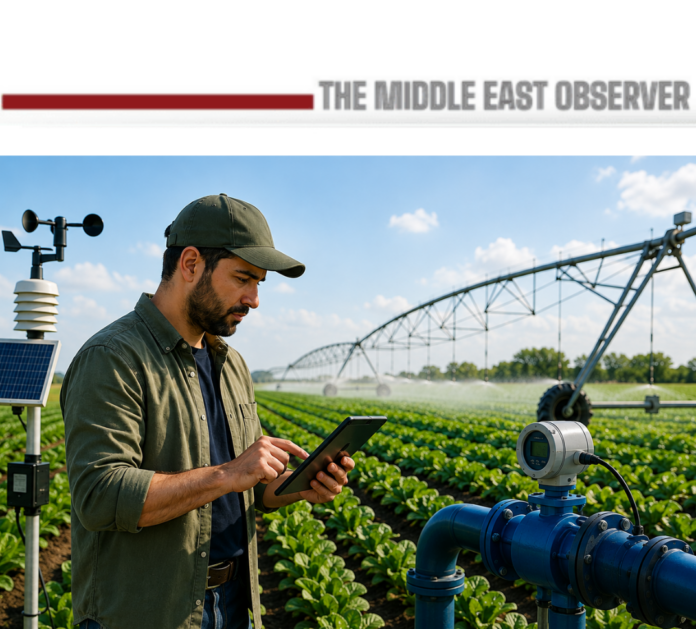
Modern agricultural water management now extends far beyond replacing flood irrigation with drip systems. Farmers are increasingly adopting integrated precision agriculture technologies that combine:
- Drip and subsurface drip irrigation
- Smart irrigation controllers
- IoT soil-moisture and climate sensors
- AI-powered decision-support systems that integrate weather forecasts, evapotranspiration models, and crop growth data
- Satellite and drone crop monitoring
- Precision fertigation
- Renewable energy-powered pumping systems
- Treated wastewater reuse
- Desalinated water for high-value greenhouse horticulture and strategic food production
Together, these technologies enable irrigation only when and where crops require water, reducing evaporation losses, minimizing fertilizer leaching, lowering energy costs, and improving both yields and crop quality.
Artificial intelligence increasingly complements these systems by analyzing weather forecasts, soil conditions, and crop development to recommend optimal irrigation schedules. Rather than relying on fixed watering calendars, farmers can make dynamic, data-driven decisions that improve water productivity while reducing operating costs.
MENA Leads Global Adoption of Pressurized Irrigation
Necessity has positioned the Near East and North Africa as a global leader in irrigation innovation. According to the Food and Agriculture Organization (FAO), the region has approximately 1.4 million hectares under drip irrigation and 1.7 million hectares under sprinkler irrigation, accounting for roughly 40% of the world’s drip-irrigated area.
This reflects decades of investment aimed at maximizing agricultural output while minimizing water consumption. Increasingly, governments are shifting policy objectives from expanding water supplies toward improving water productivity—producing more economic value and food from every cubic meter of water.
Regional Leaders in Water Innovation
United Arab Emirates
The UAE has become one of the region’s leading adopters of agricultural technology through investments in desalination, controlled-environment agriculture, hydroponics, vertical farming, AI-enabled irrigation management, and precision agriculture. These innovations support domestic food production despite extremely limited freshwater resources.
Saudi Arabia
Through Vision 2030, Saudi Arabia is accelerating investment in precision irrigation, greenhouse agriculture, treated wastewater reuse, digital farming technologies, and smart water infrastructure. The Kingdom is increasingly prioritizing crops that generate greater economic returns per unit of water consumed while reducing dependence on groundwater extraction.
Morocco
Morocco’s National Program for Water Savings in Irrigation is among Africa’s most successful irrigation modernization initiatives. Supported by the World Bank, widespread conversion to drip irrigation has significantly improved water efficiency. In the Tadla irrigation scheme, groundwater abstraction declined by approximately 43%, while agricultural productivity and farm incomes improved through more efficient water use.
Egypt
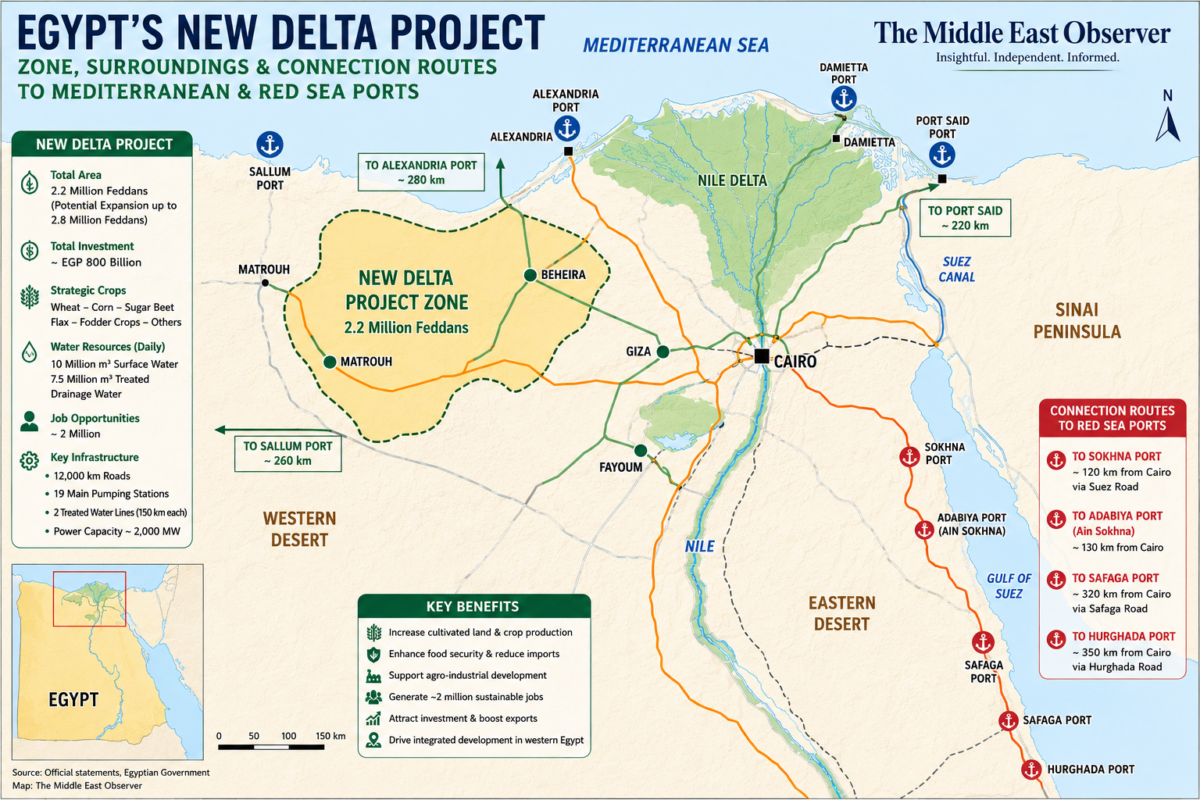
Egypt continues modernizing irrigation through buried pipeline networks replacing open canals, automated pumping stations, laser land leveling, improved farm-level water management, and digital irrigation control systems. According to the World Bank, nearly 198,000 water users have benefited from improved irrigation and drainage services under the Farm-level Irrigation Modernization Project.
These investments are becoming increasingly important as Egypt seeks to maximize productivity from finite Nile water resources while supporting agricultural expansion, export-oriented farming, and national food security.
Jordan
Jordan has become an international benchmark for agricultural water efficiency despite being one of the world’s most water-scarce countries. Approximately 90% of treated wastewater is reused, primarily for agriculture, while around two-thirds of irrigated farmland utilizes modern irrigation technologies. Jordan’s integrated approach demonstrates how policy, infrastructure, and innovation can substantially improve agricultural productivity under severe water constraints.
Water Innovation Delivers Multiple Economic Benefits
The benefits of modern irrigation extend well beyond water conservation.
Precision irrigation reduces fertilizer runoff, lowers pumping costs, decreases energy consumption, improves soil health, limits salinity risks, and enables higher-value crop production. Digital monitoring systems also allow farmers to detect crop stress earlier, improving both production consistency and market quality.
At the national level, satellite imagery and remote sensing technologies enable governments to monitor drought conditions, estimate crop water consumption, optimize reservoir operations, and improve regional water allocation without relying solely on field inspections.
Water Technology Is Becoming an Investment Opportunity
Water innovation is increasingly attracting both public and private capital. Investment is expanding across irrigation equipment manufacturing, precision agriculture software, agricultural sensors, satellite analytics, desalination technologies, wastewater recycling, and climate-smart farming solutions.
Development finance institutions, sovereign wealth funds, and impact investors are increasingly supporting projects that improve water efficiency because they simultaneously strengthen food security, climate resilience, and long-term agricultural productivity. As environmental, social, and governance (ESG) investing continues to grow, water-efficient agriculture is becoming an increasingly attractive destination for sustainable finance.
The Competitive Advantage of Every Drop
As climate change accelerates and freshwater resources become increasingly constrained, competitive advantage in agriculture will depend less on access to abundant water than on the ability to manage limited supplies more intelligently.
Across the MENA region, precision irrigation, digital agriculture, wastewater reuse, satellite monitoring, and climate-smart water management are transforming water from a production constraint into a strategic economic asset. Countries that continue investing in these technologies will be better positioned to strengthen food security, expand agricultural exports, attract agri-tech investment, and build more resilient farming systems in an increasingly water-constrained world.
Related news:
El-Sisi Orders Stronger Food Security, Strategic Reserves and Targeted Social Protection
Climate Change and Food Security in the MENA Region
Read also:
Elsewedy Electric Invests $200m to Build an Integrated Metals Manufacturing Hub
Cairo Fertilizer Conference to Spotlight Food Security, Energy Costs and Supply Chain Risks