

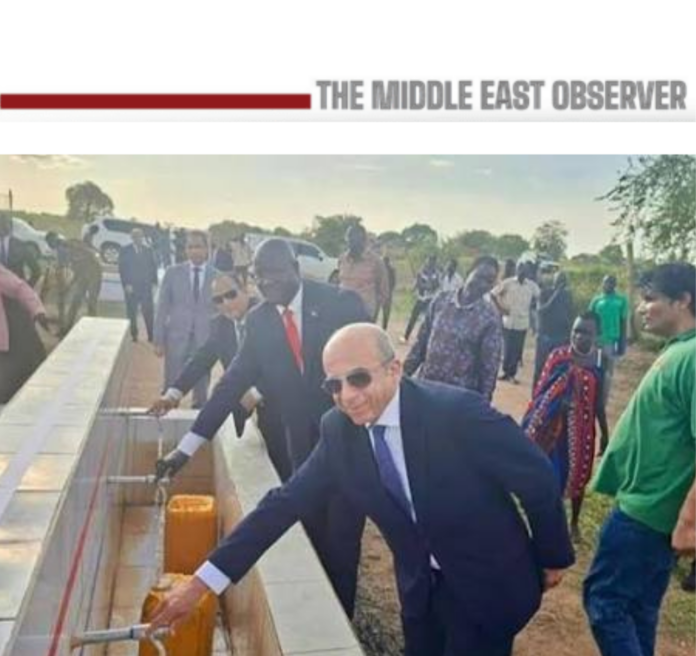
Egypt is deepening its development engagement across the Nile Basin after completing 28 solar-powered groundwater stations in South Sudan, expanding access to safe drinking water while reinforcing a long-term strategy of technical cooperation with one of Africa’s youngest nations.
The latest milestone was marked by the inauguration of the SOMBA groundwater station at the University of Juba, attended by South Sudan’s Minister of Water Resources and Irrigation James Mawiej Makuac, Egyptian Ambassador Hazem Mamdouh Fouzi, and officials from Egypt’s Ministry of Water Resources and Irrigation. The solar-powered facility supplies potable water to the university and neighbouring communities and forms part of a broader Egyptian programme aimed at strengthening water security and climate resilience in South Sudan.
According to Egypt’s Ministry of Water Resources and Irrigation, the 28 completed groundwater stations each serve more than 3,000 families, primarily in underserved rural communities where access to reliable drinking water remains limited. The programme represents one of Egypt’s largest bilateral water-development initiatives in South Sudan under a technical cooperation framework established in 2014.
Addressing a Critical Development Gap
The investment comes as South Sudan continues to face one of the world’s most severe water and sanitation challenges. According to UNICEF, 59 percent of the country’s population lacks access to safe water, while only around 10 per cent has access to improved sanitation, leaving millions vulnerable to waterborne diseases, including cholera and diarrhoea.
The United Nations and the World Bank have consistently identified improved water infrastructure as a prerequisite for achieving Sustainable Development Goal 6 on universal access to clean water and sanitation, noting that reliable water supplies contribute directly to better public health, agricultural productivity, education outcomes and economic resilience.
Solar-powered groundwater systems have become increasingly attractive across sub-Saharan Africa because they reduce operating costs, eliminate dependence on diesel-powered pumps and provide more reliable water supplies in remote communities with limited electricity infrastructure.
Programme Extends Beyond Drinking Water
Egypt’s cooperation programme encompasses a broader portfolio of water-resource projects designed to improve climate resilience and strengthen institutional capacity.
Among the flagship initiatives is the rehabilitation of the Bahr El-Ghazal waterway, where Egyptian-funded teams have completed the first phase of clearing approximately 30 kilometres of aquatic weeds and floating vegetation. The work has restored river navigation, improved water circulation, facilitated fishing and transport, and reduced flood risks affecting nearby settlements and agricultural land.
Egypt has also financed two rainwater-harvesting dams in Tonj and Gogrial in Warrap State, each capable of storing approximately 30,000 cubic metres of water for domestic use and livestock during the dry season. Complementary projects include hydrological monitoring stations, flood forecasting systems, water-quality laboratories, river transport infrastructure and technical training programmes for South Sudanese engineers and water-resource specialists.
Water Cooperation Supports Economic Development
Development specialists increasingly view water infrastructure as a catalyst for broader economic growth rather than simply a humanitarian intervention.
Reliable access to safe water reduces healthcare costs associated with waterborne diseases, supports year-round agricultural production, protects livestock, improves school attendance and lowers the time households spend collecting water—particularly women and children. These gains can enhance labour productivity and strengthen rural economies while reducing reliance on emergency humanitarian assistance.
The evaluation of UNICEF’s Sustainable Water, Sanitation and Hygiene programme in South Sudan similarly found that expanded access to safe water generated measurable improvements in health outcomes while supporting education and community resilience, although it also highlighted the importance of strengthening local maintenance capacity to ensure long-term sustainability.
“Water is fundamental to health, livelihoods and resilience, particularly in fragile settings where climate shocks and conflict compound existing vulnerabilities,” the United Nations’ World Water Development Report 2026 notes, underscoring the importance of sustained investment in equitable access to water services. (UN-Water)
A Pillar of Egypt’s Nile Basin Engagement
Egypt’s expanding programme reflects a broader foreign policy objective of strengthening practical partnerships with Nile Basin countries through technical cooperation, knowledge transfer and infrastructure development.
While Cairo continues to address transboundary water issues through established diplomatic channels and multilateral dialogue, its cooperation with South Sudan has remained focused on shared development priorities, including water management, flood mitigation, institutional capacity building and climate adaptation. Analysts generally view such initiatives as helping build long-term confidence and technical collaboration among riparian states without altering their respective legal positions on Nile water governance.
The projects also complement broader infrastructure investment across East Africa involving multilateral development institutions, Gulf investors and China, with Egypt contributing decades of expertise in river engineering, groundwater management and hydrological monitoring.
Looking Ahead
The two governments continue to examine longer-term opportunities, including the proposed Wau Multipurpose Dam on the Siwi River. If approved following feasibility studies, the project could generate approximately 10.4 megawatts of electricity, provide drinking water for around 500,000 people, and support supplementary irrigation across up to 40,000 feddans of agricultural land. The proposal remains under technical evaluation and no construction timetable has been announced.
Although modest in financial scale compared with major multilateral infrastructure programmes, Egypt’s water investments are becoming an increasingly important pillar of its regional engagement strategy. By combining renewable-energy infrastructure, technical expertise and institutional capacity building, Cairo is helping strengthen South Sudan’s long-term resilience while reinforcing economic cooperation and diplomatic partnerships across the Nile Basin. As climate pressures, population growth and development needs intensify, practical water cooperation is likely to become an increasingly valuable instrument for supporting both regional stability and sustainable economic development.
Related news:
Egypt–Eritrea Energy: Cairo Launches $23m Solar Projects to Support Power Supply
Africa Accelerates Solar Expansion as Egypt Prioritizes Grid Modernization and Energy Growth
Read also:
US-Jordan Trade Deal Unlocks Strategic Mining and Energy Investment
Egypt, Montenegro Sign Maritime Pact to Deepen Trade and Strategic Cooperation