

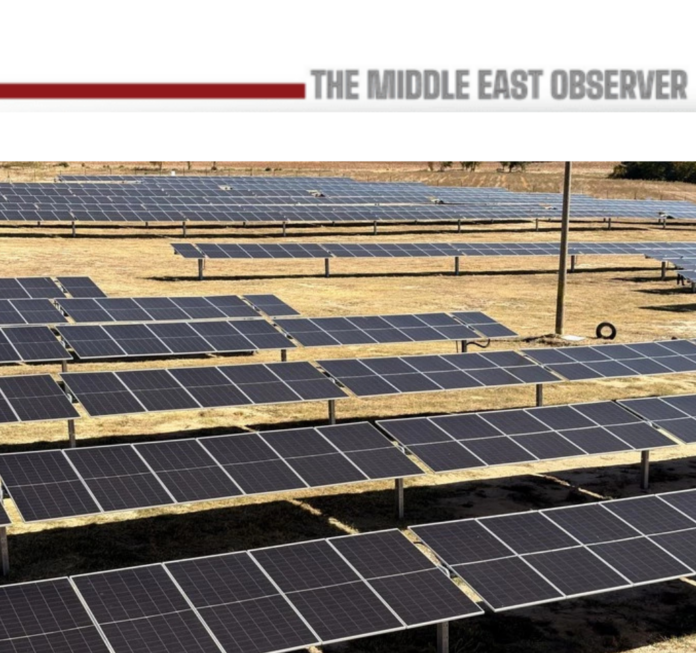
Japanese companies, including Toyota Tsusho and Hitachi, are targeting 400 megawatts of renewable-energy development in Tunisia by 2028, as the country advances a broader 1,600MW expansion programme for 2027 to reduce dependence on natural gas, attract foreign investment and strengthen electricity links with Europe.
Nacef Belkhiria, president of the Tunisian-Japanese Chamber of Commerce and Industry, announced the Japanese initiative on October 19. However, its total investment value, financing commitments and precise allocation among projects remain undisclosed.
Japanese-backed renewable projects are already advancing. Toyota Tsusho, through its Aeolus investment platform, is involved in solar developments alongside Norway’s Scatec. The portfolio includes two 50MW plants at Tozeur and Sidi Bouzid, commissioned in 2026, and a further 100MW project at Sidi Bouzid supported by up to €13.05 million in World Bank political-risk guarantees.
Other Japanese-linked developments include a 130MW solar project in Gabès and a proposed 75MW wind project at El Fahs. Their combined capacity, however, should not be treated as additional to the newly announced 400MW target without confirmation of potential overlaps.
Hitachi Energy is also participating in Tunisia’s electricity infrastructure through the ELMED interconnection with Italy, a strategic link intended to strengthen grid integration and future cross-border electricity trade.
The investments coincide with Tunisia’s plan to develop 1,600MW of renewable capacity in 2027, including 1,100MW through investor concessions and licensing and 500MW for self-generation. The government aims to raise renewables’ share of electricity generation from 12% in 2026 to 16% in 2027 and 35% by 2030.
European financing is reinforcing the expansion. The European Union announced €35.8 million in grants in January to support solar projects and related infrastructure, complementing financing from European development banks and private investors.
For Tunisia, the commercial stakes extend beyond new generating capacity. Renewable investment could reduce exposure to imported fuel costs, ease pressure on electricity supplies and create opportunities for equipment manufacturers, contractors and industrial investors.
Related news:
Tunisia Economy Under Strain as Oil Prices Surge Above Budget Assumptions
Orascom-Led Consortium Signs PPA for 900 MW Wind Farm in Gulf of Suez
Read also:
Egypt Expands Mediterranean Energy Hub as $24.9bn Import Bill Tests Resilience
Egypt and Japan Alliance to Build 20 MW Solar Power and Storage Project in Hurghada