
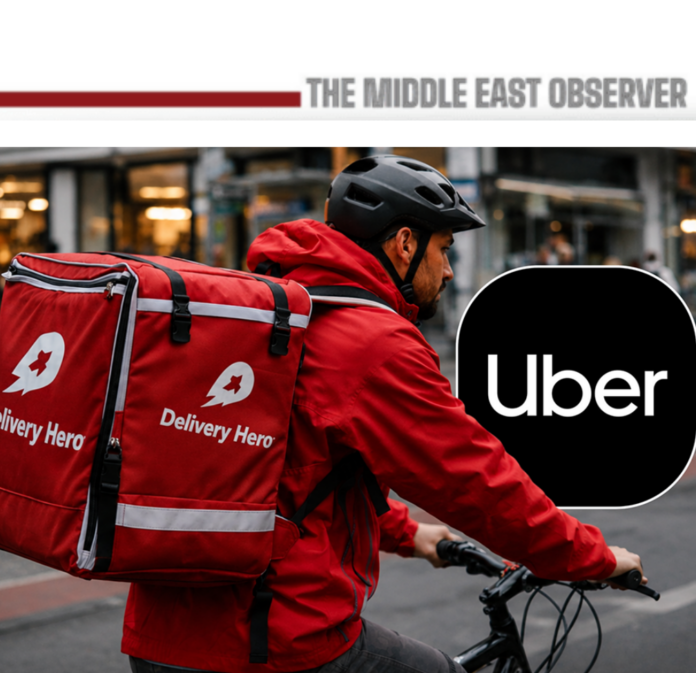
Uber is betting on the Middle East’s fast-growing digital commerce market after launching a $14.8 billion takeover offer for Germany’s Delivery Hero, a deal that would give the US technology group control of Gulf delivery leader Talabat and Saudi Arabia’s HungerStation, significantly expanding its regional delivery business. The proposed acquisition, subject to shareholder and regulatory approval, ranks among the largest transactions in the global food-delivery industry.
If completed, the acquisition would combine Uber’s mobility and delivery operations with Delivery Hero’s international portfolio, creating a platform operating in 99 markets with pro-forma gross bookings of about $236 billion, making it the world’s largest food-delivery network outside China, according to Uber.
The transaction underscores the Gulf’s growing importance to Uber’s long-term strategy. The region has become one of the world’s most attractive delivery markets, supported by high smartphone penetration, strong consumer spending and rising demand for food delivery, groceries and rapid-commerce services. Talabat, which raised about $2 billion in its 2024 initial public offering in the UAE, is the market leader across much of the Gulf, while HungerStation is among Saudi Arabia’s largest delivery platforms.
Uber has steadily expanded beyond ride-hailing since completing its acquisition of Careem in early 2020, positioning itself as a broader consumer logistics platform spanning transport, food delivery, groceries and digital services. The latest acquisition would further strengthen that strategy by adding established regional brands with extensive logistics networks and large customer bases.
Industry analysts say the deal reflects accelerating consolidation across the delivery sector as operators seek greater scale and efficiency by integrating mobility, food delivery and quick-commerce services onto a single platform. Larger networks enable companies to improve driver utilisation, reduce operating costs and deepen customer engagement through subscription-based ecosystems.
The acquisition is expected to receive close scrutiny from competition regulators given the companies’ overlapping operations. To facilitate regulatory approval, Delivery Hero has agreed to divest businesses in 14 overlapping markets before completion, while Talabat and HungerStation remain among the strategic assets Uber intends to retain.
If approved, the transaction would significantly strengthen Uber’s position in the Gulf by combining Careem’s regional ecosystem with Talabat’s market leadership and HungerStation’s dominant presence in Saudi Arabia, reinforcing the company’s ambition to build one of the Middle East’s most comprehensive digital mobility and on-demand commerce platforms.
Related news:
Uber and Baidu Partner to Launch Self-Driving Fleet in Asia and Middle East
Uber and WeRide Launch Fully Driverless Robo Taxis in Abu Dhabi in Regional First
Read also:
Houthi Threat Opens Second Front in Regional Shipping Crisis
India Approves US$20bn Push for Chip and Smartphone Manufacturing