
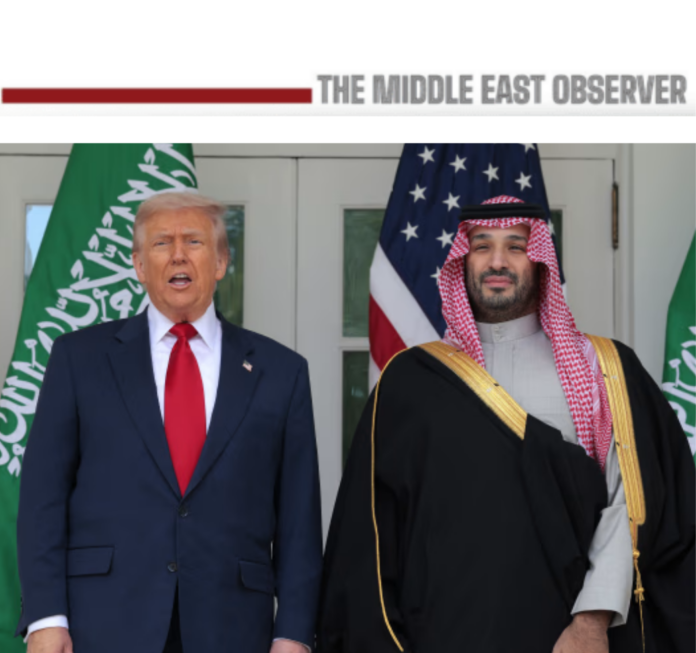
American nuclear technology companies stand to gain access to one of the world’s largest prospective civilian nuclear markets after the Trump administration approved a landmark 30-year nuclear cooperation agreement with Saudi Arabia, potentially unlocking tens of billions of dollars in future reactor, engineering and nuclear fuel-cycle contracts while establishing a framework for tightly controlled uranium enrichment inside the kingdom.
The proposed accord, expected to be submitted to the US Congress under Section 123 of the US Atomic Energy Act, would provide the legal basis for American companies to export nuclear technology, equipment and expertise to Saudi Arabia’s emerging atomic-energy sector. Although approved by President Donald Trump, the agreement must still complete the statutory congressional review process before entering into force.
Reuters reported that the agreement had been signed by US Energy Secretary Chris Wright and Saudi Energy Minister Prince Abdulaziz bin Salman, while the Associated Press and The Wall Street Journal cited officials familiar with the negotiations. Neither government had released the full text by Wednesday, leaving some technical provisions subject to official confirmation.
Unlike previous US nuclear cooperation agreements in the Gulf, the proposed Saudi pact reportedly creates a pathway for future cooperation on uranium enrichment, potentially allowing an enrichment facility to be established in the kingdom under stringent safeguards and US oversight. Officials familiar with the negotiations have indicated that any enrichment capability would remain subject to detailed feasibility studies, licensing and international monitoring rather than granting Riyadh unrestricted control over sensitive technology.
Section 123 agreements establish the legal framework governing significant civilian nuclear cooperation between the United States and foreign governments. They authorize exports of reactors, fuel, components and technical expertise but do not themselves approve reactor construction or transfer enrichment technology.
According to reports reviewed by The Wall Street Journal, one option under discussion would allow US companies to construct and operate an enrichment facility using a “black box” model designed to prevent access to sensitive centrifuge technology while enabling Saudi Arabia to participate in the civilian nuclear fuel cycle.
Vision 2030 and domestic energy strategy
The agreement reflects Saudi Arabia’s ambition to diversify its energy mix under Vision 2030, reduce the use of crude oil for domestic electricity generation and establish advanced industries capable of supporting long-term economic diversification.
Nuclear energy is expected to complement renewable power by providing reliable baseload electricity for rapidly expanding industries, including artificial intelligence infrastructure, hyperscale data centres, hydrogen production, advanced manufacturing and large-scale desalination, while freeing additional oil and natural gas for export and higher-value petrochemical production.
Saudi Arabia is also seeking to develop domestic capabilities across the nuclear fuel cycle. Geological studies conducted by the Saudi Geological Survey, together with international partners, suggest the kingdom possesses assessed uranium resources of around 90,000 tonnes, although exploration, resource definition and commercial evaluation remain ongoing. These assessments underpin Riyadh’s long-term interest in developing domestic nuclear fuel capabilities rather than relying exclusively on imported uranium.
Saudi officials continue to state that the programme is intended solely for peaceful civilian purposes and remains fully consistent with the kingdom’s obligations under the Treaty on the Non-Proliferation of Nuclear Weapons (NPT).
Safeguards remain central
The reported enrichment provision remains the agreement’s most sensitive element because uranium-enrichment technology can produce fuel for civilian reactors but, if misused, can also contribute to weapons programmes.
Unlike the United Arab Emirates’ 2009 Section 123 Agreement—which permanently renounced uranium enrichment and spent-fuel reprocessing under the US “gold standard”—the proposed Saudi accord reportedly does not require Riyadh to abandon those capabilities.
It also reportedly stops short of requiring Saudi Arabia to adopt the International Atomic Energy Agency’s (IAEA) Additional Protocol, which grants inspectors broader verification powers beyond the Comprehensive Safeguards Agreement.
Saudi Arabia remains a party to the Nuclear Non-Proliferation Treaty and implemented its full Comprehensive Safeguards Agreement after rescinding its previous Small Quantities Protocol in 2024.
Daryl Kimball, Executive Director of the Arms Control Association, has consistently argued that civilian nuclear cooperation agreements permitting uranium enrichment should incorporate the strongest available safeguards—including adoption of the IAEA Additional Protocol—to minimise proliferation risks and maintain confidence that nuclear programmes remain exclusively peaceful.
Supporters of the agreement argue that maintaining US participation would provide stronger oversight than allowing Saudi Arabia to pursue similar capabilities through alternative suppliers operating outside Washington’s strategic influence.
Nuclear industry opportunity
Beyond its geopolitical implications, Saudi Arabia represents one of the world’s largest prospective nuclear procurement markets.
Although Riyadh has evaluated reactor proposals from several international vendors over the past decade, it has not yet awarded contracts for its first commercial nuclear power station, meaning procurement opportunities remain open.
Should the programme proceed, investment is expected to extend across reactor construction, engineering services, fuel fabrication, instrumentation, digital control systems, cybersecurity, waste management, maintenance, workforce development and long-term operational support, with total spending potentially reaching tens of billions of dollars over several decades.
American companies, including Westinghouse Electric Company, are expected to compete alongside Korea Hydro & Nuclear Power (KHNP), Électricité de France (EDF), Russia’s Rosatom, and China’s China National Nuclear Corporation (CNNC), reflecting intensifying global competition for major reactor-export projects.
The agreement therefore represents not only a strategic partnership but also an opportunity for the United States to strengthen its position in the rapidly expanding international nuclear industry while limiting Chinese and Russian influence over Gulf energy infrastructure.
Part of a broader nuclear revival
Saudi Arabia’s plans coincide with a broader global revival of nuclear power as governments seek reliable low-carbon electricity to support decarbonisation, industrial electrification, artificial intelligence infrastructure and long-term energy security. According to the World Nuclear Association, more than 60 nuclear reactors are currently under construction worldwide, while many more are planned or proposed, reflecting renewed international investment in nuclear generation after years of subdued growth.
Regional and strategic implications
For years, US-Saudi nuclear negotiations were linked to broader discussions surrounding potential Saudi normalization with Israel.
The current agreement appears to have advanced independently, reflecting Washington’s growing emphasis on strategic industrial cooperation, energy security and technology partnerships.
Critics argue that permitting a future Saudi enrichment capability while continuing to oppose Iran’s enrichment programme could complicate long-standing US non-proliferation policy. Supporters counter that continued American involvement provides stronger transparency, oversight and safeguards than alternative arrangements involving competing international suppliers.
Congressional review
Once formally transmitted, the agreement will undergo the review process required under Section 123 of the Atomic Energy Act.
Lawmakers are expected to focus primarily on verification arrangements and non-proliferation safeguards. While some members of Congress have already expressed concerns over the enrichment provisions, supporters argue the agreement strengthens US strategic influence while securing significant commercial opportunities for American industry.
Strategic significance
The proposed accord extends well beyond a conventional energy partnership.
For Saudi Arabia, it represents a central pillar of Vision 2030 by supporting industrial diversification, energy security and the development of an advanced civilian nuclear industry.
For the United States, the agreement offers the prospect of securing a leading role in one of the world’s largest prospective reactor procurement programmes, supporting exports, advanced manufacturing and high-skilled employment while reinforcing Washington’s strategic position in the Gulf amid growing competition from China and Russia.
Its ultimate significance, however, will depend on whether Congress and international regulators conclude that the commercial and strategic benefits can be balanced with safeguards robust enough to preserve the integrity of the global nuclear non-proliferation regime. If approved, the accord is likely to become one of the most consequential US civilian nuclear agreements in decades, reshaping global nuclear commerce, strengthening long-term US-Saudi strategic cooperation and setting an important precedent for how future nuclear partnerships reconcile commercial opportunity with international security.
Related news:
US and Saudi Arabia Near Historic Energy Partnership: Nuclear Development on the Horizon
Egypt Tenders EGP4.5bn Link for Dabaa Nuclear Power Plant
Read also:
Egypt Restarts Power Exports to Libya After Grid Collapse
Bank Nizwa-Alizz Deal Would Create Oman’s Largest Islamic Bank