
CAIRO, October 22 — Egypt’s benchmark EGX30 extended its recovery on Wednesday, rising 1.47% to 52,854.95 points, but the rally masked widespread share declines and subdued turnover as foreign and Arab investors sold a net $1.13bn of government securities over three sessions. The divergence between rising blue-chip valuations and broader market weakness emerged as Banque du Caire’s public offering attracted subscriptions exceeding available shares, highlighting selective investor demand amid persistent pressure on Egyptian sovereign debt.Blue Chips Rise, Market Breadth Deteriorates
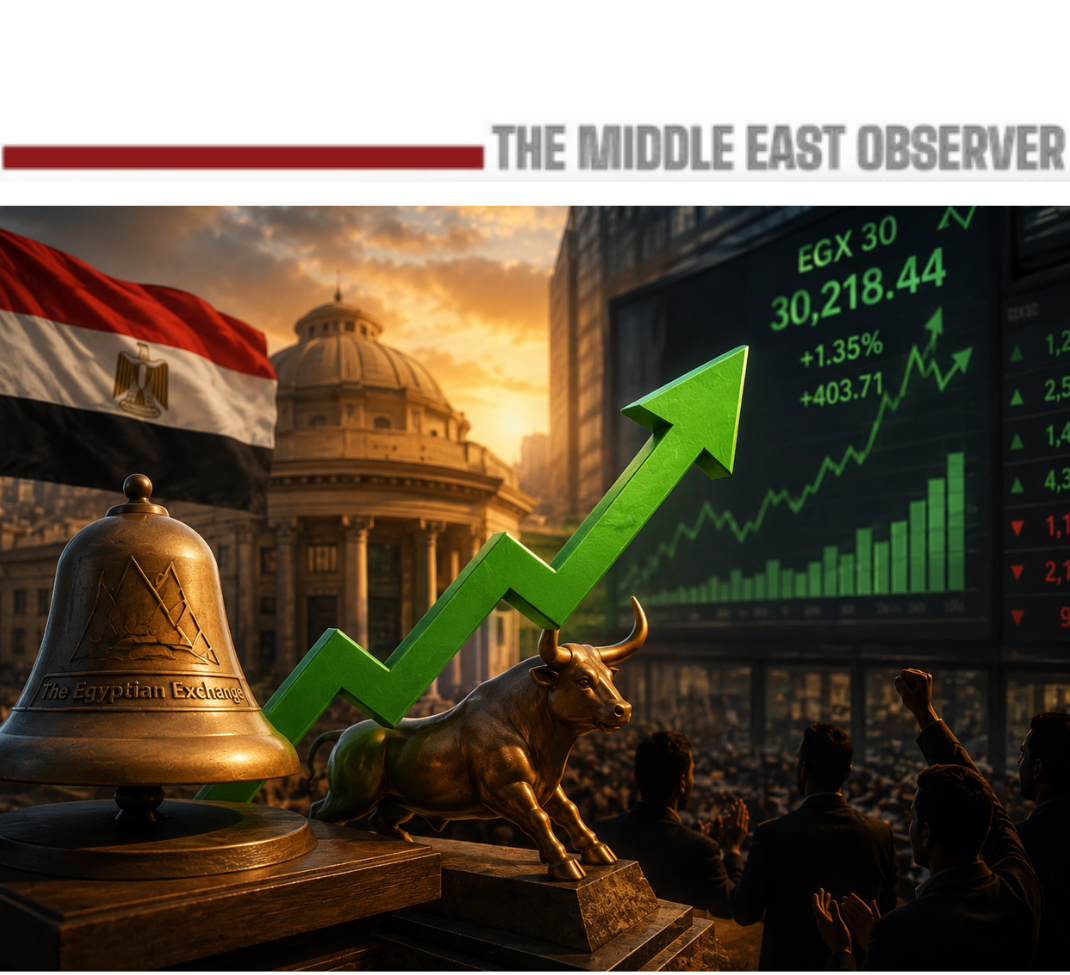
EGX30 gained 765.94 points, following advances of 1.94% on Tuesday and 0.40% on Monday. The index traded between 52,420.62 and 52,910.41 points, closing close to its session high.
Yet the broader market moved in the opposite direction. EGX70 declined 0.96% to 17,732.58 points, while EGX100 fell 0.55% to 23,881.72 points. Of 222 traded shares, 148 declined, 56 advanced and 18 were unchanged, reversing Tuesday’s broad-based advance.
Market capitalisation increased by approximately EGP26bn to EGP4.065tn, but equity turnover fell 9.5% to EGP8.26bn, around 27% below its 90-day average.
Talaat Moustafa Group rose 6.03% to EGP89.90 following the announcement of four development projects with a stated aggregate value of EGP11tn. Commercial International Bank gained 2.46%, reinforcing the benchmark’s dependence on selected heavyweight stocks.
The divergence marks an important shift in the recovery: EGX30 has regained momentum, but the wider exchange has failed to sustain Tuesday’s improvement in market participation.
Banque du Caire Tests Investor Appetite
Banque du Caire’s public offering reached 149.2% subscription coverage on Wednesday, its third subscription day, with orders for approximately 341.3mn shares against 228.75mn available. Coverage had stood at about 105% on Tuesday.
The government is initially offering 30% of the bank, with an option to increase the sale to 45%. The base offering comprises approximately 4.575bn shares at an indicative price range of EGP4.82–5.30, potentially raising EGP22.1bn–24.25bn before expenses.
The institutional book-building period runs until October 23, with final pricing scheduled for October 26 and public subscriptions closing October 28.
The transaction is an important test of Egypt’s state-asset divestment programme and investors’ willingness to commit capital to domestic banking assets. However, the public tranche represents only 5% of the initial offering. Its oversubscription does not establish comparable demand for the substantially larger institutional allocation.
Debt Selling Overshadows Foreign Equity Purchases
Foreign investors purchased approximately EGP86.4mn net in Egyptian equities on Wednesday, while Arab investors bought EGP30.8mn. Egyptian investors were net sellers of about EGP117.2mn.
The positive equity flows contrasted sharply with government-debt transactions. Foreign and Arab investors sold a net $376.4mn of Egyptian Treasury securities in the secondary market on Wednesday, following approximately $245mn on Tuesday and $505mn on Monday.
Combined three-session net sales reached approximately $1.13bn, reversing part of the demand recorded over the preceding two weeks, when foreign and Arab investors bought a combined $1.53bn net.
These figures represent secondary-market transactions rather than verified cross-border currency transfers. Nevertheless, they indicate renewed selling pressure on Egyptian sovereign securities despite continued demand for selected equities.
The distinction matters because government-debt holdings are sensitive to currency expectations, interest-rate differentials and international risk appetite. Persistent selling could complicate domestic financing conditions if it continues.
The available closing figures do not establish net institutional equity flows by nationality, limiting conclusions about whether the stock-market recovery is being driven by institutional or individual investors.
Pound Recovery Faces Monetary-Policy Test
The Egyptian pound strengthened by approximately 12 piastres against the dollar on Wednesday, interrupting a reported 11-session depreciation streak. Central Bank of Egypt quotations placed the dollar at EGP54.33 buying and EGP54.47 selling.
The rebound offered limited relief after the currency’s earlier losses, which have increased uncertainty over import costs and potential inflation pressures.
The Central Bank’s next monetary-policy decision, scheduled for October 29, comes as policymakers balance inflation risks against borrowing costs and domestic investment conditions. Overnight deposit and lending rates stand at 19% and 20%, respectively, while the main-operation rate is 19.5%.
For equity investors, the immediate question is whether currency stability and renewed institutional demand can support a broader recovery. For government-debt investors, the durability of the pound and Egypt’s interest-rate advantage remain central considerations.
Recovery Remains Uneven
Wednesday’s trading exposed a more demanding test for Egyptian financial markets than the benchmark’s advance alone suggests.
Banque du Caire’s oversubscribed public tranche and continued gains in selected blue chips demonstrate investor appetite for particular assets. But declining smaller-company indices, below-average turnover and sustained sovereign-debt selling point to a recovery that remains uneven.
The decisive signal will be whether gains spread beyond heavyweight stocks while government-debt selling subsides and the pound stabilises. Until then, the EGX30’s recovery is stronger than the market beneath it.
Related Articles:
EGX Rebounds Above 55,000 as Foreign Flows Reveal a Two-Speed Market
EGX Loses EGP81bn as Institutional Selling Tests Egypt’s IPO Revival
Read Also:
EGX Ends Week Higher as Smaller Stocks Rebound
EGX Hits Record as Domestic Liquidity Deepens Amid Foreign Portfolio Volatility