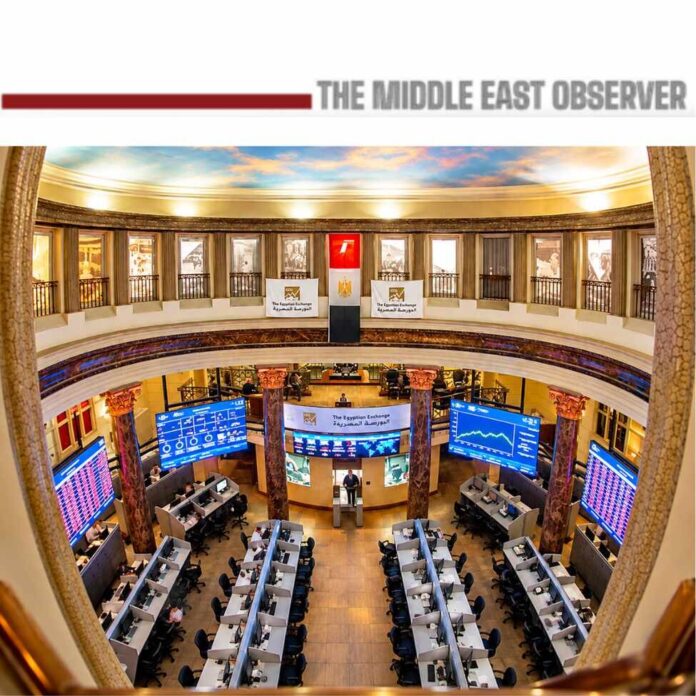
Egypt’s stock market erased nearly 85% of its early-October rebound on Sunday as domestic institutions led a broad sell-off, even as Banque du Caire announced plans for a major flotation. The simultaneous correction and expansion of the IPO pipeline present a critical test of institutional appetite for Egyptian equities.
CAIRO, October 11, 2026 — The Egyptian Exchange (EGX) resumed trading after the Armed Forces Day holiday with its benchmark EGX30 falling 1.99%, or 1,058 points, to 52,206.70, breaking below 53,000 as domestic institutional selling overwhelmed retail buying.
The EGX70 EWI declined 2.23% to 19,255.25, while the broader EGX100 EWI lost 2.26% to 25,421.74. Market capitalisation fell approximately EGP81bn to EGP4.122tn.
The sell-off extended across the exchange: 189 shares declined, 22 advanced and 10 were unchanged. Equity turnover reached EGP6.79bn across 203,979 transactions, compared with approximately EGP7.6bn on Wednesday and EGP10.3bn on October 4, confirming that liquidity continued to contract as prices weakened. Source: Arab Finance and Business Today, October 11, 2026.
Domestic Institutions Drive the Correction
Egyptian investors recorded net equity sales of EGP95.3mn, while foreign investors purchased EGP 58.7mn and Arab investors EGP 36.7mn.
The decisive pressure came from Egyptian institutions, whose net sales of approximately EGP415.6mn exceeded the EGP320.3mn purchased by Egyptian individuals. Retail investors accounted for 84.19% of trading activity.
The figures establish an important distinction: Sunday’s decline was driven by domestic institutional selling, not aggregate foreign or Arab equity withdrawals.
EGX30’s retreat from its October 4 close of 53,911.10 erased approximately 85% of the 2,016-point recovery recorded since September 30. The benchmark finished at 52,206.70, approaching its September 30 closing level of 51,894.83.
Wednesday’s tentative stabilisation has consequently given way to renewed correction, with weakening breadth, falling turnover and the loss of 53,000 reinforcing the change in market direction.
Banque du Caire Leads a New Wave of Offerings
The decline coincided with Banque du Caire’s announcement that it intends to float 30% of its issued capital through the sale of 4.575bn existing shares owned by Banque Misr.
The proposed offering combines a public tranche for Egyptian investors with a private placement for qualified domestic and international institutions. CI Capital and EFG Hermes will manage the transaction, with subscriptions expected to conclude in late October and trading anticipated in November, subject to regulatory approvals.
As a secondary offering, the proceeds would go to Banque Misr rather than provide new capital directly to Banque du Caire. Sources: Banque du Caire’s October 11 announcement, Arab Finance and Enterprise.
The transaction would follow MNT-Halan’s ongoing offering of 320mn shares, representing 20% of its Egyptian business, at EGP24.50 per share.
According to Economy Plus, orders for MNT-Halan’s 48mn-share public tranche had reached approximately 67.66mn shares, equivalent to 1.41 times subscription coverage at the reported checkpoint. The public offering remains open until October 15, and the final allocation has not yet been determined.
Egypt Education Platform is also reportedly targeting a November offering of approximately 25%, although EFG declined to comment. A prospective flotation of Misr Life Insurance could further expand the issuance calendar. Sources: Reuters and published MNT-Halan offering information.
The distinction between these transactions remains important: MNT-Halan is accepting subscriptions, Banque du Caire has announced its intention to float, and the other offerings remain prospective.
Currency Weakness Adds to Market Pressure
The dollar rose approximately 20 piastres on Sunday to EGP 52.53 buying and EGP 52.66 selling at the Central Bank of Egypt, adding exchange-rate pressure to an already weak equity market.
Combined Arab and foreign net purchases in the secondary government-debt market were reported at approximately $135,800, a sharp decline from Wednesday’s $967.4mn. The figures describe separate trading sessions and should not be interpreted as evidence that the same investors transferred capital between equities and debt.
Monetary conditions remain restrictive, with the CBE’s overnight deposit and lending rates at 19% and 20%, respectively. Elevated government borrowing yields continue to offer investors an alternative to equities and raise the returns required to justify equity risk.
IPO Revival Faces Its First Major Market Test
Sunday’s sell-off has left EGX30 close to surrendering its entire early-October recovery. The September 30 close near 51,895 is now an important downside reference, while a sustained recovery above 53,000, accompanied by stronger breadth and renewed institutional buying, would be needed to improve the near-term outlook.
The expanding IPO pipeline presents a separate opportunity. Banque du Caire could broaden the market’s banking representation, while MNT-Halan and prospective education and insurance listings would diversify its investable universe.
Yet additional listings cannot, by themselves, reverse the correction. Their commercial success will depend on realistic pricing, institutional participation, completed subscriptions and sufficient secondary-market liquidity after trading begins.
Egypt is preparing to bring significant new equity supply to market just as domestic institutions are reducing exposure to existing shares. Whether the new offerings attract durable investment rather than short-lived subscription demand will be a defining test of the EGX’s recovery and Egypt’s wider capital-market development.
Related news:
UAE Greenlights Institutional Stablecoin for Trade and Settlement
EGX30 Rebounds but Weak Breadth Exposes a Narrow Recovery
Read also:
Orange Raises 2026 Outlook as Africa & Middle East Adds 10 Million Data Users