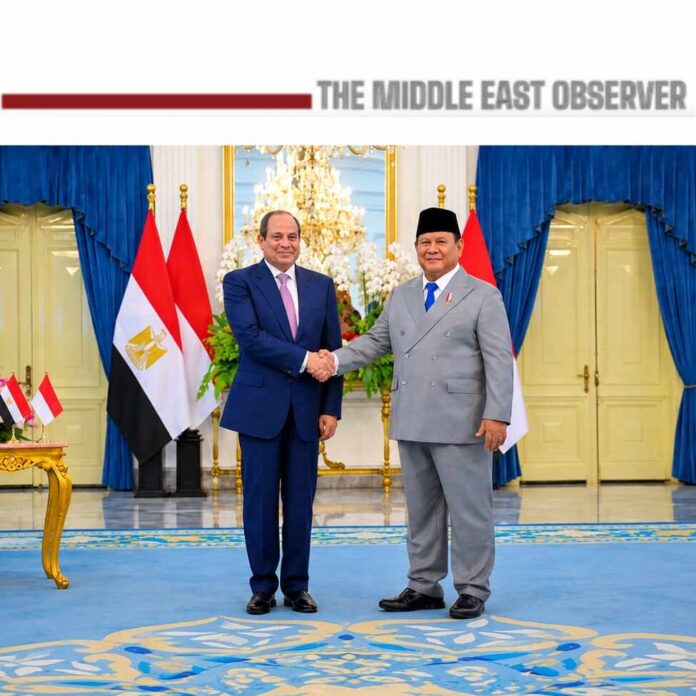
President Abdel Fattah El-Sisi concluded a two-day visit to Indonesia on October 11 with four bilateral agreements and a commitment to raise trade to $5 billion by 2030, as Cairo and Jakarta moved to translate their strategic partnership into investment, industrial production and closer economic integration.
Talks with Indonesian President Prabowo Subianto at Jakarta’s Merdeka Palace focused on expanding market access, developing joint manufacturing projects and strengthening cooperation in defence, agriculture, energy and logistics. The leaders also backed proposals for a bilateral Economic Partnership Agreement and a joint investment fund.
The visit, held on October 10–11, followed Prabowo’s three trips to Egypt since December 2024 and the elevation of bilateral relations to a strategic partnership in April 2025. It marked the final leg of El-Sisi’s Asian tour, which also included South Korea and Malaysia.
Four Agreements Establish Cooperation Framework
According to statements issued by the Egyptian Presidency and Indonesia’s State Secretariat on October 11, the presidents witnessed the exchange of four memoranda of understanding covering a strategic partnership action plan, maritime affairs and fisheries, statistical cooperation, and visa exemptions for holders of diplomatic, official and special passports.
The strategic action plan is intended to strengthen government coordination and activate existing bilateral mechanisms, including joint commission meetings.
Trade Expansion and Economic Partnership Agreement
El-Sisi announced a target of increasing bilateral trade to $5 billion by 2030, accompanied by efforts to remove trade barriers and improve market access.
The objective implies a substantial expansion from existing commercial levels, with the two governments seeking to encourage private-sector participation and increase manufacturing cooperation rather than rely exclusively on traditional merchandise trade.
Prabowo proposed advancing an Economic Partnership Agreement designed to expand trade, investment and business opportunities. Such an arrangement could eventually improve preferential market access, establish clearer trade rules and support cross-border industrial supply chains.
For Egyptian manufacturers, Indonesia represents a sizable Southeast Asian market, while Indonesian companies could use production facilities in Egypt to reach African, Middle Eastern and other international markets, subject to applicable trade rules and competitiveness.
The commercial opportunity lies in developing production and distribution networks capable of generating exports in both directions, rather than merely increasing bilateral import volumes.
Sovereign Investment Cooperation Targets Agriculture and Fertilisers
A central investment initiative concerns cooperation between Indonesia’s Danantara investment institution and Egypt’s Future of Egypt for Sustainable Development Agency.
The joint presidential statement identified crude palm oil and its derivatives, phosphate fertilisers and related raw materials as priority areas for production, distribution and potential investment.
Indonesia’s established palm-oil industry offers opportunities for processing, distribution and downstream manufacturing partnerships in Egypt. Fertiliser cooperation could similarly link Egypt’s phosphate resources and industrial capacity with Indonesian demand and distribution networks.
Both governments encouraged the institutions to expand their cooperation into infrastructure, energy, logistics and agribusiness, potentially creating a broader portfolio of investment projects.
Joint Investment Fund Could Accelerate Projects
Prabowo also welcomed an initiative to establish a joint investment fund involving investment institutions from both countries.
The proposed mechanism could help finance strategic projects, particularly those requiring substantial capital and coordinated participation by public institutions and private investors.
Potential applications include agricultural processing, logistics infrastructure, industrial manufacturing and energy investment.
A functioning investment vehicle would provide the partnership with a financing mechanism extending beyond conventional diplomatic agreements.
Defence Industry and Technical Cooperation
Defence and security formed another major component of the summit.
Prabowo confirmed an agreement to strengthen defence-industrial cooperation, military education, joint training and exchanges of technical specialists and senior personnel.
The initiative could support technology transfer, technical capacity and future industrial partnerships.
The presidents also agreed to expand educational cooperation through university partnerships, student exchanges, technical training and institutional capacity-building.
Indonesia welcomed Al-Azhar University’s November 2025 decision to introduce Indonesian-language instruction at its Faculty of Languages and Translation, reinforcing the longstanding educational relationship between the two countries.
Regional Security, Gaza and Nile Water Rights
The summit extended beyond commercial cooperation to regional security, including the Gaza conflict, Gulf tensions and maritime stability.
Both presidents reaffirmed support for Palestinian statehood, opposed forced displacement and called for continued humanitarian assistance. Indonesia recognised Egypt’s role in facilitating relief deliveries to Gaza.
On Nile water security, Indonesia acknowledged the importance of the river to Egypt and supported adherence to international principles governing transboundary watercourses, including the obligation not to cause harm.
The leaders also expressed concern over Gulf hostilities and their consequences for energy markets, navigation and international economic stability, calling for de-escalation and diplomatic solutions.
These concerns have direct economic implications. Persistent disruption to maritime routes and energy supplies could increase transport and production costs, potentially complicating efforts to expand trade between Egypt and Southeast Asia.
Investment Outlook: Turning Strategic Commitments into Industrial Growth
The Jakarta summit has given Egypt and Indonesia a more defined economic agenda, combining an ambitious trade target with investment financing proposals, manufacturing cooperation and stronger institutional coordination.
Its most consequential initiatives are the proposed Economic Partnership Agreement, the joint investment fund and potential production partnerships involving Danantara and the Future of Egypt agency. Together, these could establish a foundation for more integrated industrial and agricultural supply chains.
The distinction between agreements and investment delivery remains critical. The four signed memorandums establish cooperation frameworks, while the proposed fund and economic partnership agreement have yet to be finalised.
For Egypt, the partnership offers Indonesian investment, industrial expertise and greater access to Southeast Asian markets. For Indonesia, Egypt provides a strategic manufacturing and export gateway to Africa, the Middle East and Europe, supported by preferential trade agreements. Realising these mutual benefits now requires converting the Jakarta agreements into actionable plans, committed investment and commercially viable projects, with clear timelines and measurable targets. The diplomatic framework is in place; its success will be measured by capital deployed, production expanded and trade generated.
Related news:
Private Investment Takes the Lead in Egypt’s Economic Shift
Egypt, Saudi Arabia, Turkey & Pakistan Signal Push for New Regional Security Framework
Read also:
Egypt, Greece and Cyprus Build a Mediterranean Bridge to Europe
Aramco Reallocates Capital While Accelerating Industrial Digitalisation