

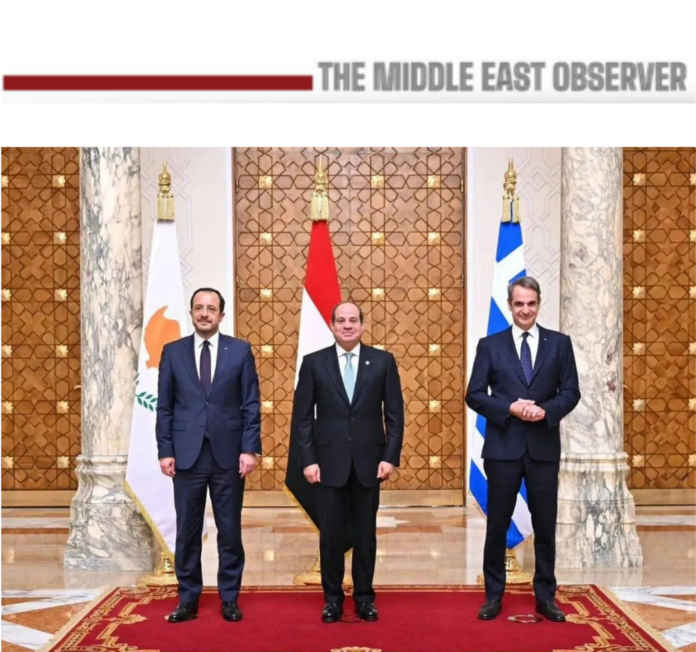
El Alamein declaration puts energy, labour mobility, investment and industrial localisation behind a decade-old partnership increasingly linking Egypt with European markets
EL ALAMEIN — Egypt, Greece and Cyprus moved to give greater economic and institutional weight to their Eastern Mediterranean partnership on Tuesday, committing to accelerate electricity and gas links, expand organised Egyptian labour mobility and translate political alignment into investment and concrete projects.
President Abdel Fattah El-Sisi, Cypriot President Nikos Christodoulides and Greek Prime Minister Kyriakos Mitsotakis, meeting in El Alamein, issued a joint declaration that sharpened the economic purpose of a cooperation mechanism established in Cairo in November 2014.
The three leaders identified energy security as a fundamental pillar, backed the GREGY electricity interconnector, called for faster connection of Cypriot gas fields to Egyptian infrastructure, encouraged deeper private-sector integration and supported organised employment opportunities for Egyptians in Greece and Cyprus.
They also committed governments and institutions to regular implementation follow-up—an important shift for a mechanism whose next challenge is less diplomatic consensus than execution.
The summit coincided with the second El Alamein International Airshow and Space Exhibition, EIAS 2026, bringing governments, armed forces and more than 250 aviation, defence and technology exhibitors from around 50 countries into the same Mediterranean setting.
Together, the two events highlighted Egypt’s broader proposition: use geography, infrastructure and international partnerships to connect Egyptian energy, labour and industrial capacity with European markets while deepening domestic technological capability.
The economic interests are complementary. Egypt offers energy infrastructure, renewable potential, industrial scale and labour; Cyprus contributes offshore gas resources and EU membership; Greece provides access to Europe’s electricity network, shipping system and institutions.
The emerging question is whether those advantages can form an economic corridor carrying energy, capital, technology and skilled labour across the Mediterranean.
Energy Becomes the Backbone
The declaration places energy at the centre of that architecture.
The leaders explicitly backed continued development of GREGY, saying the Egypt-Greece electricity connection would strengthen energy security while linking the Eastern Mediterranean with European markets.
The project is designed as an approximately 954-kilometre high-voltage direct-current submarine connection capable of carrying up to 3,000 MW between Egypt and Greece.
For Egypt, the opportunity extends beyond electricity exports. Direct access to European demand could strengthen the economics of additional solar and wind capacity and support investment in grids, storage and green industrial production.
For Europe, it would provide another geographically diversified source of renewable electricity.
But GREGY remains a development project rather than an operating corridor. Its economic value still depends on financing, regulatory approvals, construction and sufficient generation capacity.
Natural gas is further advanced.
In July, Eni and TotalEnergies reached a final investment decision on Cyprus’s Cronos gas development, targeting first production in 2028. The field contains more than 3tn cubic feet of gas initially in place, with planned output of about 500mn cubic feet a day.
Cronos gas is expected to move into Egypt through infrastructure linked to Zohr before being transferred to the Damietta LNG terminal for liquefaction and export, including to European markets.
The structure is economically efficient:
Cyprus supplies the resource. Egypt supplies processing and LNG infrastructure. Europe provides a major destination.
This strengthens Cairo’s ambition to function as an Eastern Mediterranean energy hub not simply by producing gas, but by receiving, processing and exporting resources produced elsewhere in the region.
The two energy routes could therefore operate in parallel:
Cypriot gas → Egypt → LNG → Europe.
Egyptian renewable electricity → Greece → European power markets.
In both, Egypt’s economic value increasingly lies in connectivity as well as production.
Europe, Investment and Labour Complete the Corridor
The trilateral mechanism also sits inside Egypt’s wider relationship with the European Union.
The EU-Egypt Strategic and Comprehensive Partnership, established in 2024, covers economic stability, investment, migration, security and human capital and is backed by a €7.4bn package for 2024-2027.
Greece and Cyprus therefore matter to Cairo not only as neighbouring states, but as EU members capable of linking Egyptian projects with European capital, institutions and markets.
The declaration also gives labour mobility clearer trilateral backing.
The three leaders called for expanded cooperation on regular migration and organised employment opportunities for Egyptian workers in Cyprus and Greece, subject to national legislation and bilateral agreements.
The economic equation is straightforward.
Egypt has a large, relatively young workforce. Greece and Cyprus face labour shortages in parts of ageing European economies, including agriculture, tourism and construction.
Regulated mobility can help employers fill vacancies, generate employment and remittance income for Egypt and create legal pathways distinct from irregular migration.
Migration becomes not only a border-management question, but also a labour-market imbalance that regulated economic policy can address.
The same commercial logic underpins the leaders’ call for deeper trade and investment ties. The declaration encourages business communities to use the three countries’ geographic and competitive advantages to generate partnerships, jobs and greater economic integration.
The mechanism’s credibility will increasingly depend on whether strong government relations produce productive private investment rather than merely additional agreements.
Security Makes Integration Financeable
The declaration also sets clearer political parameters around the economic project.
Egypt, Cyprus and Greece reaffirmed sovereignty, territorial integrity and international law, including the UN Convention on the Law of the Sea in agreements involving maritime-boundary delimitation—an important provision in a region where offshore resources and energy routes depend on legal certainty.
The leaders also addressed Gaza, Lebanon and Libya alongside broader regional instability. On Gaza, they backed humanitarian access, reconstruction, Palestinian territorial unity and a sovereign Palestinian state based on the June 4, 1967 lines with East Jerusalem as its capital.
These positions carry direct economic consequences.
Conflict affects energy prices, shipping insurance, trade routes, tourism, supply chains and investment. Egypt has seen this through disruptions affecting Red Sea navigation and Suez Canal revenues; Greece has deep exposure through shipping; Cyprus requires long-term predictability to commercialise offshore gas.
Electricity interconnectors require decades of political confidence. Gas infrastructure requires enforceable agreements. Labour corridors require functioning borders. Capital requires predictability.
Security is what makes integration financeable.
The declaration also gives Greece and Cyprus an explicit position on Egypt’s Nile water security, recognising Cairo’s dependence on the river and calling for compliance with international law, including the principles of non-harm, cooperation, prior notification and consultation.
For Egypt, that adds two EU member states to its wider diplomatic argument that transboundary Nile management should be governed by negotiated rules rather than unilateral action.
EIAS Puts Industrial Localisation in Focus
Alongside the summit, EIAS 2026 placed Egypt’s industrial ambitions on display.
The Ministry of Military Production is showcasing domestically produced ammunition, weapons, equipment and advanced electronic systems while pursuing talks with international companies on partnerships, industrial integration and defence, aviation and space technologies.
Its stated objective is not simply procurement, but localisation of manufacturing technology and deeper domestic production capacity.
That distinction matters economically.
The value of international defence and aerospace partnerships should ultimately be measured by what remains inside the Egyptian economy:
technology transferred, components manufactured locally, engineers trained, maintenance capabilities established, domestic suppliers integrated and exports generated.
Assembly alone creates less value than developing engineering, electronics, software, systems integration and intellectual capability.
The same principle applies more broadly: foreign partnerships create their greatest economic value when imported technology becomes domestic productive capacity.
EIAS also fits Egypt’s wider strategy of strategic diversification. Cairo is expanding relations simultaneously with Europe, Gulf states, China, the US, Russia and Türkiye rather than organising its external policy around a single bloc.
The Egypt-Greece-Cyprus mechanism should therefore not be reduced to an anti-Türkiye alignment. Its more durable foundations are energy connectivity, European market access, investment, labour flows and shared economic interests.
Institutions Begin to Catch Up With Strategy
The declaration adds an institutional layer to the physical projects.
The leaders committed to regular follow-up by governments, institutions and private sectors so that political consensus produces concrete projects and programmes.
They also recalled plans to activate a permanent secretariat for the Tripartite Cooperation Mechanism in Nicosia, giving the partnership an administrative structure capable of monitoring implementation between summits.
That matters because the mechanism is no longer being judged solely by political continuity.
It is increasingly being tested on whether it can organise and deliver cross-border projects at commercial scale.
The El Alamein declaration also resolves the earlier ambiguity over summit numbering: the leaders said they look forward to holding the 11th Tripartite Summit in Cyprus, making the current meeting the El Alamein Tripartite Summit rather than the 11th summit.
The Execution Test
The economic tests are now clear.
Cronos has reached a final investment decision and is targeting first gas in 2028.
GREGY must still move through financing, approvals and construction.
Cypriot gas connections must become physical energy flows through Egyptian infrastructure.
Labour agreements must generate transparent employment channels at a meaningful scale.
European partnership commitments must produce productive private capital.
And EIAS relationships must eventually deliver local content, technology transfer, exports, supply-chain development and foreign-exchange value.
If those tests are met, the architecture taking shape could connect Egyptian renewable electricity with European demand; Cypriot gas with Egyptian LNG facilities; Egyptian workers with European labour shortages; and foreign aerospace and defence partnerships with domestic industrial capacity.
The significance of El Alamein is therefore no longer simply another diplomatic summit beside an international exhibition.
It is that energy, investment, labour, industry and security are increasingly converging around the same Mediterranean geography.
After more than a decade of Egypt-Greece-Cyprus summits, infrastructure and institutions are beginning to appear behind the political relationship. Whether they create lasting strategic value will now depend less on further declarations than on cables laid, gas delivered, workers legally employed, factories localised and investment committed.
Related news:
Egypt, Greece, and Cyprus Strengthen Trilateral Ties for Stability and Prosperity
Read also:
Dubai’s Parkin Targets Egypt in Push Beyond UAE
CMA CGM Plans to Step Up Suez Transits as Canal Traffic Recovers