Egyptian stocks rebounded sharply on Tuesday after three consecutive EGX30 declines, with gains spreading across large and smaller companies. But volatile flows between equities and government debt point to a more important divide: foreign investors remain considerably more willing to buy Egypt’s high-yielding sovereign paper than its listed companies.
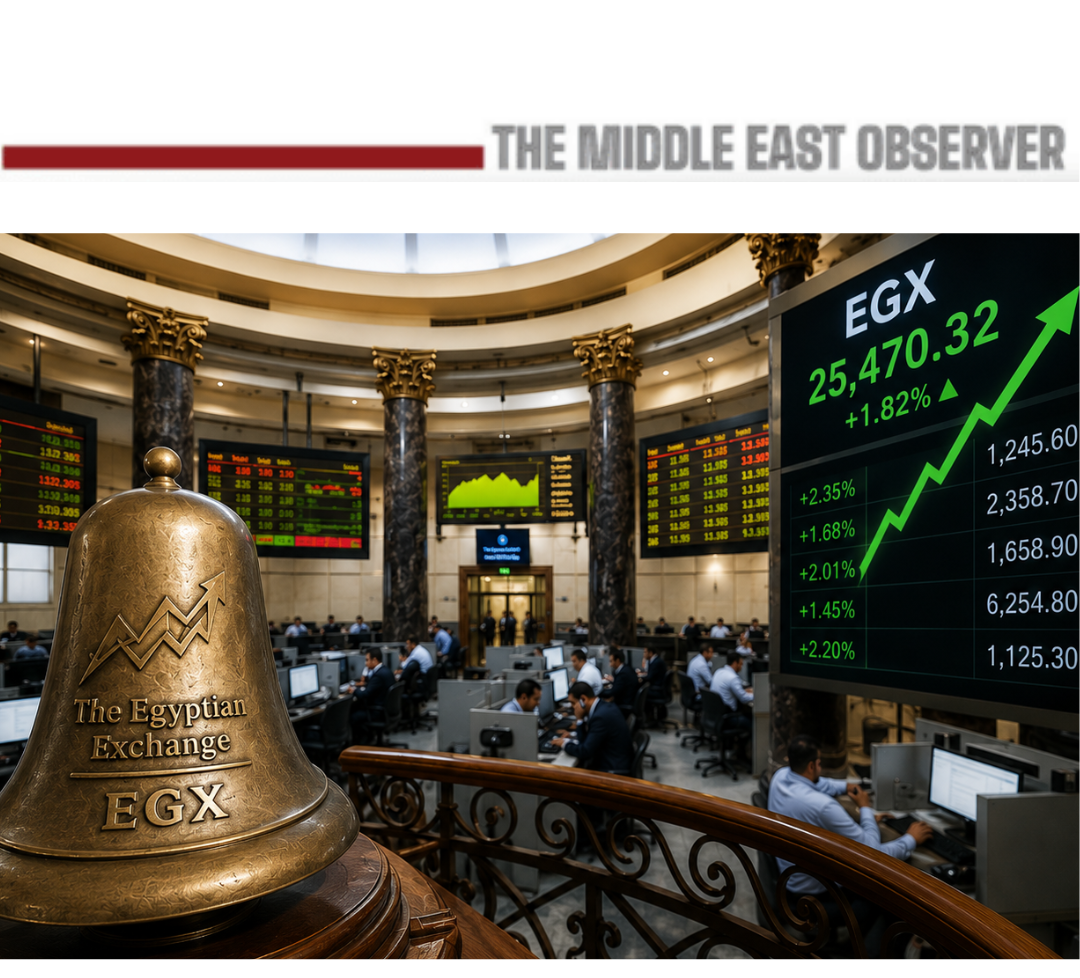
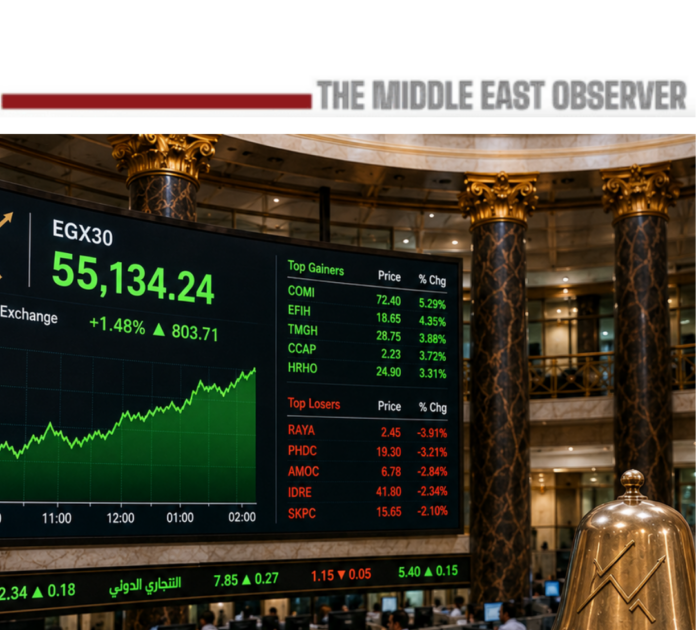
The EGX30 rose 1.03% on September 1 to 55,431.29 points, reversing Monday’s 0.13% decline. EGX70 jumped 2.03% to 21,318.22 and EGX100 gained 1.73% to 27,735.23, while EGX35-LV advanced 1.72%.
Market capitalisation increased by about EGP66.4bn to EGP 4.354 tn, while turnover reached EGP 16.1bn. The rebound was broad rather than concentrated in the benchmark: 122 stocks advanced against 87 decliners.
That marked a sharp reversal from Monday.
Monday’s Weakness Went Beyond the EGX30
On August 31, EGX30 slipped only 0.13% to 54,866.04, but the modest benchmark decline understated broader weakness.
EGX70 fell 2.06% and EGX100 dropped 1.51%, while market capitalization declined to EGP 4.287 tn.
Tuesday reversed most of that deterioration. EGX30 gained 565 points, EGX70 recovered almost all of Monday’s loss and market capitalization added more than EGP66bn.
Commercial International Bank rose 1.98%, supporting the benchmark, but the simultaneous recovery in smaller shares made Tuesday’s move a higher-quality rally than one driven solely by index heavyweights.
The Week Remains Positive
Measured from the previous week’s August 26 close, EGX30 is up about 0.6% through Tuesday, while EGX70 is marginally higher and market capitalisation has increased by roughly EGP71bn.
The path has nevertheless been volatile: EGX30 fell 0.31% on Sunday and 0.13% on Monday before Tuesday’s 1.03% rebound.
August itself was constructive. EGX30 gained about 2.7%, while total market capitalization increased 8.9%, or roughly EGP257bn, to EGP 4.28tn.
The market therefore remains close to record territory, but recent sessions suggest that breadth is becoming a better measure of the rally’s quality than the EGX30 alone.
The EGP21bn Foreign Inflow Was Debt, Not Equities
The more revealing development came from investor flows.
Monday’s headline data showed non-Arab foreign net buying of EGP 21.39bn — a figure that, without careful classification, could be interpreted as an extraordinary foreign move into Egyptian equities.
It was not an ordinary equity flow.
The figure reflects the much larger transactions occurring in Egypt’s secondary government-debt market, while separate listed-equity data showed foreigners selling stocks that day.
The distinction materially changes the investment interpretation.
Foreign investors were selling Egyptian equities while simultaneously buying government debt.
That demonstrates one of the defining features of Egypt’s current portfolio-investment landscape: high domestic yields can attract substantial international fixed-income capital even while overseas investors remain selective towards listed companies.
Tuesday Reversed the Flows
Tuesday produced almost the opposite pattern.
Foreign investors became net equity buyers of EGP113.6mn, alongside EGP135.4mn of Egyptian buying, while Arab investors sold EGP249.0mn. Foreigners accounted for 9.36% of trading and Arabs 3.31%, compared with 87.32% for Egyptian investors.
At the same time, government-debt flows moved sharply in the opposite direction.
Foreign and Arab investors recorded a combined net selling of about $287.8mn in secondary-market Treasury bills. Foreigners accounted for $165.3mn of the selling and Arabs $122.5mn. No Treasury-bond transactions were recorded for either group in the published data.
The two sessions therefore illustrate why Egypt’s portfolio flows cannot accurately be described simply as foreign money entering or leaving the country.
The capital is moving differently across asset classes.
August Confirms the Debt-Equity Divide
The monthly data make that distinction clearer.
Foreign investors recorded approximately EGP33.3bn — about $655mn — of net purchases of secondary-market Treasury bills during August, while Arab investors recorded about EGP 28.9bn, or $569mn, of net selling.
Egypt therefore has an increasingly visible two-speed foreign-investment story.
It can attract international capital into high-yielding government securities more readily than into listed equities.
The difference is economically important. Debt investors are primarily assessing yield, currency and sovereign risk. Equity investors must additionally assess corporate earnings, valuations, governance, liquidity and company-specific exposure to the Egyptian economy.
For the EGX, narrowing that gap is becoming one of the clearest tests of the market’s next phase.
The Pound and Rates Raise the Equity Hurdle
Currency risk reinforces that distinction.
The dollar moved towards EGP51 by Tuesday. For international shareholders, a rising EGX in pound terms does not necessarily translate into an equivalent hard-currency return if the pound weakens at the same time.
The corporate impact is also uneven. Exporters and companies earning foreign currency can benefit in local-currency terms, while import-dependent businesses face higher costs and companies carrying foreign-currency debt can face balance-sheet pressure.
Currency exposure is therefore becoming a mechanism for stock selection rather than merely a macroeconomic backdrop.
Interest rates create a similar divide.
The CBE’s overnight deposit rate remains 19%, with the lending rate at 20% and main-operation rate at 19.5%.
High rates support bank earnings and the appeal of government securities, but they also raise the hurdle for equities. After the EGX30’s strong 2026 advance, companies increasingly need earnings growth capable of compensating investors for equity risk against high domestic fixed-income returns.
That puts greater emphasis on earnings quality, balance-sheet strength, pricing power and the currency composition of revenues.
Governance Rules Tighten
Regulators are simultaneously strengthening the institutional framework.
The Financial Regulatory Authority’s Resolution 195 of 2026 prohibits insiders, company officials and shareholders controlling 20% or more of a listed company from trading its securities during the five business days before and the business day after publication of financial results. The amendments also strengthen conflict-of-interest procedures.
These are structural rather than near-term trading catalysts, but stronger governance matters if Egypt wants to convert greater international interest in its markets into long-term institutional equity allocations.
A Better Rally — but a Higher Bar
Tuesday was therefore stronger than the EGX30’s 1.03% rise alone suggests.
Large caps advanced, smaller shares rebounded, breadth improved and market capitalisation added more than EGP66bn. Foreigners also returned as modest equity buyers.
But the cross-market picture remains more complicated.
Foreign investors can move hundreds of millions of dollars through Egypt’s government-debt market while their daily equity positions remain comparatively small. The pound is again testing the EGP51 area, and high domestic yields offer a formidable alternative to stocks.
The central investment question is therefore becoming clearer:
Egypt is attracting foreign yield-seeking capital more readily than foreign equity capital.
The next stage of the EGX rally depends on whether broader participation persists, foreign equity buying becomes sustained and corporate earnings justify valuations against both high domestic yields and currency risk.
The EGX remains close to record territory. Market breadth has recovered and regulatory reforms are strengthening the infrastructure.
But after a powerful rally, the standard for the next advance is higher.
Another EGX30 record would matter less than evidence that Egypt can convert foreign appetite for its high-yielding debt into sustained demand for its listed companies.
Related news:
Foreign Investors Lift Egyptian Stocks Despite Local & Arab Sell-Off
Egypt’s IPO Test: From Temporary Listings to Real Liquidity
Read also:
Egyptian Banks Raise Deposit Rates as Loan Demand Strengthens
Egypt’s Fund Boom Signals Deeper Shift in Capital Markets Architecture