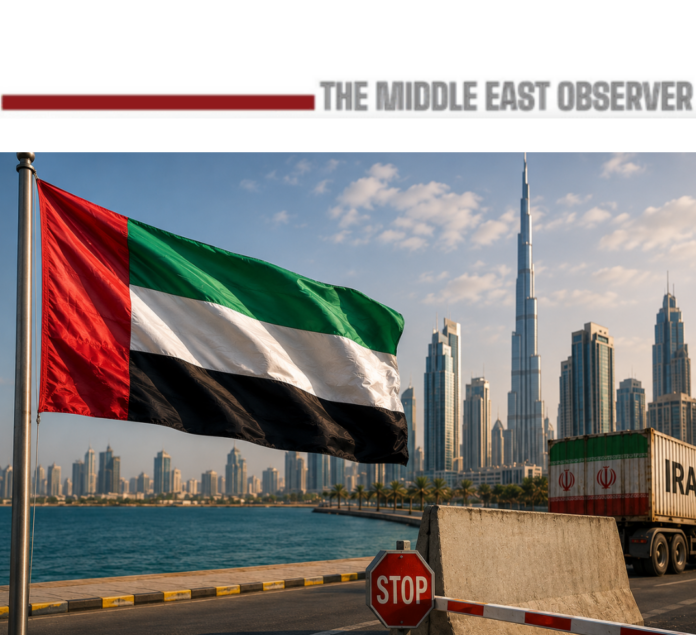
The United Arab Emirates has suspended trade, commercial exchanges and financial transactions with Iran, disrupting one of Tehran’s most important import and payment routes at a time of mounting pressure on the Iranian economy.
The measure was announced on August 18, 2026, with the UAE foreign ministry saying dealings had been halted “until further notice”. It followed Abu Dhabi’s assertion that two ballistic missiles launched from Iran had targeted maritime traffic near UAE waters. Iran rejected the allegation.
The economic exposure is substantial. Iran imported $68.55bn of merchandise in 2024, of which $21.01bn, or 30.6%, was recorded as coming from the UAE, according to World Trade Organization data. The Emirates was Iran’s largest recorded import partner, ahead of China at 26% and Türkiye at 16.3%.
Iran also exported $7.16bn of merchandise to the UAE, equivalent to 12.8% of its exports, putting recorded bilateral merchandise trade above $28bn in 2024.
That figure is a measure of Iran’s historical exposure rather than the value of commerce immediately lost. UAE-Iran trade had already been heavily disrupted after the regional war began on February 28, with direct cargo movements through Dubai’s Jebel Ali port resuming only in late June.
Implementation Remains Unclear
The UAE prohibition is broad, covering trade, commercial exchanges and financial transactions, but detailed implementation rules had yet to be disclosed. That leaves uncertainty over existing contracts, cargo in transit, humanitarian trade, pharmaceuticals and personal remittances.
The impact will depend heavily on how banks, customs authorities, ports and free-zone operators implement the restrictions. Until detailed rules emerge, it would be premature to assume that every category of trade or payment will be treated identically.
The financial component could ultimately prove more consequential than the interruption of direct merchandise trade because of the UAE’s long-standing role in facilitating regional payments and commercial settlement for Iranian businesses.
Why the UAE Matters
Dubai’s importance lies less in what the Emirates manufacture than in its role as a re-export, logistics and payments hub linking Iranian businesses with suppliers in third countries.
A significant portion of goods recorded as Iranian imports from the UAE originates elsewhere and passes through Dubai before reaching Iran. Restricting that route therefore affects not only bilateral commerce but also a wider procurement network used by Iranian companies.
The greatest immediate exposure is likely to fall on importers using Dubai re-export channels and manufacturers reliant on foreign machinery and intermediate goods, particularly where payments are settled through UAE-linked intermediaries.
UAE logistics groups, traders and financial intermediaries will also lose business, although the exposure is asymmetric: Iran relied on the Emirates for almost one-third of its recorded imports in 2024, while the UAE operates a much larger and more diversified trading economy.
Pressure on Currency and Inflation
The most important macroeconomic transmission may come through foreign exchange and payments.
Iran has adapted to decades of US and European sanctions through third-country traders, alternative currencies and intermediary settlement structures. Reduced access to UAE channels adds another layer of friction to those arrangements.
The International Monetary Fund forecasts Iran’s real GDP to contract 5.4% in 2026, with consumer-price inflation projected at 68.9%.
Further constraints on access to dollars, UAE dirhams and other convertible currencies could add pressure to the rial. A weaker exchange rate would increase the domestic cost of imported machinery, raw materials, food and consumer products.
The economic effect does not require trade to stop. If Iranian companies can complete the same transactions only through additional intermediaries, more expensive currencies or longer routes, the resulting costs will weigh on corporate margins and, ultimately, domestic prices.
For manufacturers, this could translate into higher costs for capital equipment and intermediate goods. For households, the impact would be felt mainly through higher prices for imported and import-dependent products.
Iran Can Reroute Trade, at a Cost
Iran is not without alternatives.
China accounted for 26% of Iranian merchandise imports and 26% of exports in 2024, while Iraq absorbed 20.9% of exports and Türkiye supplied 16.3% of imports. Oman and other regional and Asian markets provide additional commercial routes.
Tehran also has extensive experience operating under sanctions and is likely to reroute a substantial share of affected commerce.
But greater dependence on a smaller number of markets would leave Iran with fewer alternative suppliers, buyers and payment channels. The UAE restrictions may therefore deepen Tehran’s reliance on China, already its largest export market and second-largest source of imports.
The UAE action should not, however, be interpreted as an embargo capable on its own of shutting Iran’s principal oil-export business. Iranian crude exports are concentrated mainly in Asia and are already shaped by US sanctions and disruption around the Strait of Hormuz.
The first economic effects of the UAE measure are therefore more likely to appear through higher import costs, tighter access to foreign exchange, payment delays and inflation than through an immediate collapse in oil revenues.
Risk of Broader Gulf Restrictions
A more serious risk for Tehran would arise if other Gulf states adopted similar measures. There was no indication as of August 19 of a co-ordinated GCC-wide prohibition on Iranian trade.
The UAE decision nevertheless matters because the Emirates remained a major regional commercial interface for Tehran even during years of Western sanctions. Similar measures elsewhere would narrow the neighbouring trading and payment networks available to Iranian companies.
For now, the severity of the UAE measure will depend principally on duration and enforcement.
Iran is likely to reroute a substantial share of affected trade through China, Türkiye, Oman and other markets. But a prolonged and tightly enforced UAE freeze would raise transaction and financing costs, constrain access to foreign exchange and add to inflationary pressure in an economy already under severe strain.
Related news:
Can Egypt Turn Pharmaceutical Self-Sufficiency into Regional Leadership?
Egypt Eyes a Bigger Medical Tourism Market on Cost, Care and Tourism Strengths
Read also: