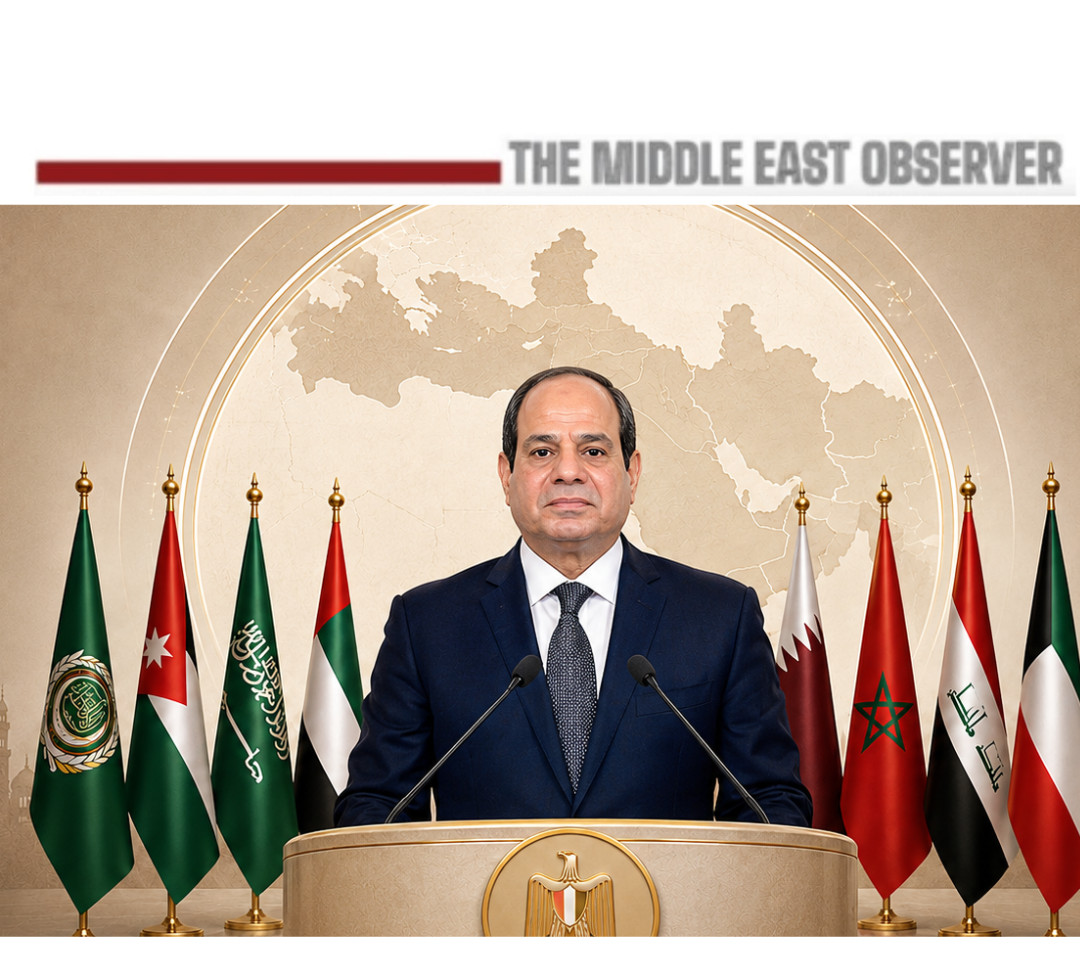
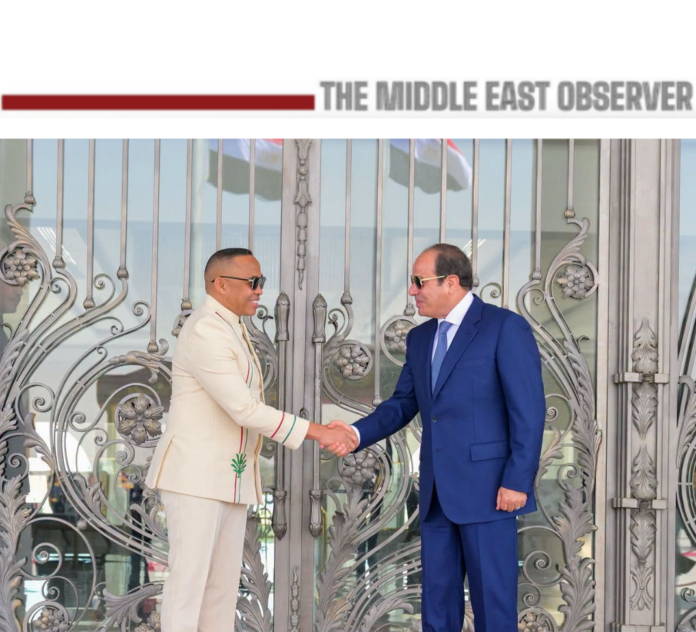
President Abdel-Fattah El-Sisi and Madagascar’s President Michael Randrianirina signed five cooperation agreements in New Alamein City, marking a significant step in Egypt’s strategy to deepen its economic footprint across Africa while supporting Madagascar’s efforts to attract investment during its political transition.
The visit—the first official bilateral visit to Egypt by a Malagasy head of state since diplomatic relations were established in 1970—combined political engagement with a broad economic agenda. The agreements cover political consultations, investment promotion, maritime transport and port development, artificial intelligence and digital transformation, and youth and sports cooperation, providing an institutional framework for expanding commercial relations beyond their current modest level.
The meeting was the second between the two leaders in less than three months, following discussions on the sidelines of the Africa–France Summit in Nairobi in May, reflecting the growing pace of bilateral engagement.
Bilateral Trade Leaves Considerable Room for Expansion
Despite belonging to both the African Union and the Common Market for Eastern and Southern Africa (COMESA), Egypt and Madagascar maintain relatively limited commercial ties.
According to Madagascar’s official 2024 trade statistics, bilateral merchandise trade totalled approximately US$148.5 million, comprising US$134.1 million of Egyptian exports and US$14.4 million of Malagasy exports, leaving Egypt with a merchandise trade surplus of nearly US$120 million.
While Egypt ranks among Madagascar’s important suppliers of manufactured products, bilateral trade remains small compared with Egypt’s commercial exchanges with larger African partners such as Kenya, South Africa and Morocco, highlighting substantial untapped potential.
Egypt’s exports consist primarily of value-added industrial and consumer products, led by wheat flour, refined petroleum products, sanitary products and chemical preparations used in manufacturing. Madagascar’s exports remain heavily concentrated in agricultural commodities, with coffee accounting for the overwhelming share of shipments to Egypt, followed by cloves and pepper.
The relatively narrow composition of Madagascar’s exports illustrates both the country’s dependence on agricultural commodities and the opportunity to diversify trade into higher-value manufactured and processed products.
COMESA Preferences Have Yet to Translate into Stronger Trade
Although both countries benefit from preferential market access under the COMESA Free Trade Area, tariff reductions alone have not generated substantial bilateral commerce.
Structural constraints—including limited direct shipping connections, relatively high freight costs, restricted trade finance, geographical distance and limited business familiarity—continue to suppress trade flows despite the favourable institutional framework.
Against that backdrop, the memorandum on maritime transport and port cooperation could prove one of the visit’s most commercially significant outcomes. Improved logistics, greater cooperation between port authorities and more efficient shipping services would help lower transaction costs and facilitate trade throughout Eastern and Southern Africa.
The investment-promotion agreement is equally important, providing a structured mechanism for encouraging private-sector engagement and facilitating future investment projects.
Infrastructure Offers the Greatest Commercial Opportunity
Beyond existing trade, infrastructure development represents the most significant area for expanding economic cooperation.
Madagascar continues to face substantial investment requirements across electricity networks, transport infrastructure, water management, healthcare facilities and industrial development. These sectors broadly correspond with areas where Egyptian engineering firms, construction companies, manufacturers and infrastructure developers have expanded their activities across African markets during the past decade.
Egyptian companies have already participated in selected projects in Madagascar, particularly in electricity infrastructure. However, commercial engagement remains project-specific rather than representing large-scale Egyptian foreign direct investment.
Future expansion will depend less on political declarations than on project preparation, financing structures, procurement transparency, payment security and the broader investment climate. The agreements therefore establish an institutional platform upon which commercial opportunities may develop rather than guaranteeing immediate contracts.
Digital Cooperation Broadens the Partnership
The inclusion of artificial intelligence and digital transformation demonstrates how bilateral cooperation is evolving beyond traditional sectors.
Egypt has increasingly positioned itself as a regional provider of digital-government solutions, technical training and information technology expertise. Extending that experience to Madagascar could support public-sector modernisation, administrative efficiency, digital skills development and improved government services.
For Madagascar, however, successful implementation will require complementary investment in communications infrastructure, cybersecurity, electricity supply and institutional capacity. The memorandum should therefore be viewed as a long-term framework whose effectiveness will ultimately depend on clearly defined projects and sustainable financing.
Political Engagement Supports Economic Cooperation
The discussions also addressed agriculture, healthcare, renewable energy, transport, water resources and institutional capacity-building, illustrating the increasingly comprehensive nature of bilateral relations.
The political context remains important. Madagascar is undergoing a transitional period following the military-led change in government in October 2025, with the authorities committed to restoring constitutional civilian rule through elections after a transitional process.
El-Sisi reiterated Egypt’s support for Madagascar’s institutional development and reaffirmed Cairo’s willingness to share technical expertise and capacity-building experience. Such cooperation has become an increasingly important component of Egypt’s diplomatic engagement across Africa alongside trade, investment and infrastructure partnerships.
Climate Resilience Creates Additional Investment Opportunities
Climate resilience emerged as another priority area during the talks.
Madagascar remains one of Africa’s most cyclone-prone countries, while Egypt faces growing challenges linked to water security, rising temperatures and coastal vulnerability. These shared pressures create opportunities for cooperation in renewable energy, irrigation, desalination, water-resource management and climate-resilient infrastructure.
Beyond humanitarian cooperation following recent cyclones, both governments are positioning climate adaptation as an area capable of attracting development finance and supporting long-term economic resilience.
Egypt’s Broader African Strategy
The visit reflects Cairo’s wider strategy of strengthening economic integration with African partners through infrastructure development, trade facilitation, technical cooperation and private-sector expansion.
For Egypt, stronger relations with Madagascar also enhance engagement with the western Indian Ocean region while reinforcing cooperation within COMESA. The island nation’s strategic location along major Indian Ocean shipping routes adds a further commercial dimension to the relationship.
Randrianirina’s proposal to establish a resident Malagasy embassy in Cairo would provide an institutional mechanism for sustaining political dialogue while supporting business development and implementation of the newly signed agreements.
Implementation Will Determine Success
The five agreements significantly expand the institutional framework governing Egypt-Madagascar relations. Their economic significance, however, will ultimately depend on implementation.
Converting diplomatic momentum into measurable commercial outcomes will require identifiable investment projects, stronger logistics links, greater private-sector participation and sustained follow-up by both governments.
If successfully implemented, the agreements could help diversify bilateral trade, expand Egyptian commercial activity in the Indian Ocean region and strengthen Cairo’s position as an infrastructure, technology and development partner across Africa.
For Madagascar, the partnership offers an opportunity to attract investment, modernise critical infrastructure and broaden international economic cooperation. The extent to which those objectives are realized will depend not on the agreements themselves but on the financing, execution and policy continuity that follow.