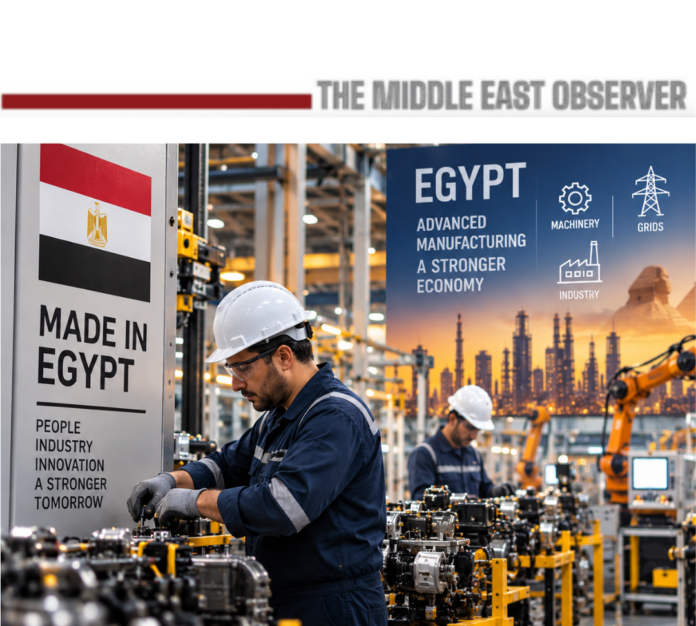
ECES screened more than 1,000 products to identify where Egypt could build higher-value manufacturing and exports, with the strongest opportunities clustering around electrical equipment, industrial machinery, advanced materials and technologies serving grids, electric mobility and the energy transition.
CAIRO — Egypt could build its next phase of industrial expansion around electrical equipment, machinery, precision instruments and advanced materials, shifting investment policy away from broad sector-wide incentives towards individual products and interconnected supply chains with stronger export, technology and investment potential.
A September 2026 study by the Egyptian Center for Economic Studies, or ECES, assessed 1,058 product groups to determine where existing Egyptian capabilities could be developed into higher-value industries. The strongest opportunities were concentrated in machinery, electrical equipment, fabricated and basic metals, advanced materials and precision instruments, particularly products used in electricity grids, electric vehicles, batteries, renewable energy and green hydrogen.
The significance extends beyond the individual products. ECES finds that many sit inside the same industrial ecosystem, sharing engineering skills, suppliers, technologies and infrastructure. That creates the potential for investment in one manufacturing capability to support several adjacent industries rather than a single end-market.
The study therefore challenges a conventional industrial-policy approach based mainly on what Egypt already exports competitively. Its central proposition is that today’s strongest exports are not necessarily those capable of generating the greatest technological upgrading, productivity gains and investment opportunities in the future.
Five Tests for Industrial Potential
To identify those opportunities, ECES constructed a Trade and Investment Composite Index, or TICI, evaluating products across five dimensions: current Egyptian export competitiveness; the direction and momentum of exports; attractiveness to investment; economic complexity, reflecting the knowledge and capabilities required to manufacture a product; and “Greenplexity”, measuring the potential to enter emerging green value chains.
The approach combines present capability with future opportunity. A product can therefore rank highly even where current Egyptian exports remain relatively modest if global demand is expanding, Egypt possesses adjacent production capabilities and manufacturing it could deepen the country’s technological base.
ECES tests the results under two weighting systems. The first gives equal importance to all five pillars. A second, more forward-looking model gives greater weight to export momentum, product complexity and green-industry potential. Products are ranked according to their performance under both scenarios, with those averaging above 0.7 forming the priority portfolio.
The methodology nevertheless contains an important qualification for investors. Some underlying data are necessarily backward-looking, including the 2017/18 CAPMAS Economic Census, used for part of the domestic investment analysis. The index is therefore better understood as a strategic screening tool identifying areas deserving deeper commercial assessment rather than a measure of current project-level profitability.
ECES labels its resulting portfolio the “Top Fifty Products”, although the published table contains 51 separately identifiable HS four-digit product entries. The complete published portfolio is reproduced below.
The Priority Product Portfolio
The distribution is highly concentrated. Electrical machinery and industrial equipment account for a large share of the identified opportunities, complemented by metals, engineered components and specialised materials that can feed several manufacturing value chains.
Precision and control equipment: instruments for measuring or checking liquids and gases (HS 9026); physical and chemical-analysis instruments (HS 9027); measuring and checking instruments and machines (HS 9031); and automatic regulating and controlling instruments (HS 9032).
Electrical machinery and equipment: electrical transformers and static converters (HS 8504); electrical control and distribution boards and panels (HS 8537); parts for electrical switching and control equipment (HS 8538); electrical machines and apparatus with individual functions (HS 8543); parts for electric motors and generators (HS 8503); electric accumulators and storage batteries (HS 8507); high-voltage switching and protection equipment (HS 8535); insulated wire and cable (HS 8544); electromagnets and permanent magnets (HS 8505); primary cells and batteries (HS 8506); telephone and communications equipment (HS 8517); low-voltage switching and protection equipment (HS 8536); semiconductor devices (HS 8541); electrical insulators (HS 8546); and insulating fittings for electrical equipment (HS 8547).
Machinery and mechanical equipment: air-conditioning machinery (HS 8415); industrial and laboratory furnaces and ovens (HS 8417); centrifuges and filtering or purification equipment (HS 8421); lifting and materials-handling machinery (HS 8428); industrial and laboratory temperature-treatment machinery (HS 8419); refrigerators and refrigeration equipment (HS 8418); mechanical spraying and dispersing equipment (HS 8424); automatic data-processing machines (HS 8471); taps, cocks and valves (HS 8481); and ball and roller bearings (HS 8482).
Aluminium and copper products: other aluminium articles (HS 7616); unwrought aluminium (HS 7601); aluminium bars, rods and profiles (HS 7604); copper wire (HS 7408); and copper tube and pipe fittings (HS 7412).
Iron and steel products: screws, bolts, nuts and related fasteners (HS 7318); iron and steel structures and structural parts (HS 7308); iron and steel tube and pipe fittings (HS 7307); iron and steel springs (HS 7320); cast iron and steel articles (HS 7325); stainless steel in primary and semi-finished forms (HS 7218); flat-rolled iron or non-alloy steel products (HS 7208); and narrow flat-rolled stainless-steel products (HS 7220).
Advanced industrial materials: glass fibres and glass-wool products (HS 7019); technical ceramic wares (HS 6909); specialised stone and mineral products (HS 6815); woven synthetic-filament fabrics (HS 5407); compounded unvulcanised rubber (HS 4005); vulcanised-rubber tubes, pipes and hoses (HS 4009); plastic plates, sheets, film and foil (HS 3921); artificial and colloidal graphite (HS 3801); and refractory cements, mortars and related compositions (HS 3816).
The Cluster Matters More Than the Individual Ranking
The investment significance lies in the concentration of these products around common industrial systems.
ECES groups the portfolio into six overlapping value chains: electricity-grid infrastructure, electric vehicles, batteries and energy storage, green hydrogen and fuel cells, renewable-energy equipment, and heat pumps and energy-efficient technologies.
Transformers, switchgear, control panels, insulated cables and electrical fittings illustrate the overlap. Manufacturing expertise developed for electricity networks can also supply renewable-energy projects and electric-vehicle infrastructure, allowing engineering skills, testing facilities, suppliers and industrial inputs to serve several markets.
Much of the portfolio consequently sits at the intersection of conventional industrialisation and the energy transition. Transformers, cables, valves, bearings, refrigeration equipment, industrial furnaces and structural metals are needed by factories and power systems regardless of whether final demand originates in traditional infrastructure, renewable energy or electric mobility.
That broadens the commercial logic.
For investors, clustering could offer demand diversification: an electrical-equipment manufacturer need not depend on one industry if the same products can serve power networks, manufacturing plants, renewable-energy projects and transport infrastructure.
It can also support localisation and import substitution where domestic infrastructure and industrial demand provide an initial market from which larger-scale export activity can develop. The study itself does not provide project-level import-substitution calculations, but its product-based framework identifies areas where domestic capability and international demand may overlap.
A third opportunity lies in supplier clustering. Manufacturers of electrical equipment, metal products, machinery and advanced materials frequently require common services — engineering, metalworking, testing, logistics, technical labour and component suppliers. Concentrating related investments can therefore lower entry barriers for subsequent projects and deepen the local supplier base.
The portfolio also creates potential for technology partnerships and joint ventures, particularly where Egypt possesses manufacturing capabilities but requires more advanced technology, designs or production know-how to move into higher-value components.
These are relative opportunities rather than guaranteed returns. Individual projects would still require detailed assessment of capital expenditure, energy prices, local-content economics, technology access, skills, logistics, export markets and competition.
Higher Scores Do Not Simply Follow Existing Exports
Another important result is that several engineering, electrical-equipment and advanced-manufacturing products perform strongly despite relatively modest current Egyptian export values.
That reflects the index’s attempt to identify what Egypt could become competitive in rather than simply reinforcing products in which it is already strong. ECES argues that relying on revealed comparative advantage alone could result in weaker long-term choices where products lack technological complexity or exposure to future growth industries.
Some products perform particularly strongly under both weighting systems. Electrical transformers and static converters, electrical control panels, specialised electrical machinery, air-conditioning equipment, industrial furnaces, centrifuges and materials-handling machinery record scores of 0.9 under both scenarios, indicating strength under both present-oriented and future-oriented criteria.
The message is not that every high-ranked product carries the same risk or investment horizon. Some represent expansion of capabilities already present in Egypt; others are adjacent manufacturing opportunities that build on existing engineering or materials expertise; and a further group would require greater technology acquisition and capital before becoming internationally competitive.
That distinction matters for investors deciding whether an opportunity is immediately scalable or represents longer-term strategic positioning.
Traditional Export Industries Remain Part of the Strategy
The report does not propose abandoning industries such as food processing, textiles or ready-made garments because they are absent from the priority portfolio.
ECES explicitly states that such sectors remain core elements of Egypt’s existing export structure and retain significant expansion potential, including an important role in wider export-growth ambitions.
The distinction is therefore between expanding industries that already generate substantial exports and building an additional layer of manufacturing capable of increasing technological sophistication, productivity and domestic value added.
Egypt would need both.
From Sector Incentives to Product-Level Investment
The study’s strongest policy recommendation follows directly from its methodology: Egypt should move from sector-based industrial targeting towards specific products and value-chain segments.
Broad categories such as automotive, electronics, engineering or renewable energy can conceal major differences between individual manufacturing activities. Some components may already fit Egypt’s cost structure and industrial capabilities; others may require technology, skills or investment that remain commercially difficult.
ECES therefore argues that policymakers should identify the specific products where several conditions coincide — competitiveness, investment potential, export momentum, technological complexity and exposure to growing green value chains — and concentrate support around them.
That would make investment policy more selective. The report proposes instruments including industrial clusters, export financing, technology-transfer programmes, innovation grants, supplier-development initiatives and specialised industrial zones, rather than broad incentives applied uniformly across entire sectors.
For investors, the resulting proposition extends beyond access to Egypt’s domestic market. A competitive manufacturing base in transformers, cables, control systems, industrial machinery, engineered metals, batteries or advanced materials could potentially serve overlapping demand from domestic infrastructure, regional industrialisation and the expanding international investment cycle in electrification and low-carbon technologies.
The report’s proposed shift is therefore fundamental: from asking which industries Egypt should support to identifying the precise products it can competitively manufacture, upgrade and export — then building the suppliers, technology, financing and industrial infrastructure required around them.
If implemented effectively, that approach would turn industrial policy from a broad allocation of incentives into a more targeted attempt to build interconnected manufacturing ecosystems capable of competing across several markets at once.
Related news:
Domestic Buying Broadens Market Gains as EGX30 Pauses After Rally
Why Global Pharmaceutical Companies Continue Expanding Manufacturing Across MENA
Read also:
OECD Urges Egypt to Shift from Food Subsidies to Innovation-Led Agriculture
Egypt Advances Integrated Ports and High-Speed Rail Strategy to Strengthen Regional Trade