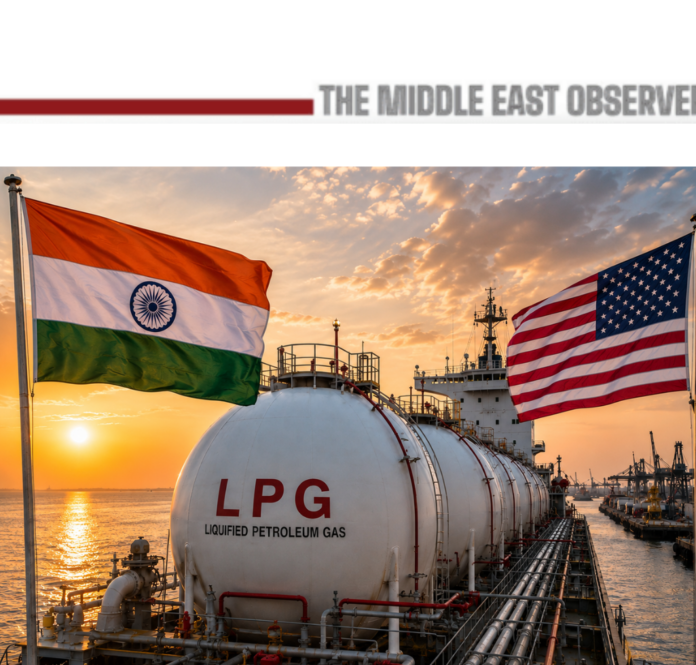
India plans to source up to one-quarter of its liquefied petroleum gas (LPG) imports from the United States in 2027, marking one of the country’s largest shifts in fuel procurement as New Delhi seeks to diversify supplies following severe disruptions to shipping through the Strait of Hormuz earlier this year.
According to Reuters, state-owned Indian Oil Corporation (IOC), Bharat Petroleum Corporation (BPCL) and Hindustan Petroleum Corporation (HPCL) are expected to issue tenders within the next one to two months for U.S. LPG supplies scheduled for delivery in 2027. A delegation from the three refiners is also expected to visit the United States to discuss long-term sourcing arrangements with American exporters. The procurement initiative follows military escalation involving Iran that disrupted Gulf shipping routes and forced India to invoke emergency measures, diverting petrochemical feedstocks from industry to households that rely on LPG as cooking fuel.
India, the world’s third-largest oil importer, purchased around 90% of its 21.85 million tonnes of LPG imports from the Middle East in 2025, while imports accounted for approximately 66% of domestic LPG consumption, according to government data. Reducing that dependence has become a strategic priority as policymakers seek to strengthen energy security and reduce exposure to geopolitical risks affecting one of the world’s most critical energy transit corridors.
The planned increase in U.S. purchases also supports a broader realignment in bilateral energy trade. India has pledged to raise energy imports from the United States by $10 billion, to around $25 billion, as both countries work towards a target of $500 billion in bilateral trade by 2030. Higher U.S. energy imports could also help narrow India’s trade surplus with Washington, an issue that has featured prominently in ongoing trade negotiations. At the same time, New Delhi has accelerated spot purchases from the United States and other suppliers to offset reduced Middle Eastern shipments. U.S. LPG imports exceeded 1 million tonnes in June for the first time and are expected to surpass India’s original 2026 annual contract target of 2.2 million tonnes, underscoring the growing role of U.S. supplies in India’s energy mix.
To support higher volumes of long-haul imports, Indian Oil is seeking stakes in Very Large Gas Carriers (VLGCs), marking the first time an Indian refiner has pursued ownership of LPG carriers. The investment would reduce reliance on chartered vessels, improve control over freight capacity and logistics, and provide greater flexibility for cargoes originating from the U.S. Gulf Coast.
The policy would strengthen the commercial position of U.S. Gulf Coast LPG exporters, whose expansion has been underpinned by abundant shale gas production and growing export infrastructure. It would also create additional opportunities for shipping companies, commodity traders and port operators serving trans-Pacific and Indian Ocean energy routes. While Middle Eastern producers are expected to remain India’s principal LPG suppliers, the strategy is likely to intensify competition among exporters for one of the world’s fastest-growing import markets while encouraging buyers to place greater emphasis on supply resilience alongside long-term pricing and freight economics.
Provisional government data show India’s LPG consumption declined about 8% year-on-year to 14.7 million tonnes during the first half of 2026, while imports fell approximately 28% to 7.5 million tonnes as Gulf supplies tightened. Industry expectations cited by Reuters indicate demand could recover to around 31 million tonnes in 2027, lifting LPG imports to roughly 20 million tonnes as supply conditions normalise and domestic consumption rebounds.
India’s diversification strategy has also been articulated as a long-term energy security policy. Junior Oil Minister Suresh Gopi told lawmakers that expanding the country’s supplier base is intended to “ensure supply security and mitigate risks arising from regional disruptions or geopolitical events.” If implemented, the procurement programme would represent one of India’s most significant shifts in LPG sourcing in recent years, with the potential to reshape procurement strategies across Asia as major importers increasingly balance energy security, commercial competitiveness and geopolitical risk.
Related news:
Strait of Hormuz Tensions Reshape Global Energy Markets
Energy Security Drives China’s Response to Gulf Oil Crisis
Read also:
How Gulf Energy Logistics Could Evolve After the Hormuz Crisis
How Gulf Energy Logistics Could Evolve After the Hormuz Crisis