Foreign institutions bought into Thursday’s decline, but domestic profit-taking and broad weakness across property, telecoms and construction pulled every major index lower
CAIRO — Egyptian equities ended the week under broad selling pressure on Thursday as domestic investors took profits, the pound weakened against the dollar and the market began adjusting to the reinstatement of stamp duty on listed securities.
The benchmark EGX30 declined 0.35% to close at 53,442.20 points, while selling spread to smaller companies following several sessions of pronounced mid-cap outperformance.
The EGX70 Equal Weight Index fell 1.03% to 18,233.32 points, and the broader EGX100 Equal Weight Index lost 0.91% to 24,035.88 points. The EGX33 Shariah Index dropped 0.73% to 6,012.67 points, while the lower-volatility EGX35-LV retreated 0.85% to 6,315.14 points.
Total market capitalization closed at approximately EGP3.937tn, down about EGP22bn from Wednesday.
Thursday’s decline differed from the divided trading that had characterised much of the week. Earlier sessions showed blue-chip consolidation alongside continued gains among small- and mid-cap shares. By the close, however, every principal index was lower, indicating that profit-taking had broadened beyond the EGX30.
Domestic Profit-Taking Drives the Retreat
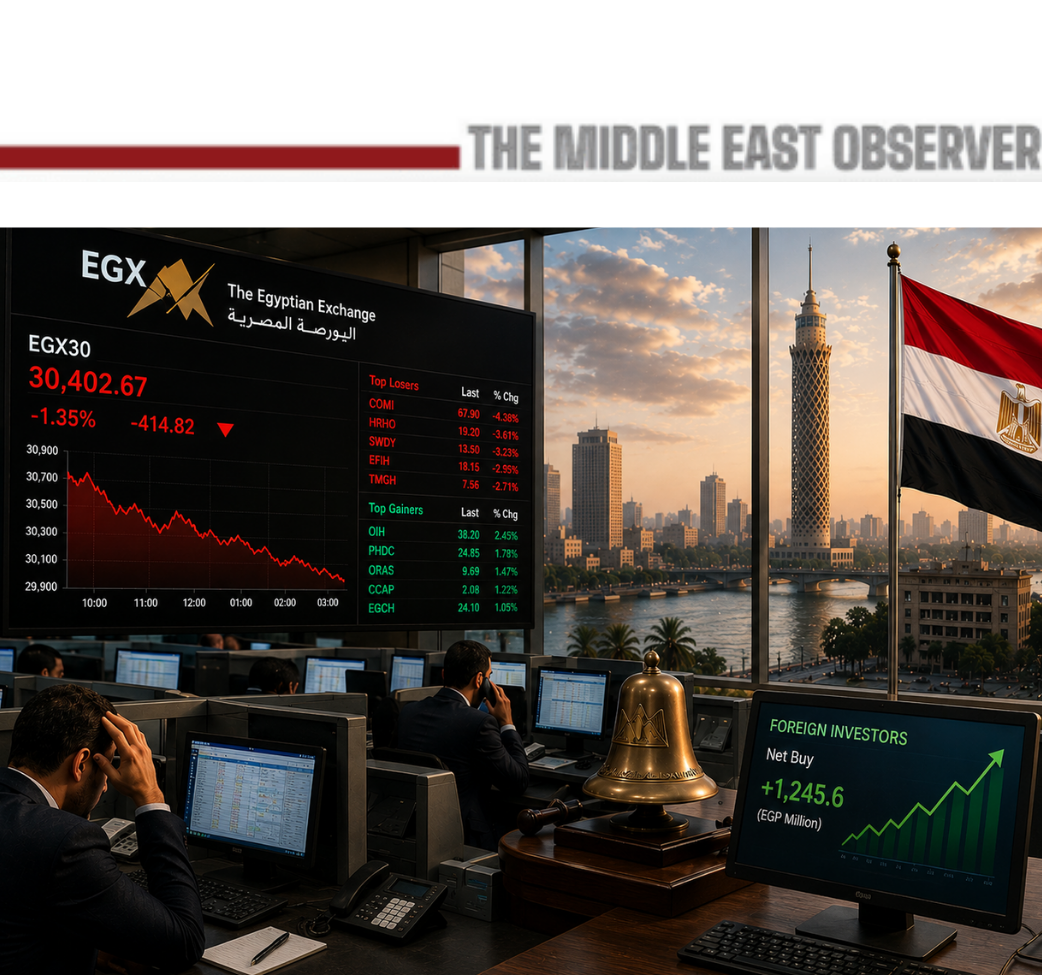
Regular-session trading data showed Egyptian investors were net sellers of approximately EGP275.7mn, while Arab investors recorded net purchases of about EGP45.5mn and non-Arab foreign investors bought a net EGP230.2mn.
The figures suggest that the decline was driven primarily by domestic profit-taking rather than a broad withdrawal of international capital.
Retail investors were net sellers, while institutions emerged as net buyers. Foreign institutions accounted for most overseas purchases, indicating that some professional investors used the market’s decline to increase exposure selectively.
Domestic investors continued to dominate trading activity, while retail participation remained the principal source of day-to-day liquidity. The net buying by institutions nevertheless offered a measure of support during a session marked by widespread selling.
Negative Breadth Confirms a Broad Pullback
Turnover remained above EGP11bn, indicating continued investor participation despite the decline.
Market breadth was decisively negative, with 171 stocks falling, compared with only 38 advancing and 12 closing unchanged. The figures confirm that selling pressure extended well beyond a handful of heavyweight constituents.
Telecommunications and information technology were among the weakest sectors, while property, construction materials and consumer shares also declined. Chemicals, fertilisers and refining companies provided limited support but were insufficient to reverse the market’s broader direction.
Among the more liquid shares, Alexandria Mineral Oils Company advanced about 7%, Abu Qir Fertilizers gained 2.4%, and Abu Dhabi Islamic Bank Egypt rose approximately 1.4%.
On the downside, Telecom Egypt lost about 3%, Beltone Holding fell 2.6%, and Heliopolis Housing declined 2.5%.
The exchange-wide gainers were led by GlaxoSmithKline Egypt, which rose by the daily limit of 20% to EGP239.76. Alexandria Flour Mills gained 19.99% to EGP184.78, while Catalyst Partners Middle East advanced 15.01% to EGP26.67.
These sharp gains were concentrated in a small number of companies and did little to offset the deterioration across the wider market.
Small-Caps Retain Their Weekly Advantage
Thursday’s reversal reduced, but did not eliminate, the week’s outperformance by smaller companies.
For the week, the EGX30 declined by approximately 0.9%, while the EGX70 still advanced by nearly 3%. The EGX100 gained about 1.9%, illustrating that investor interest in smaller and medium-sized companies remained intact despite Thursday’s broad-based sell-off.
The divergence suggests that investors continued to identify opportunities beyond the exchange’s largest constituents, particularly among companies offering stronger domestic earnings exposure or lower relative valuations.
The EGX30 nevertheless remained substantially higher for the year. By the end of July, the benchmark was approximately 27.8% above its level at the start of 2026, placing the week’s decline within a much stronger year-to-date advance.
Thursday’s retreat therefore represented consolidation after an extended rally rather than a decisive reversal of the market’s longer-term direction.
Stamp Duty Introduces a New Trading Cost
The week also brought a significant change to Egypt’s equity-tax framework.
Law No. 153 of 2026, published in the Official Gazette on 28 July, reinstated stamp duty on transactions in securities listed on the Egyptian Exchange from 29 July.
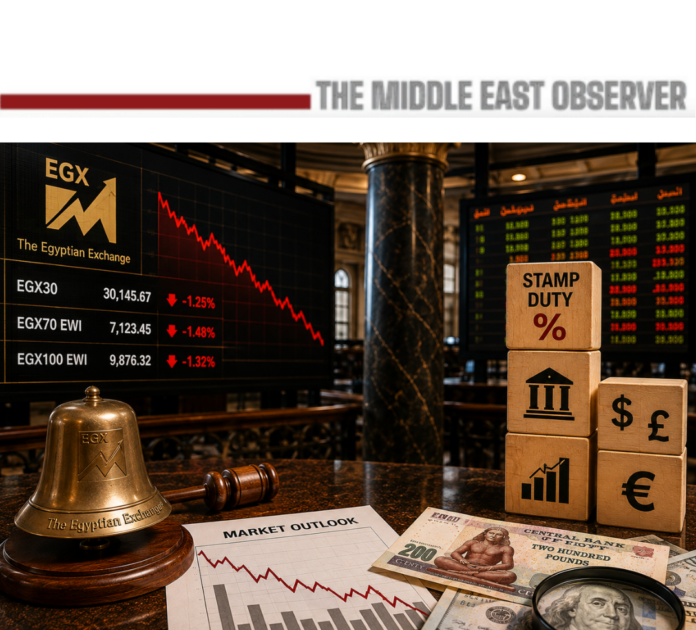
The levy is charged at 0.5 per thousand, equivalent to 0.05%, on each side of a standard transaction. Both the buyer and seller bear the charge, regardless of whether the transaction produces a profit.
Same-day transactions are subject to a reduced rate of 0.25 per thousand on each side. Listed investment-fund certificates and licensed market-making transactions are exempt.
The framework replaces the proposed capital-gains tax on listed securities with a simpler transaction-based charge. This offers greater administrative certainty because investors are no longer required to calculate taxable gains using individual purchase costs and selling prices.
However, stamp duty is payable on transaction value rather than investment profit. It could therefore have a greater effect on high-turnover strategies and frequent retail trading than on longer-term institutional portfolios.
The lower rate for intraday trades and the exemption for market makers appear designed to limit the potential impact on liquidity. Thursday’s relatively strong turnover suggests that the immediate effect was modest, although several weeks of trading data will be required before the market’s behavioural response can be assessed reliably.
Pound Weakness Complicates Foreign Returns
The Egyptian pound weakened against the dollar during Thursday’s session, with the Central Bank of Egypt reporting rates of approximately EGP51.09 for buying and EGP51.19 for selling, compared with levels close to EGP50.66 and EGP50.76 a day earlier.
Dollar interbank turnover reportedly increased to $2.25bn during the week from about $1.41bn in the preceding week, reflecting greater demand for foreign-currency liquidity amid more cautious regional portfolio positioning.
The higher interbank volume does not, by itself, demonstrate sustained capital flight. Thursday’s equity data showed foreign institutions purchasing Egyptian shares even as the currency weakened.
Nevertheless, exchange-rate performance remains central to the investment case for international funds. A weaker pound can reduce foreign investors’ dollar-denominated returns even when local equity prices rise.
IMF Approval Supports External Financing
The International Monetary Fund’s Executive Board completed Egypt’s seventh review under the Extended Fund Facility and its second review under the Resilience and Sustainability Facility on 30 July.
The decision made about $1.5bn available under the EFF and a further $272mn under the RSF, providing Egypt with approximately $1.8bn in additional financing.
The approval strengthens Egypt’s near-term external financing position and offers reassurance over the continuity of the country’s economic reform programme.
The Fund’s assessment nevertheless remained conditional. It called for continued fiscal discipline, tight monetary policy, exchange-rate flexibility and faster progress on state asset sales and private-sector participation.
For the stock market, the IMF decision provides an element of macroeconomic support, but its longer-term significance will depend on implementation. Investors will be watching whether Egypt accelerates its divestment programme, maintains a functioning foreign-exchange market and contains renewed inflationary pressure.
Institutional Participation Becomes the Key Test
Recent market research has emphasized that improving profitability among Egyptian companies and a gradual recovery in domestic activity remain supportive of equities.
Sustaining higher valuations, however, is likely to require more consistent institutional participation, stable currency conditions and continued progress on structural reform. A rally led primarily by domestic retail liquidity may remain vulnerable to abrupt profit-taking, particularly after the strong gains recorded earlier in the year.
Thursday’s combination of institutional buying and retail selling illustrates this tension. Professional investors appeared willing to add exposure during the decline, but the market’s negative breadth showed that confidence remained selective.
Outlook
July concluded with the Egyptian Exchange consolidating after one of its strongest year-to-date advances. Thursday’s decline reflected domestic profit-taking, weaker market breadth and currency pressure rather than a clear change in the market’s underlying direction.
Investors entering August are expected to focus on second-quarter corporate earnings, implementation of the revised stamp-duty framework, the pound’s response to regional risk and progress on the government’s state-owned enterprise listing programme.
The sustainability of foreign institutional participation will also be closely watched following Thursday’s purchases and the IMF’s approval of Egypt’s latest programme reviews.
Whether the rally resumes will depend on the market’s ability to convert elevated liquidity into broader institutional demand, supported by earnings growth, currency stability and credible execution of economic and capital-market reforms.
Related news:Market Modernisation Push Sends EGX Capitalisation Above EGP 3.29 Trillion
Alexandria Petroleum Upgrade Drives Egypt’s Refining and Export Growth
Read also:
EGX Rally Broadens as Foreign Buying Pushes Benchmark Above 52,500