
Broader market outperforms as investors assess capital-market reforms and state listing program
CAIRO — Egypt’s stock market regained momentum on Monday after a brief bout of profit-taking, with all major indices ending higher as renewed foreign buying and continued strength in smaller listed companies offset weakness in several heavyweight shares. The recovery reinforced a trend that has emerged throughout July, with investors increasingly broadening their focus beyond the benchmark index while monitoring the government’s capital-market reform agenda.
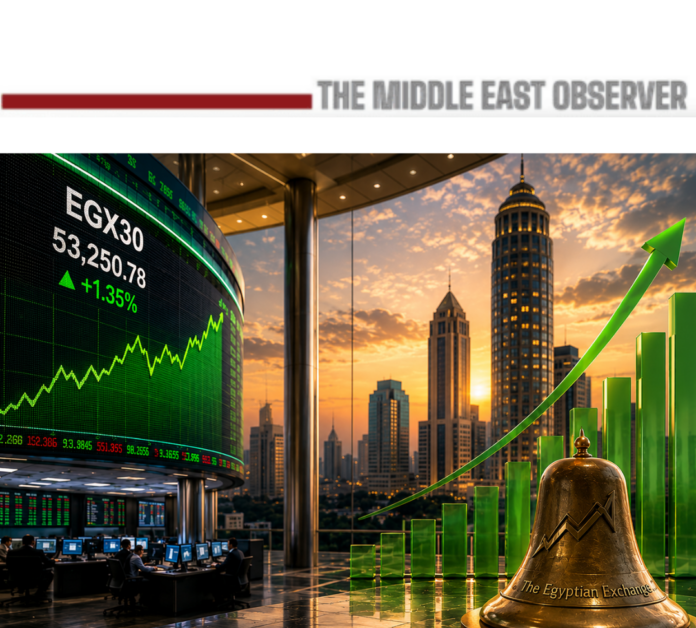
The EGX30 rose 0.40% to close at 53,633.92 points, recovering part of Sunday’s decline but remaining below the 54,000-point level reached earlier this month. The EGX70 Equal Weight Index climbed 1.51% to 18,124.84 points, while the EGX100 Equal Weight Index advanced 1.16% to 23,984.11 points. The EGX35-LV gained 0.34%, and the EGX33 Shariah Index added 0.29% to 6,047.31 points.
Market capitalisation increased by approximately EGP18bn to EGP3.95tn, reversing much of the previous session’s decline. Market breadth was also positive, with advancing shares comfortably outnumbering decliners, reinforcing that Monday’s gains extended beyond a limited group of blue-chip stocks.
Liquidity Improves Alongside the Market Recovery
Trading activity strengthened compared with Sunday’s session. Total turnover reached approximately EGP11.16bn across more than 242,000 transactions, accompanying the rebound in equity prices and indicating stronger participation across the market.
Retail investors accounted for around 80.6% of reported trading activity, while institutions represented approximately 19.4%, underscoring the continued importance of domestic individual investors in providing day-to-day market liquidity.
Official Egyptian Exchange nationality statistics showed non-Egyptian investors finishing the session as net buyers, while Egyptian investors were net sellers. Although overseas purchases represented a relatively modest proportion of total turnover, they indicated that foreign investors continued to participate selectively in Egyptian equities.
Stable Currency Provides a Supportive Backdrop
The Egyptian pound traded within a relatively narrow range against the US dollar during Monday’s session, with the Central Bank of Egypt’s reference rates standing at approximately EGP50.65 for buying and EGP50.79 for selling.
While exchange-rate stability was not the principal driver of the market’s advance, a more predictable currency environment remains an important consideration for international portfolio managers assessing returns on Egyptian financial assets alongside corporate earnings, domestic interest rates and macroeconomic conditions.
Small and Mid-Caps Continue to Lead the Market
The latest trading sessions have reinforced the divergence between the benchmark index and the broader market. While the EGX30 has largely consolidated its gains above 53,000 points following a strong rally earlier in July, the equal-weight indices have continued to post stronger percentage advances, pointing to broader participation across listed companies.
Among Monday’s strongest performers, GlaxoSmithKline Egypt and Alexandria Flour Mills both reached the exchange’s daily 20% price limit, while Aspire Capital Holding for Financial Investments advanced 14.65%.
Among actively traded large-cap shares, Abu Dhabi Islamic Bank Egypt rose 4.8%, while Rameda gained 3.7%. Arabia for Investment and Development, Industrial and Engineering Projects, and El Ahram Printing and Packaging recorded the session’s largest declines.
The mixed performance across individual shares suggests investors continued to differentiate between companies on the basis of earnings expectations, liquidity and company-specific fundamentals rather than pursuing broad-based buying across every sector.
State Listings and Market Reform Stay in Focus
Beyond the day’s trading, investors remained focused on Egypt’s efforts to deepen domestic capital markets through additional state-owned company listings.
The Financial Regulatory Authority (FRA) has launched a structured IPO-readiness programme covering corporate governance, disclosure standards, investor relations and listing requirements for temporarily listed state-owned enterprises. Temporary listing represents a preparatory regulatory stage rather than a public offering, with companies required to satisfy governance and disclosure obligations before proceeding to an IPO.
The government continues to target several state offerings over the coming year, subject to market conditions and regulatory approvals. Progress will ultimately be measured by the successful execution of transactions that broaden market liquidity, expand free float and attract long-term institutional investors.
The reform programme also extends beyond IPO preparation. Regulators are finalising the operational framework for securities borrowing and short selling, while recent tax amendments replacing capital-gains tax on listed securities with a proportional stamp-duty regime are intended to simplify the taxation framework for listed equities.
Weekly Perspective
Monday’s rebound largely offset the benchmark’s decline in the previous session while reinforcing the broader market’s stronger momentum.
Although the EGX30 has consolidated after its sharp advance earlier this month, the EGX70 and EGX100 have continued to outperform over recent sessions, suggesting investor interest has broadened beyond the exchange’s largest companies.
Analysts have noted that improving market breadth and a more active IPO pipeline could support trading activity over the medium term, although sustained institutional participation and stronger corporate earnings will remain essential for maintaining momentum.
Outlook
Attention now shifts to second-quarter earnings announcements, domestic monetary policy, exchange-rate developments and the implementation of Egypt’s capital-market reforms.
Monday’s rebound suggests investors remained willing to add equity exposure following the previous session’s profit-taking. Whether the market can build on recent gains will depend less on individual trading sessions than on earnings growth, macroeconomic stability, continued foreign participation and the successful execution of the government’s programme to expand and deepen Egypt’s capital markets.