

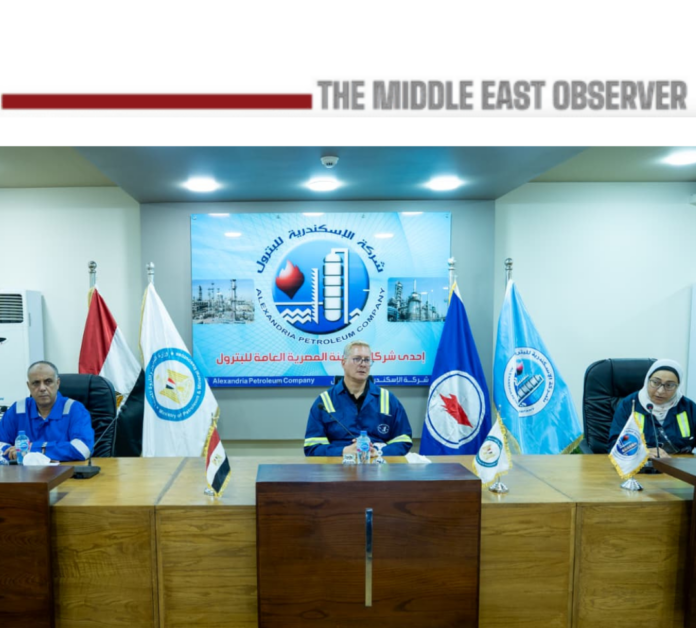
CAIRO — Egypt’s crude oil production has reached its highest level in almost two years, supported by stronger upstream investment, higher refinery utilisation and a broad modernisation programme that is reshaping the country’s downstream petroleum sector, Petroleum and Mineral Resources Minister Karim Badawi said during a visit to the Alexandria Petroleum Company refinery.
The increase in production follows the government’s efforts to restore investor confidence by settling outstanding payments to international oil companies, encouraging partners to accelerate exploration, field development and production activities. Higher domestic crude and condensate output has enabled larger volumes of locally produced and imported crude to be processed at Egyptian refineries, increasing value addition while strengthening domestic fuel supplies.
Badawi said refinery utilisation has risen to approximately 80% in 2026, reflecting improved crude availability and higher operating efficiency across the country’s refining network. The higher operating rates have supported increased production of gasoline, diesel and jet fuel, reducing reliance on imported refined products while creating larger exportable surpluses.
The stronger refining performance has translated into record petroleum-product exports. Egypt exported more than 2.3 million tonnes of refined petroleum products during the first half of 2026—matching the country’s total exports for the whole of 2025. Export revenues reached approximately US$2.3 billion between January and June, generated primarily from jet fuel, naphtha, waxes and vacuum distillates.
The minister said exports are expected to increase further to around 2.5 million tonnes during the second half of the year as refinery utilisation continues to improve and additional efficiency projects come on stream.
The export growth also reflects stronger regional demand for transportation fuels and Egypt’s improving refining yields following a series of plant modernisation projects. Analysts have noted that sustained aviation fuel demand and Mediterranean refining margins continue to support export opportunities for efficient regional refiners, although profitability remains sensitive to crude prices and global product demand.
According to the International Energy Agency (IEA), investment in refining capacity and operational efficiency remains increasingly important as energy-producing countries seek to maximise value from each barrel through higher-value petroleum products rather than exporting crude alone.
Egypt’s refining expansion has been driven by a series of modernisation projects overseen by the Egyptian General Petroleum Corporation (EGPC). Capacity enhancements have increased production across several major refineries, including Cairo Oil Refining Company’s Mostorod complex, where monthly gasoline production has risen by approximately 45,000 tonnes alongside an additional 40,000 tonnes of jet fuel.
Alexandria National Refining and Petrochemicals Company (ANRPC) is currently operating at more than 110% of its design capacity, while Amreya Petroleum Refining Company has increased monthly production of 92-octane gasoline by between 10,000 and 15,000 tonnes. Operating rates have also improved at the Middle East Oil Refinery (MIDOR), complemented by ongoing upgrades at Alexandria Petroleum Company’s lubricants complex.
Badawi said closer integration between Egypt’s refining companies has become a central pillar of the sector’s development strategy, allowing intermediate products to be transferred between facilities for conversion into higher-value finished products. The approach has expanded domestic production of base oils, waxes, Euro-specification diesel, aviation fuel and linear alkylbenzene (LAB), a key feedstock used in detergent manufacturing.
The ministry is also advancing a new pipeline of refinery modernisation projects valued at approximately US$4.5 billion, aimed at strengthening Egypt’s energy security, lowering import costs and improving the international competitiveness of Egyptian refined-product exports.
Alexandria Petroleum Modernisation Delivers Significant Savings
During his visit, the minister reviewed the rehabilitation of the lubricants complex at Alexandria Petroleum Company, one of Egypt’s oldest refineries, which has operated for nearly 75 years.
The locally executed project restored one of two boilers that had been operating for approximately 45 years, with the second nearing completion. The rehabilitation programme cost around EGP150 million, compared with an estimated replacement cost exceeding EGP2 billion for a new boiler.
The company estimates the project will reduce annual operating costs by approximately EGP30 million, while lowering natural gas consumption, extending equipment life and reducing carbon emissions. The modernisation programme has also restored production of several lubricant and wax grades, improved product quality and was completed with zero lost-time incidents, reflecting the sector’s emphasis on operational safety.
Badawi praised the engineering capabilities of Egyptian petroleum specialists, noting that the successful rehabilitation demonstrates growing domestic expertise in refinery maintenance and modernisation that could eventually be exported to regional markets as engineering services.
Alexandria Petroleum Company also increased production of asphalt and fuel oil during fiscal year 2025/26, while expanding output of intermediate feedstocks used in higher-value petroleum and petrochemical products, including LAB, high-octane gasoline components, lubricants, industrial waxes and solvents.
Petroleum products remain among Egypt’s leading merchandise exports and an increasingly important source of foreign currency. The latest refinery upgrades indicate the government is seeking to transform Egypt from primarily a producer of hydrocarbons into a more competitive regional refining and value-added energy hub. If sustained, higher refinery utilisation, greater Petroleum products and continued investment could strengthen Egypt’s position in Mediterranean fuel markets while reducing import dependence and improving export revenues.
Related news:Egypt Expands Nile Delta and Mediterranean Gas Plans with Harbour Energy and Eni
Egypt Plans $600mn Petroleum Logistics Zone on the Mediterranean
Read also: