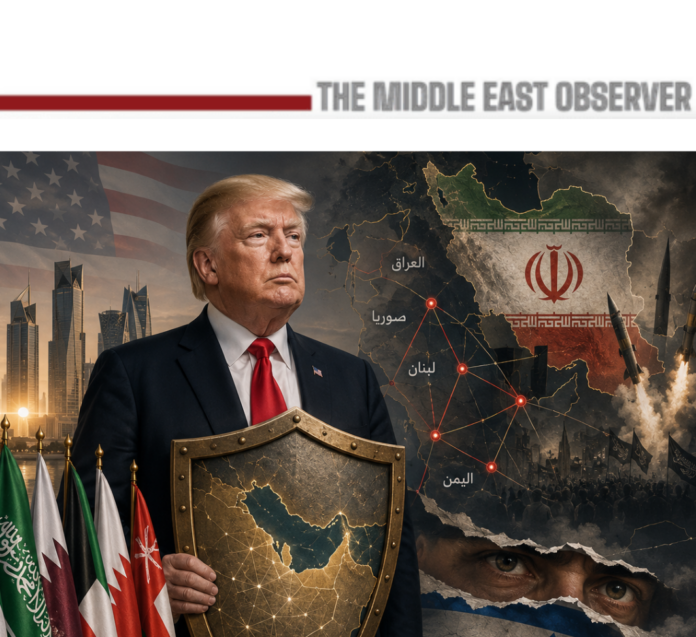
A week has passed since the resumption of mutual bombardment between the United States and Iran. President Trump has stated more than once that he would impose a 20% tariff on ships crossing the Strait of Hormuz, then backtracked and announced that he would replace that with an agreement with Gulf states for additional investments in the United States. Regardless of the fact that this is a type of piracy, the goal of the renewed bombardment seems two-fold: pressuring Tehran militarily and economically on one hand, and pressuring the Gulf allies financially on the other. To clarify this, we can ask some intuitive questions: Didn’t Trump realize that Iran would respond? Hasn’t Iran repeatedly declared that striking oil facilities would be met with the bombing of Gulf oil facilities, and that it is a bridge for a bridge, a power station for a power station, and a water station for a water station? Doesn’t this mean that Trump knows very well that his step would expose his Gulf allies to military pressures and that he wants to raise the ceiling of financial commitments for the Gulf in exchange for protection that he might end up doing nothing to achieve except refraining from bombing Iran?
Based on recent field and political developments, President Trump’s statements and actions can be viewed as an attempt to achieve multiple goals simultaneously, transcending a mere response to Iran’s provocations.
First: Financial demands in exchange for protection: President Trump explicitly stated his desire for Gulf states, such as Saudi Arabia, the UAE, and Qatar, to compensate the United States for the costs of “protecting” them and securing the Strait of Hormuz, even though had it not been for his intervention in Iran, there would have been no need to secure the strait. This puts the allies in a position of financial pressure, as they are asked to pay the price for protection that may not be fully guaranteed. From here, it seems that the US administration sees this crisis as an opportunity to redefine the “protection” relationship with its Gulf allies. By keeping the Iranian threat alive, and perhaps escalating it, Washington can pressure these wealthy countries to provide additional investments or financial compensations. This is very much like demanding an “indemnity” from the Gulf states in exchange for a security role that may not be at the required level to achieve comprehensive stability.
Second: Iranian deterrence and “red lines”: Iran, for its part, continues to wave a harsh response to any attack targeting its infrastructure. It has translated this threat into actions, expanding the scope of its attacks to include vital energy facilities in Saudi Arabia, the UAE, and Qatar, in response to the US strikes. This confirms that the Iranian threat to target “a bridge for a bridge, a power station for a power station” is an actual strategy aimed at raising the cost of war for the Gulf and America, aiming not only to force the United States to stop the bombardment but also to force it to reduce the density of its presence in the Gulf states.
The goal of the US pressure seems two-fold: pressuring Tehran militarily and economically on one hand, and pressuring the Gulf allies financially on the other. This policy pushes the Gulf countries to recalculate costs, as they find themselves forced to strengthen their defenses and try to maintain a safe distance from the conflict, while bearing increasing financial and security burdens. Trump’s backtracking on the idea of imposing a 20% tariff on ships crossing the strait after pressure from Gulf leaders, replacing it with a demand for “huge investments” in the United States in exchange for protection, reflects Washington’s desire to turn the crisis into direct economic gains, raising questions about the seriousness of its commitment to defending Gulf interests. It seems that the US administration is wagering that Iran will not bear the exorbitant cost of war, and that the Gulf states will be forced to pay to protect themselves, while the United States tries to avoid sliding into a costly ground war. But this wager may collapse with the continuation of direct Iranian attacks on the interests of Washington and its allies.
In contrast, it seems that Iran is moving forward with its deterrence strategy based on raising the cost of war for America and its allies in the Gulf. Iran has expanded its attacks to reach the vital infrastructure of neighboring countries hosting US bases. It announced the targeting of a power generation and water desalination plant in Kuwait, causing damage and disconnecting a large number of generation units. It also targeted US bases in Bahrain, Qatar, and Jordan, stressing that any US attack on its infrastructure would be met with “the crushing of all infrastructure in the region.” Likewise, Iran continues its threat to prevent the export of even a single drop of oil and gas from the region as long as the US “aggression” continues. It has targeted oil tankers belonging to Gulf states in the Strait of Hormuz, resulting in fatalities, and announced its control over navigation traffic therein away from US forces. Thereby, the Iranian leadership continues its escalatory discourse. It seems that it aims through it to transition from the strategy of strategic patience, which manifests in the ability to bear pressure despite incurring human and material losses as a result of the US bombardment that hit bridges, airports, and facilities, to a strategy of escalation to the brink of the abyss. In light of the current nuclear status, Iran is currently considered a threshold state, meaning it possesses the technical and technological capabilities to manufacture a nuclear weapon, but it has not taken the final political decision to do so. This status grants it leverage without bearing the consequences of openly possessing the weapon. In contrast to that, Russia and China are leading intensive diplomatic efforts, through what is called the “Vienna Trio,” aimed at preventing any military attack on Iran and resolving the nuclear file politically. This coordination reflects their strategic interests in the stability of the region and the protection of their investments, especially after they contributed to shaping Iran’s negotiating position and supported it materially during the war, granting them leverage in any future settlement. Consequently, any unilateral US step, especially nuclear, will face fierce opposition from Moscow and Beijing and could lead to international consequences with untoward outcomes.
In light of this diplomatic deadlock and the collapse of temporary understandings, “field miscalculation” (such as heavy US casualties or an uncalculated reaction) remains the spark that could turn the current war of attrition into a comprehensive regional conflagration that cannot be controlled.
The problem that the West does not realize is that while defeat for the US administration is measured by the collapse of the currency, the destruction of bridges, the paralysis of ports, and public pressure, the political and religious doctrine of the Iranian regime (derived from the literature of the revolution and the formula of “the duty of the oppressed to confront the arrogant”) considers surrender to be the only absolute defeat. The governing principle in this doctrine is that victory is not a material inevitability; rather, victory is steadfastness on the principle and confronting the “Great Satan.” Death in this confrontation is not a “human loss” since “martyrdom” grants the moral and historical legitimacy to the project. This thinking makes it very difficult to deter the other side by threatening material destruction only. The real problem here is the “cultural and ideological blindness” of the United States. Where Washington believes that raising the cost of war will eventually force Tehran to sit at the negotiating table to save what can be saved. But in reality, the more the US military and material pressure increases, the more the internal Iranian narrative is fed, and the political conflict turns into a “holy existential battle” that justifies all economic suffering to the home front, and the more diplomatic maneuvering margins vanish, because any concession under bombardment and siege will be interpreted within the Revolutionary Guard and governing institutions as “heresy” against the principles and a shameful retreat, which threatens the legitimacy of the regime from within more than it is threatened by US missiles.
In this context, the Iranian threat to close the Strait of Hormuz emerges as a full-fledged economic “Samson Option”; Tehran is not merely waving a card to cut off Gulf oil revenues here, but is holding the fuse of an “economic nuclear bomb” capable of exploding energy markets and global supply chains in moments. This scenario represents the fatal weak point in Trump’s pragmatic calculations; while the US President is wagering on milking the crisis financially, any crazy jump in oil prices as a result of closing the strait will immediately translate into a fierce global inflationary wave that hits the US domestic front and aborts his electoral promises to maintain economic stability. Here precisely, the magic turns on the magician, and the US naval blockade transforms from a tool to strangle Iran into a spark that might burn the economic achievement upon which Trump builds his political legitimacy.
The conclusion is that America is fighting to obtain a “negotiating concession” or a “better deal,” while the Iranian side views the battle from the perspective of “truth and falsehood,” “disbelief and faith.” And when the extreme commercial pragmatic mindset meets an ideological doctrine that does not see death as a defeat, miscalculation becomes inevitable, and diplomatic solutions become almost impossible because the two sides do not speak the same political language at all.
In contrast, we notice that Israel, despite declaring that it is in a state of readiness to participate in the attack, prefers to wait and reap the profits without being exposed again to destructive Iranian missiles. The Israeli government, in short, wants “to fight until the last American soldier.”
For Israel, the ideal outcome has already been achieved, as expressed by an Israeli media figure. The United States has engaged with its full military weight and is launching continuous raids to strike the infrastructure and logistics of the Revolutionary Guard. Israel sees that destroying Iranian capabilities through US bombers achieves its strategic goal of destroying the “snake’s head” without having to pay the political, military, or economic bill directly from its own pocket. The Israeli leadership is fully aware of the scale of destruction caused by Iranian ballistic missiles in previous rounds, and realizes that the Israeli domestic front, its economy, and its vital facilities cannot bear another wide round of escalation at this particular time. Consequently, stepping back and leaving Washington in the forefront protects the Israeli depth from a direct and severe Iranian retaliation. While Iran is busy confronting the “complete blockade” and the intensive US bombardment, Israel exploits this margin to carry out focused military operations in the close and surrounding fronts (such as Gaza and Lebanon), where it seeks to end and dismantle what remains of the capabilities of Hezbollah and Hamas, benefiting from the lack of direct support and reinforcement coming from Tehran, which is busy with the “battle for survival” against Washington.
Likewise, the Israeli waiting provides Tel Aviv with a political pressure card; it appears as the “disciplined partner” that listens to the US request not to expand the war unilaterally, and in return, it pockets the price of this discipline in the form of full US diplomatic cover for its operations in Gaza and Lebanon, and continuous flows of qualitative military aid to compensate for its depleted stockpiles of air defenses (such as Arrow, David’s Sling, and the Iron Dome). Israel is currently practicing a strategy of “opportunistic waiting”; it has pushed the United States into the direct wrestling ring with Iran, and is now sitting in the spectator seats watching the attrition of both sides, ready to intervene only at the “last moment” to impose its conditions on the table or deliver a final swift strike if the opportunity of the Iranian regime’s collapse looms, while ensuring its cities are neutralized from the current Iranian bank of targets, which focuses entirely on US bases and the interests of Washington’s allies in the Gulf.
Strait of Hormuz Tensions Reshape Global Energy Markets
US Dollar Prices Reflect Local Liquidity Pressures Amid Global Strength