Foreign investors returned as net buyers of Egyptian equities on Thursday, helping the Egyptian Exchange end the week higher despite continued selling pressure in the country’s local government-debt market. The divergence pointed to increasingly selective international positioning towards Egyptian assets, with investors distinguishing between company-specific earnings prospects and the currency, interest-rate and geopolitical risks attached to sovereign fixed income.
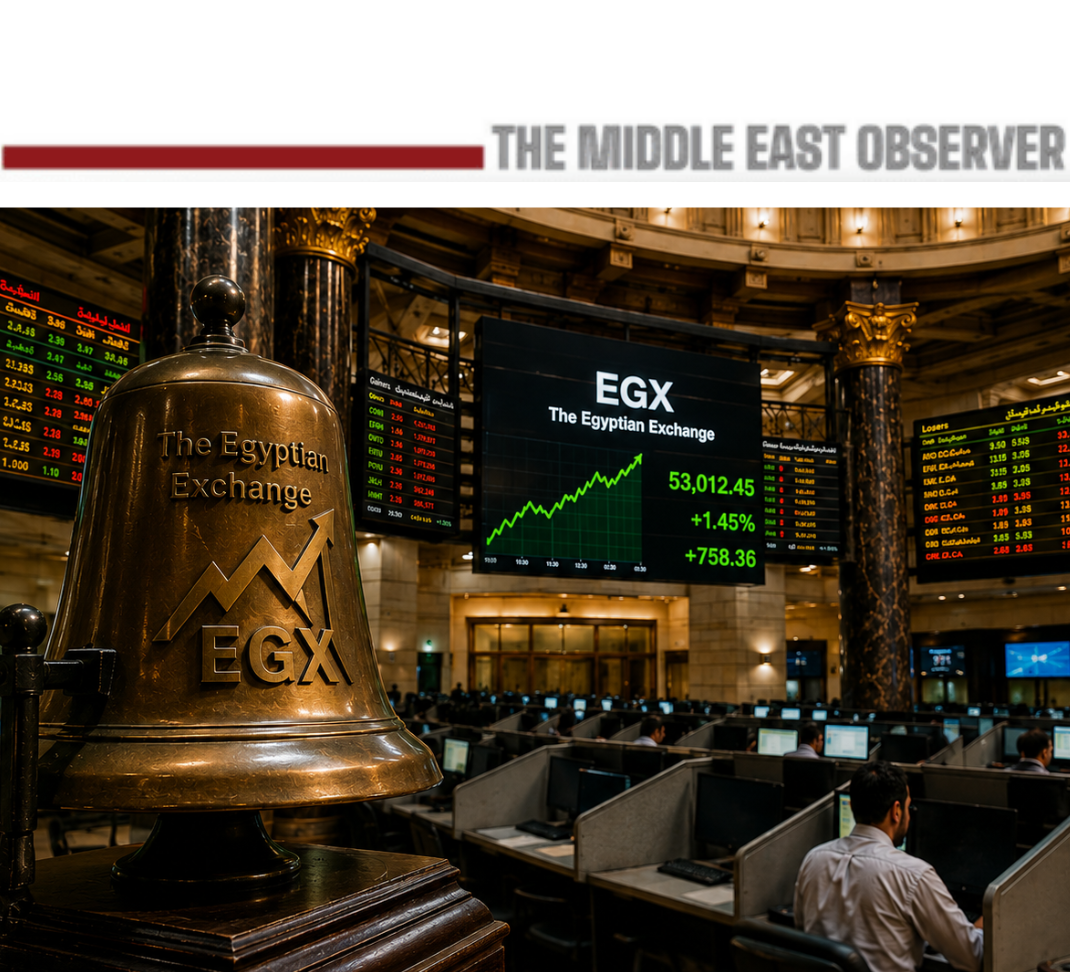
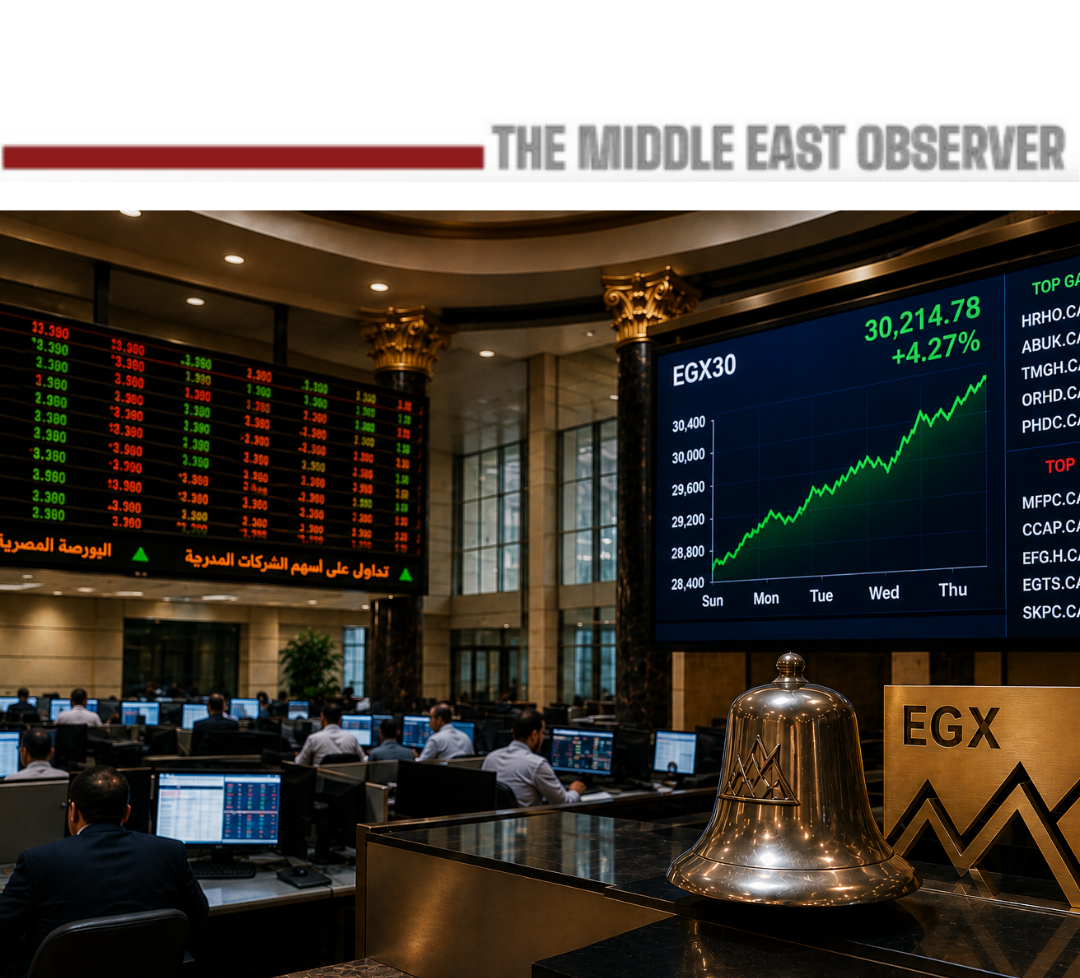
The benchmark EGX30 rose 0.70% in the final session of the week to close at 52,928.06 points. The EGX33 Shariah Index gained 0.54% to 5,950.19, while the lower-volatility EGX35-LV advanced 0.53% to 6,226.11.
The strongest gains came outside the blue-chip benchmark. The EGX70 Equal Weight Index, which provides greater exposure to small- and mid-cap companies, climbed 1.54% to 17,049.97, while the broader EGX100 Equal Weight Index added 1.24% to 22,887.36. All five principal indices finished Thursday higher.
Listed companies added approximately EGP22bn in market capitalisation during the session, taking the total to EGP3.887tn. Compared with the previous Thursday, the market gained about EGP75.4bn over the week.
Foreign Buying Supports the Final Session
Foreign investors recorded net equity purchases of approximately EGP414mn on Thursday, while Arab investors were net sellers by about EGP 262.4mn and Egyptian investors recorded net sales of roughly EGP151.6mn.
The figures reconcile across the three investor groups and provide a more reliable account of equity-market positioning than the substantially larger values published in some market summaries, which appear to include government securities or other exchange transactions rather than listed-share activity alone.
Foreign purchases were therefore the main net-flow support during the session, although Egyptian investors continued to account for the majority of gross trading activity.
The distinction is important. A relatively small foreign share of overall turnover can still generate a meaningful net inflow when purchases exceed sales, while domestic participants may dominate total activity but finish the session as net sellers.
More broadly, the contrast between foreign buying in equities and recent selling of Egyptian Treasury securities suggests that international investors are differentiating more sharply between asset classes. Equity investors can target individual companies with improving earnings, foreign-currency revenues or sector-specific growth prospects. Fixed-income investors remain more directly exposed to exchange-rate movements, monetary-policy expectations and regional geopolitical risk.
Broad Participation Extends Beyond Blue Chips
Published session statistics showed approximately 129 advancing shares, compared with 77 decliners and 15 unchanged stocks. The positive breadth indicated that gains extended beyond a limited number of heavyweight EGX30 constituents.
Ordinary equity turnover was reported at about EGP7.8bn, while broader exchange activity was higher once negotiated and other transactions were included. Approximately 2.2bn shares changed hands through about 163,000 transactions across 220 companies.
The breadth of the advance was reflected more clearly in the performance of the equal-weighted indices than in the EGX30 alone.
Measured from the close on Thursday, July 9:
- The EGX30 gained approximately 1.18% over the week.
- The EGX70 advanced about 4.72%.
- The EGX100 rose approximately 3.71%.
The EGX70’s rise was roughly four times that of the blue-chip benchmark, showing that small- and mid-cap shares drove a significant share of the week’s performance. The EGX100’s outperformance provided further evidence that the rally was broadly distributed.
This does not necessarily imply uniform strength across all sectors. Equal-weighted indices can advance rapidly when a large number of smaller constituents rise, even when the largest listed companies deliver more moderate gains.
Healthcare Shares Highlight Selective Trading
Among Thursday’s leading gainers, Delta for Printing and Packaging rose by the daily limit of 20% to EGP 242.40, while GlaxoSmithKline Egypt advanced 19.99% to EGP 105.70. Nozha International Hospital gained 13% to close at EGP 21.56.
The largest decline was recorded by Alexandria New Medical Center, which fell 16.20% to EGP118.50. The drop followed several sessions of unusually strong gains and was consistent with profit-taking, although no company-specific catalyst for Thursday’s decline was identified in the reports reviewed.
Egyptian Real Estate Group declined 4.88% to EGP1.56, while Catalyst Partners Middle East lost 4.28% to EGP17.43.
Healthcare companies consequently featured among both the session’s strongest gainers and its largest decliner. The pattern suggested that investors were responding to individual corporate stories rather than rotating uniformly into or out of the sector.
Company Results Underscore Earnings Divergence
Corporate disclosures released around the end of the week presented a mixed picture, reinforcing the increasingly company-specific nature of valuation across the Egyptian market.
Qalaa’s Loss Reflects Provisioning More Than Operations
Qalaa Holdings reported a consolidated net loss after minority interests of EGP1.2bn in 2025, compared with a profit of EGP6.4bn in the previous year.
Revenue declined to EGP 135.5bn, partly reflecting a planned 32-day maintenance shutdown at the Egyptian Refining Company during the second quarter. Group earnings before interest, tax, depreciation and amortisation remained broadly stable at EGP 21.7bn.
The shutdown affected revenue and operating performance but was not the principal cause of the consolidated loss. Qalaa said the bottom line was mainly affected by an EGP2.168bn interest provision connected with debt-settlement and restructuring agreements with local banks.
The company said the provision could be reversed once the relevant agreement conditions are completed. Excluding it, Qalaa estimated that pro-forma consolidated net income after minority interests would have reached approximately EGP918.8mn.
The distinction is material. The reported loss was heavily influenced by an accounting provision, while underlying operating performance was more stable than the headline net result initially suggested.
Taaleem’s Revenue Growth Fails to Lift Net Profit
Taaleem Management Services reported a 9.4% decline in net profit after minority interests during the first nine months of its 2025/26 financial year, to EGP 736.8mn from EGP813.5mn.
Revenue nevertheless rose to approximately EGP2.41bn, from EGP1.8bn in the corresponding period, while gross profit increased to EGP1.8bn from EGP1.37bn.
The divergence between revenue and net income indicates that higher operating, financing, tax or other below-the-line costs absorbed part of the company’s top-line growth. A definitive explanation would require examination of the full financial statements rather than revenue and gross-profit figures alone.
Maridive Delivers Profit and Margin Growth
Maridive and Oil Services reported the strongest result of the three companies. First-quarter net profit increased 29% to US$23.24mn, while revenue rose 10% to US$66.31mn.
Gross profit increased by approximately 16% to US$33.95mn, lifting the gross margin to about 51%, from roughly 48% a year earlier. The result pointed to improved operating efficiency, as profit growth outpaced the increase in revenue.
Collectively, the disclosures reinforced an increasingly important market theme. Investors are likely to focus less on broad macroeconomic narratives and more on earnings quality, leverage, cash generation and balance-sheet resilience as the reporting season develops.
Maridive demonstrated improving profitability, Taaleem delivered strong revenue growth but weaker net income, and Qalaa’s reported loss was driven largely by restructuring-related provisioning rather than a comparable deterioration in operating earnings.
Debt-Market Outflows Present a Contrasting Signal
The divergence between equity and fixed-income flows was one of the week’s defining market features.
Arab and foreign investors reportedly recorded approximately US$1.46bn in net sales in the secondary market for Egyptian government debt during the preceding week, as geopolitical tensions in the Middle East prompted renewed caution towards local-currency Treasury securities.
At the same time, interbank foreign-exchange transactions declined by about 4% to US$1.79bn, although the reported volume remained above the typical weekly range of approximately US$750mn to US$1.2bn.
These movements illustrate why foreign portfolio flows should not be treated as a single measure of investor sentiment. Government-debt holders are particularly sensitive to currency depreciation, real interest rates, policy expectations and the ease with which positions can be unwound. Equity investors can instead select companies with pricing power, foreign-currency income or stronger earnings visibility.
The Egyptian pound ended Thursday at EGP50.47 to the dollar for buying and EGP50.61 for selling at the Central Bank, recovering by about four piastres at the end of the week. It nevertheless remained approximately 3.3% weaker than at the beginning of July, indicating that the late-week improvement was a limited correction rather than a reversal of the broader monthly depreciation.
A Broader Rally, but Not a Uniform One
The week produced three clear market signals.
First, gains broadened decisively beyond the EGX30. The EGX70 and EGX100 substantially outperformed the benchmark, while advancing shares comfortably exceeded decliners in the final session.
Second, foreign investors returned as net equity buyers despite recent selling in local government debt. The contrast suggests tactical differentiation between Egyptian asset classes rather than a uniform positive or negative view of the market.
Third, corporate results highlighted the growing importance of company-level fundamentals. Profit growth at Maridive, margin pressure at Taaleem and provision-driven losses at Qalaa presented markedly different investment cases despite being reported against the same domestic macroeconomic backdrop.
The week’s performance therefore suggested that equity investors remained focused on individual earnings and balance-sheet conditions despite continuing geopolitical uncertainty and volatility in portfolio flows.
Outlook
The coming weeks will test whether the market’s recent advance can be sustained as corporate reporting broadens across banks, property developers, industrial companies and consumer businesses.
Investors will examine the effects of financing costs, exchange-rate movements and domestic demand on margins and cash generation. Companies with foreign-currency revenue, manageable leverage and the ability to pass higher costs to customers are likely to remain better placed than highly indebted or import-dependent businesses.
Attention will also remain on inflation, Central Bank policy signals, the government’s listing programme and the direction of foreign portfolio investment. Continued equity inflows would provide additional market support, while renewed debt-market selling or further pressure on the pound could affect valuation assumptions and foreign investor returns.
The EGX ended the week with gains across all principal indices, positive market breadth and clear small- and mid-cap outperformance. Yet the mixed earnings picture and continuing currency and fixed-income risks indicate that investor confidence remains differentiated rather than broad-based.
As the reporting season progresses, earnings quality, balance-sheet resilience and sector-specific fundamentals are likely to play a greater role in determining returns than the direction of the benchmark alone.
Related news:
Domestic Buying Broadens Market Gains as EGX30 Pauses After Rally
Kuwait Launches 15-Year Residency Programme to Attract Foreign Investment
Read also:
Cultivated Wheat Area Jumps by 600,000 Feddans in 2025/2026 Season
Parliament Seeks Stronger Institutional Role for National Investment Bank