
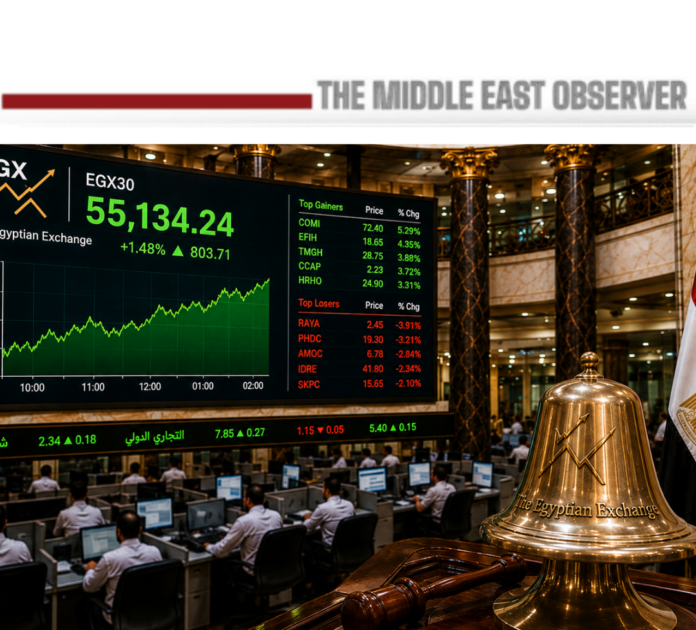
Egyptian stocks extended their rebound on Wednesday, pushing the EGX30 towards record territory despite heightened regional risk and a weakening pound. The performance offers early evidence that Egypt’s equity market may be becoming better able to absorb external shocks — but shifts in sovereign-debt positioning and uneven market breadth show that resilience is not yet immunity.
The EGX30 rose 0.45% on September 2 to 55,679.72 points, following Tuesday’s 1.03% advance. It reached an intraday high of 55,743.18, leaving the benchmark close to its 52-week peak of 56,101.69.
Market capitalization increased by about EGP27bn to EGP 4.380 tn. The broader market was less convincing: EGX100 edged up 0.03%, while EGX70 fell 0.44% to 21,225.15, partly reversing Tuesday’s 2.03% rebound.
The divergence suggests the rally is becoming more selective as it approaches record territory.
EGX Shows Early Signs of Greater Shock Absorption
Wednesday’s advance matters more in the context of heightened regional risk.
For Egypt, the important signal is not simply that the EGX30 gained 0.45%, but that investors did not respond to the latest geopolitical uncertainty with a broad liquidation of Egyptian equities.
Instead, buying remained concentrated in parts of the large-cap market. Banks rose 1.76%, industrial goods and services gained 1.06% and basic resources advanced 0.99%, while healthcare and pharmaceuticals declined 0.78%.
That sector differentiation is potentially constructive.
A market in which investors discriminate between companies according to earnings exposure, pricing power and macroeconomic sensitivity can prove more durable than one driven almost entirely by indiscriminate liquidity.
There is also a structural explanation for some of the EGX’s shock absorption.
Egyptian investors accounted for 90.3% of Wednesday’s listed-equity trading, compared with 7.21% for foreigners and 2.49% for Arab investors. Individuals represented almost 78% of transactions.
That large domestic liquidity base can reduce the immediate transmission of changes in international risk appetite into share prices.
But it carries an important qualification: domestic dominance is not the same as institutional depth. A market sustained primarily by local investors still needs stronger and more persistent foreign participation to achieve a durable international re-rating.
The Week Has Turned Positive
The week’s progression reinforces the resilience argument — cautiously.
EGX30 fell 0.31% on Sunday and 0.13% on Monday, before rebounding 1.03% on Tuesday and another 0.45% on Wednesday. From the previous week’s August 26 close, the benchmark has gained about 1%.
Market capitalisation has increased by roughly EGP98bn over the same period to EGP 4.380 tn.
More importantly, the market absorbed the early-week weakness quickly rather than allowing it to develop into a deeper correction.
But breadth remains the qualification.
EGX70 surrendered part of Tuesday’s recovery on Wednesday and remains slightly below its August 26 level. The benchmark is therefore advancing faster than smaller companies are confirming the move.
That makes market breadth a more important test of the rally’s quality than another EGX30 record alone.
August nevertheless provides a stronger underlying foundation: gains during the month extended well beyond the largest benchmark stocks, leaving Wednesday’s small-cap decline as something to monitor rather than evidence that the broader rally has broken.
Foreign Equity Buying Returns — but Remains Modest
Wednesday’s investor flows also require careful classification.
The large EGP14bn-scale foreign-selling figure reported in some market data should not be interpreted as ordinary listed-equity selling.
Detailed listed-share data instead show foreign investors as net buyers of about EGP194.6mn, driven largely by foreign institutions, which bought roughly EGP 196.6mn. Egyptian investors recorded net selling of approximately EGP174.1mn and Arab investors about EGP20.5mn.
That follows foreign net equity buying on Tuesday and is therefore direction ally encouraging.
But the scale remains modest relative to domestic activity.
Two positive sessions do not establish a structural return of foreign capital to Egyptian equities. Sustained institutional buying over several weeks would provide much stronger confirmation.
The Bigger Foreign Move Was in Government Debt
The sovereign-debt market delivered a more consequential signal.
Foreign and Arab investors recorded a combined net selling of about $270.8mn in secondary-market government securities on Wednesday. But the headline outflow masks an important split by maturity.
Foreign and Arab investors were actually net buyers of $287.9mn of Treasury bills, with foreigners alone purchasing a net $280.4mn.
The selling was concentrated in longer-duration Treasury bonds, where foreign investors recorded approximately $558.8mn of net sales.
That is a materially different signal from a wholesale exit from Egyptian sovereign debt.
It suggests investors remained willing to capture Egypt’s high short-term yields while reducing exposure further along the maturity curve.
Such positioning can be consistent with increased sensitivity to duration, future interest rates, currency risk and geopolitical uncertainty.
For investors assessing Egypt’s resilience, the distinction matters: foreign capital has not abandoned Egyptian yield, but it appears increasingly selective about how long it is prepared to remain exposed.
The Pound Shows Where Pressure Remains
The currency provides the clearest reason not to overstate the resilience argument.
The dollar reached EGP51.0414 for buying and EGP 51.1808 for selling at the Central Bank of Egypt on Wednesday, up from about EGP50.87/50.97 a day earlier.
Wednesday’s price action therefore suggests that part of the adjustment to changing risk conditions may be appearing through portfolio positioning and the exchange rate rather than immediately through a broad equity sell-off.
That distinction matters for stocks.
A rising EGX in Egyptian pounds does not necessarily generate equivalent hard-currency returns for international investors when the pound is weakening. At company level, depreciation can favour exporters and businesses with foreign-currency revenues while pressuring import-dependent companies and borrowers carrying foreign-currency liabilities.
Currency exposure is therefore increasingly becoming a stock-selection factor rather than merely a macroeconomic backdrop.
High Rates Are Both Cushion and Constraint
Interest rates add another layer to the picture.
The CBE’s overnight deposit rate remains 19%, with the lending rate at 20%.
Those yields help explain continued foreign appetite for short-term government paper and can support banking-sector profitability.
But they also raise the hurdle for equities.
As the EGX approaches record territory, companies increasingly need to generate earnings growth sufficient to compensate investors for taking equity risk when relatively high returns remain available in fixed income.
That puts greater emphasis on earnings quality, balance-sheet strength, pricing power and the currency composition of revenues.
This is where Wednesday’s sector differentiation becomes relevant. The next stage of the rally is likely to depend less on broad liquidity and increasingly on which companies can deliver real earnings growth against high financing costs and currency volatility.
Resilience Is Emerging — Not Yet Proven
Wednesday strengthens the argument that Egyptian equities are becoming better able to absorb regional and external shocks.
The market recovered rapidly from its weak start to the week. The EGX30 is again approaching record territory. Domestic investors provide a large liquidity base, while foreign institutions return as modest equity buyers.
But the vulnerabilities are equally visible.
The pound has weakened beyond EGP51 to the dollar. Foreign investors sharply reduced longer-duration sovereign exposure. And smaller stocks failed to confirm Wednesday’s EGX30 advance.
The distinction is therefore between resilience and immunity.
Egyptian equities appear increasingly capable of absorbing a shock without immediately translating it into a broad market sell-off. But the pressure can still emerge elsewhere — through the currency, sovereign-debt positioning and greater differentiation between companies.
Three tests now matter more than another index record:
whether market breadth again confirms the EGX30; whether foreign equity buying becomes sustained rather than episodic; and whether corporate earnings can justify valuations against high domestic yields and currency risk.
Egypt has already demonstrated its ability to attract international capital into high-yielding short-term government debt. Its equity market has shown that domestic investors can sustain a powerful rally.
The harder test is bringing those two stories together.
Another EGX30 record would attract attention. Evidence that international investors are prepared to extend their Egypt exposure beyond short-term sovereign yield into longer-duration assets and listed companies would be considerably more important.
Related news:
Treasury bonds to reach hiked records by end of this year
Bitcoin Slides Toward $65,000 as Trade Policy Uncertainty Jolts Risk Assets
Red also:
Dubai Enables Secondary Trading of Tokenised Property in Market First
Foreign Buying Lifts EGX as Blue Chips Rejoin Broader Advance