EGX70 gains 2.6% and turnover remains above EGP15bn as broader indices outperform despite mixed foreign flows
CAIRO — Egyptian equities advanced across all principal indices on Tuesday as renewed domestic buying lifted the benchmark and extended the strong performance of small- and mid-cap shares, reinforcing a market trend that has characterised the opening sessions of August.
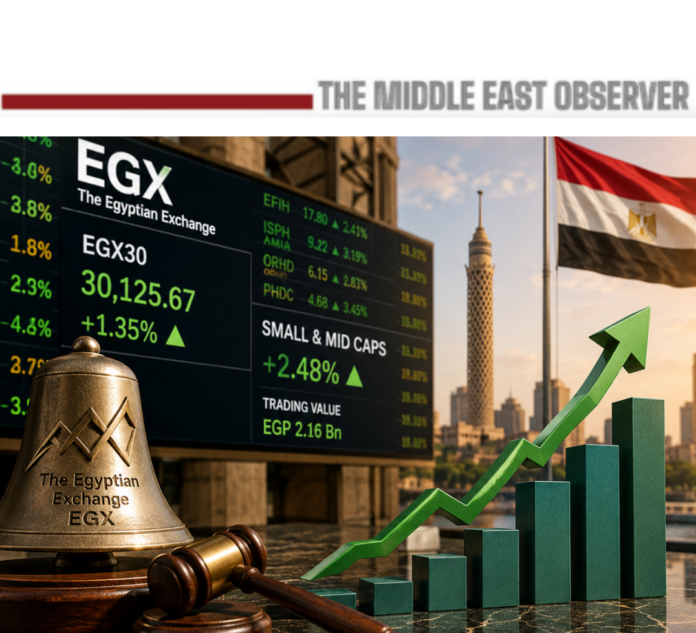
The EGX30 gained 0.75% to close at 54,501.70 points, recovering from Monday’s modest decline. The EGX33 Shariah Index rose 1.57% to 6,260.84 points, while the EGX35-LV advanced 0.84% to 6,623.75 points.
Smaller companies again outperformed. The EGX70 Equal Weight Index climbed 2.61% to 19,796.97 points, more than three times the benchmark’s gain, while the EGX100 Equal Weight Index added 2.17% to 25,825.06 points. Market capitalization increased by nearly EGP52bn to EGP 4.074 tn.
Market participation remained healthy. Listed-equity turnover stayed above EGP15bn for a second consecutive session, with nearly 340,000 transactions executed during the day. Market breadth was positive, with 109 advancing shares, 94 decliners and 18 unchanged, indicating that buying extended beyond a narrow group of large-cap companies.
Broader Market Continues to Outperform
Tuesday reinforced the divergence that has emerged between Egypt’s benchmark index and its equal-weighted counterparts.
Compared with the close of the previous trading week, the EGX30 has gained around 2%, while the EGX70 has advanced approximately 8.6% and the EGX100 around 7.4%. The EGP35-LV has risen by almost 5%, reflecting sustained demand across a broader segment of listed companies.
The disparity reflects the concentrated nature of the EGX30. Investment and Foreign Trade Minister Mohamed Farid has noted that only a handful of companies account for roughly half of the benchmark’s weighting, making its performance heavily influenced by a small number of large constituents.
Equal-weighted indices, by contrast, provide a clearer indication of overall market participation. Their continued outperformance suggests that investors remain willing to increase exposure beyond the exchange’s largest stocks, although Tuesday’s breadth figures also indicate that buying has become increasingly selective rather than indiscriminate.
Domestic Investors Continue to Underpin Trading
Regular-session trading data showed Egyptian investors as modest net buyers, while Arab and non-Arab foreign investors recorded limited net sales.
This differs from deal-inclusive transaction statistics carried by some market reports, which showed substantially larger foreign purchases resulting from negotiated transactions. Those figures should not be interpreted as reflecting ordinary secondary-market sentiment.
Domestic investors continued to account for the overwhelming majority of listed-equity trading, underlining the importance of local liquidity in sustaining the market’s recent advance.
Although non-Arab foreign investors were modest net sellers during Tuesday’s regular session, the broader monthly picture remained more constructive. Foreign investors were net buyers of approximately EGP1.4bn in listed equities during July after recording net sales in the second quarter, suggesting that overseas appetite has begun to improve, although one positive month is not sufficient to establish a lasting trend. Banking shares accounted for the largest share of foreign institutional buying during July.
Healthcare Leadership Becomes More Selective
Trading remained highly stock-specific.
GlaxoSmithKline Egypt advanced by the daily limit of 20%, while Alexandria Flour Mills rebounded by 20% after suffering a limit-down decline during the previous session. Mohandes Insurance, Elsewedy Electric, Juhayna Food Industries, Edita Food Industries and Oriental Weavers also posted notable gains.
The pharmaceutical sector, however, no longer moved uniformly higher. EIPICO, Rameda and Ibnsina Pharma all declined following sharp advances in recent sessions, illustrating that investors have become increasingly selective rather than applying a broad re-rating across healthcare shares.
The sharp moves in both directions also reflect the influence of short-term momentum trading, particularly among smaller companies where daily price limits can amplify volatility.
Market Reforms Move Closer
The rally coincides with continued progress on Egypt’s capital-market reform programme.
The government is targeting a gradual increase in average daily turnover from the current EGP10bn-12bn range to EGP24bn, and ultimately EGP48bn, through larger listings, deeper institutional participation and broader capital-market development.
Finance Minister Ahmed Kouchouk has also outlined tax incentives for qualifying large listings while confirming the replacement of the planned capital-gains tax on listed securities with a proportional stamp-duty regime and exemptions for licensed market makers.
Meanwhile, EGX Executive Chairman Omar Radwan said final testing is under way for Egypt’s revised securities lending and short-selling framework, a reform intended to improve price discovery, expand hedging tools and strengthen market liquidity. He also reaffirmed plans to broaden the exchange’s product base through further bond-market development and additional investment products.
Currency Stability Supports Sentiment
The Egyptian pound weakened only marginally against the US dollar during Tuesday’s trading.
The Central Bank of Egypt quoted the dollar at approximately EGP50.22 for buying and EGP50.36 for selling, representing only a modest reversal after the pound’s stronger performance earlier in the week.
Relative exchange-rate stability continues to support investor confidence by limiting one of the principal risks facing foreign investors in Egyptian assets.
Longer-Term Foreign Participation Improving
While Tuesday’s regular-session foreign flows were modestly negative, the broader trend has shown signs of improvement.
Foreign investors recorded net purchases of around EGP1.4bn during July after being net sellers during the second quarter, indicating that international interest in Egyptian equities has strengthened alongside improving macroeconomic conditions and higher market liquidity. The recent increase remains encouraging but should be viewed cautiously until supported by a longer period of sustained inflows.
Market Accessibility Remains in Focus
Egypt is also awaiting the outcome of S&P Dow Jones Indices’ review of its emerging-market classification. EGX Chairman Omar Radwan has argued that stronger foreign-exchange liquidity, improved market turnover and healthier external balances reinforce Egypt’s case for retaining its current status. Although any decision would not take effect before 2027, it remains important for international investor perceptions of market accessibility.
Outlook
Tuesday’s advance reinforced the view that Egypt’s equity rally is broadening beyond the benchmark index. Small- and mid-cap companies continued to outperform, turnover remained elevated and domestic investors again provided the principal support for the market.
The immediate challenge is whether stronger turnover, continued domestic participation and improving foreign interest can sustain gains as second-quarter earnings gather pace. Progress on IPOs, market reforms and the rollout of securities lending and short selling will determine whether the recent advance evolves into a broader institutional rally rather than remaining concentrated in retail-driven market segments.
Related news:
Brent Falls to $72.5 as Iraq Exposes OPEC to a New Challenge
Pharma and Oil Stocks Lead Weekly Gains as Foreign Investors Snap Up Egyptian Equities
Read also:
Domestic Buying Broadens Market Gains as EGX30 Pauses After Rally
Maersk and Hapag-Lloyd Signal Suez Canal Recovery as Confidence Gradually Returns