

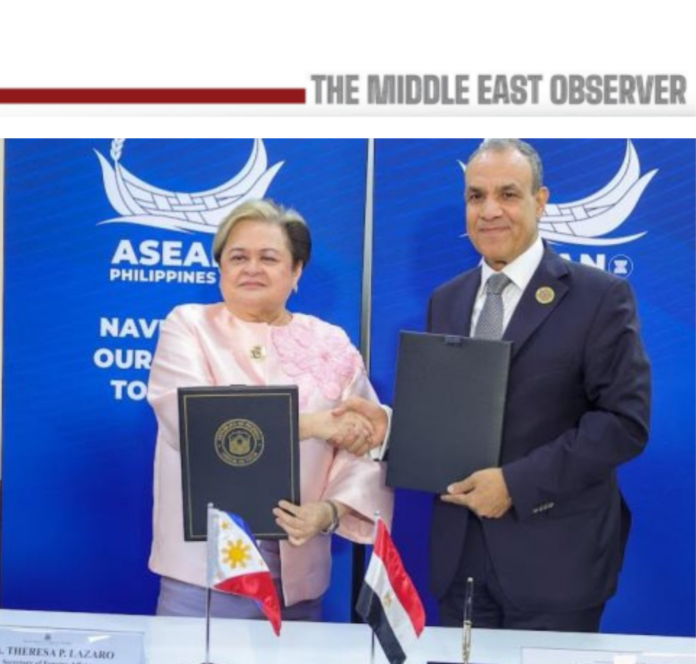
Egypt secured immediate market access for five agricultural exports to the Philippines after the two countries elevated their political dialogue to the ministerial level during the 10th round of Egypt–Philippines Political Consultations, held in Manila on 24 July. The meeting, led by Egyptian Foreign Minister Badr Abdelatty and Philippine Foreign Secretary Maria Theresa Lazaro, marked the first time the consultations have been chaired by the two countries’ foreign ministers since the mechanism was established and coincided with the 80th anniversary of diplomatic relations between Egypt and the Philippines.
The most commercially significant outcome was the signing of an accord granting Egyptian grapes, onions, garlic, tomatoes and carrots immediate access to the Philippine market, subject to the implementation of agreed sanitary and phytosanitary import protocols. The measure provides Egyptian exporters with a new gateway into one of Southeast Asia’s fastest-growing consumer markets and supports Cairo’s strategy of diversifying agricultural exports beyond its traditional destinations in Europe, the Middle East and Africa. Agricultural products have become one of Egypt’s fastest-growing non-oil export categories, making new market-access agreements an increasingly important component of the country’s export diversification agenda.
The accord also builds on a rapidly expanding, albeit still relatively modest, bilateral trading relationship. According to the Philippine Statistics Authority (PSA), merchandise trade between Egypt and the Philippines reached US$36.66 million in 2025, nearly doubling from US$19 million in 2024. Egypt exported goods worth US$19.81 million to the Philippines, while Philippine exports to Egypt totalled US$16.85 million, leaving a modest trade surplus in Egypt’s favour. Egyptian exports are concentrated in mineral products and agricultural goods, while Philippine shipments consist primarily of electrical and electronic equipment, machinery and food products.
The consultations formed part of Abdelatty’s official visit to the Philippines and Egypt’s broader strategy to deepen commercial engagement with the Association of Southeast Asian Nations (ASEAN), whose ten member economies represent a combined market of more than 680 million consumers and rank among the world’s fastest-growing economic regions. As global supply chains continue to diversify, Cairo has sought to strengthen trade and investment ties with high-growth Asian economies while expanding export opportunities for Egyptian producers.
Beyond the agricultural accord, both governments agreed to accelerate efforts to expand bilateral trade and investment, support the establishment of an Egyptian–Philippine Business Council, and deepen cooperation across agriculture, pharmaceuticals, tourism, education, labour, defence and investment. The two sides also agreed to amend their diplomatic visa exemption agreement to extend coverage to holders of official and special passports, facilitating closer government engagement and business exchanges.
Regional and international developments also featured prominently in the discussions, with both ministers exchanging views on developments in the Middle East, maritime security, freedom of navigation and cooperation within the United Nations and ASEAN frameworks, underscoring their shared commitment to rules-based international cooperation and secure global trade routes.
Officials said agriculture would serve as the initial pillar of a broader economic partnership. Future discussions are expected to focus on expanding agricultural market access, increasing fertilizer trade, facilitating pharmaceutical registrations, strengthening business-to-business cooperation and encouraging greater two-way investment. The proposed Egyptian–Philippine Business Council is expected to provide an institutional platform for translating government agreements into private-sector partnerships.
For Egypt, the Manila agreements represent another step in broadening export markets and strengthening commercial engagement with Southeast Asia. For the Philippines, they expand access to Egyptian agricultural products while creating opportunities for wider cooperation in manufacturing, investment and industrial trade. If implemented successfully, the framework agreed in Manila could serve as a platform for broader ASEAN market access, helping Egyptian exporters diversify revenues while creating new opportunities for Philippine businesses seeking commercial partnerships in North Africa and the Middle East.
Related news:
Economic Growth in Asia: A Bright Future Ahead
Egyptian Agriculture: A Rising Force in Global Trade
Read also:
Uber’s $14.8bn Delivery Hero bid deepens Gulf delivery ambitions
BlackRock Becomes First Asset Manager to Surpass $15 Trillion