
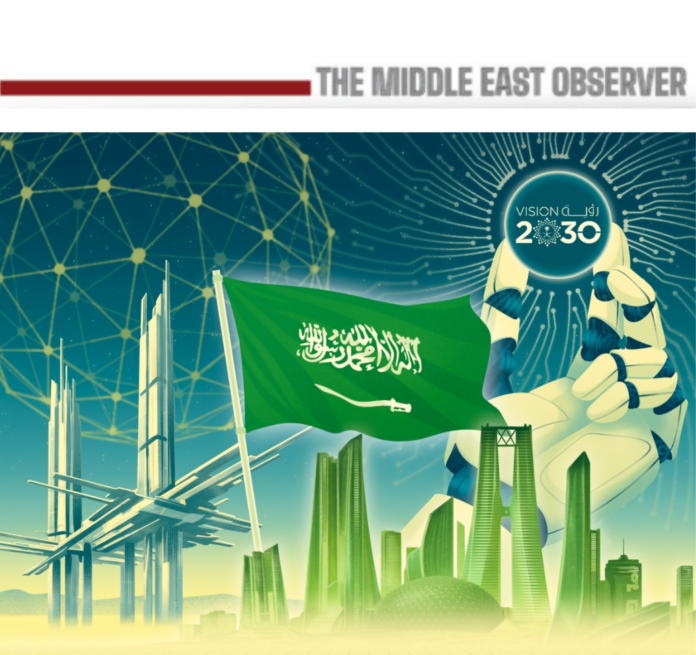
Saudi Arabia is seeking to reduce the burden on sovereign capital while strengthening its defences against geopolitical disruption, as Riyadh prepares to host Money20/20 Middle East from September 14-16.
The timing brings together three priorities shaping the next phase of Vision 2030: sustaining business confidence, protecting trade and supply chains, and drawing more global capital alongside state investment.
Saudi Arabia’s non-oil Business Confidence Index rose to 56.7 in August, its highest level since February, supported by stronger sentiment in industry and services. The rebound from the sharp March decline points to greater resilience in business sentiment, even as regional risks and weaker growth remain constraints.
Riyadh is also moving to contain the financial impact of those risks. The Cabinet has approved a Saudi Marine War Risks Insurance Pool, coordinated by Saudi Re under Insurance Authority supervision, to support cargo, vessel hulls and related maritime exposures.
The pool is designed to preserve insurance capacity when geopolitical tensions push private cover sharply higher or make it harder to secure. It effectively turns insurance capacity into an instrument of economic resilience, helping protect trade flows, supply chains and Saudi Arabia’s logistics ambitions during periods of regional disruption.
At the same time, the Public Investment Fund is intensifying its engagement with global investors. Senior PIF officials and executives from HUMAIN, Red Sea Global and King Abdullah Financial District are expected to meet Apollo, Blackstone, Brookfield, Carlyle, KKR and other investors in New York this week, according to Semafor.
The Lazard-arranged meetings are intended to prepare the ground for future debt and equity investment rather than finance a single transaction.
For years, PIF was known on Wall Street primarily as a source of capital. Riyadh is increasingly asking Wall Street to become a source of capital for Saudi Arabia itself.
That shift is becoming more important as Vision 2030 enters a capital-intensive phase spanning artificial intelligence, tourism, infrastructure, industry and urban development. The challenge is no longer simply to fund projects, but to reduce the amount of sovereign capital required to sustain them.
Money20/20 therefore gives Riyadh a timely platform to present that broader model to global investors and financial institutions: stronger domestic confidence, financial protection against external shocks and deeper access to private capital.
The significance is increasingly measured not by how much Saudi Arabia can spend, but by how effectively it can multiply sovereign capital, absorb risk and crowd in private investment.
The test is whether Riyadh can turn sovereign capital into a catalyst rather than the principal source of funding. If it can, Vision 2030 will rest increasingly on private co-investment, risk-sharing and capital recycling rather than direct state spending.
Related news:
Saudi Arabia Eyes Bangladesh as South Asia’s Next Logistics Gateway
Saudi Arabia Broadens Its Investment Base as Trade Surplus Soars 329%
Read also:
Egypt Accelerates Its Biotechnology Ambitions as Regional Demand Grows
Egypt Moves Towards $5.3bn Healthcare Investment With Two Medical Cities Plan