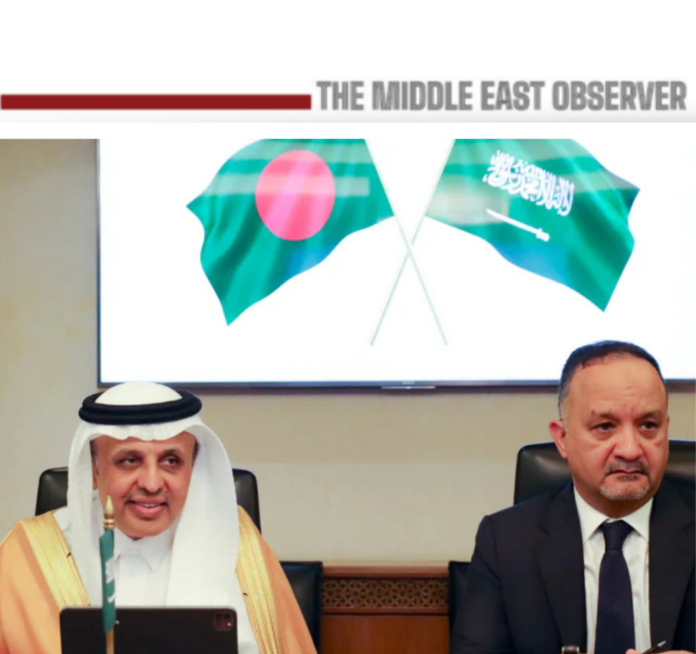
Saudi port operator Red Sea Gateway Terminal International (RSGTI) is considering investments of up to US$1 billion in Bangladesh’s ports and logistics infrastructure, signalling an ambition to position the country as a strategic South Asian gateway linking the Gulf, the Indian Ocean and wider Asian markets.
The proposed expansion builds on RSGTI’s initial US$170 million investment in the Patenga Container Terminal at Chattogram Port. The project began after the Saudi operator was selected as the international partner to develop and operate Bangladesh’s first public-private container terminal, culminating in the signing of a 22-year concession agreement with the Chittagong Port Authority in 2023. Over the following three years, RSGTI invested approximately US$170 million in modern ship-to-shore cranes, hybrid yard equipment and digital operating systems before officially launching full commercial operations at the terminal in 2026. The successful completion of that first phase has now laid the foundation for the company’s proposed investment of up to US$1 billion across Bangladesh’s ports and logistics infrastructure.
Designed to handle around 500,000 twenty-foot equivalent units (TEUs) annually, the terminal is Bangladesh’s first internationally operated container facility and RSGTI’s first overseas venture, providing the Saudi operator with a platform for wider expansion across the country’s maritime and logistics sector.
Beyond a Single Terminal
The proposed investment could extend to additional ports, logistics facilities and related infrastructure, including potential participation in the planned Bay Terminal, indicating that Patenga is intended as the first stage of a broader Bangladesh strategy rather than a standalone concession.
Bangladesh’s export-driven economy and strategic location on the Bay of Bengal make it an attractive logistics hub connecting South Asia with the Gulf, Southeast Asia, East Africa and Europe. A larger Saudi presence could strengthen regional supply-chain connectivity while supporting Bangladesh’s expanding manufacturing and export base.
For Bangladesh, further investment could increase port capacity, ease congestion and improve trade competitiveness, although the full economic benefits will depend on continued improvements in inland transport links, rail connectivity and customs efficiency. While the terminal handled about 154,500 TEUs in 2025, well below its annual capacity, utilisation is expected to rise as shipping services expand and cargo volumes grow.
Part of a Broader Saudi Strategy
For Saudi Arabia, the expansion aligns with Vision 2030’s objective of building a globally integrated transport and logistics network alongside the Kingdom’s traditional energy sector, generating commercial returns while strengthening its presence across strategically important maritime trade corridors.
The Bangladesh initiative predates the latest regional tensions, having originated with the 2023 concession agreement. However, recent disruptions affecting shipping through the Strait of Hormuz and the Red Sea have reinforced the strategic value of geographically diversified logistics assets.
The broader direction is consistent with Saudi Arabia’s expanding international logistics and energy strategy. In June 2026, Saudi Aramco Chairman Yasir Al-Rumayyan said the company was evaluating an expansion of its global oil storage network beyond its existing overseas facilities, highlighting the strategic importance of internationally located storage hubs following recent disruptions to shipping through the Strait of Hormuz. Alongside the Kingdom’s growing portfolio of overseas ports, logistics infrastructure and transport investments, the initiative reflects a broader policy of enhancing the resilience, flexibility and global reach of Saudi supply chains under Vision 2030.
Although Bangladesh cannot replace Gulf export routes through Hormuz, an operational presence on the Bay of Bengal provides Saudi Arabia with access to one of the world’s fastest-growing manufacturing regions while expanding its commercial reach across South Asia and the wider Indo-Pacific.
If realised, the proposed US$1 billion programme would rank among Saudi Arabia’s largest logistics investments in South Asia, reinforcing Bangladesh’s emergence as a regional maritime hub while illustrating the Kingdom’s long-term strategy of integrating transport, logistics and energy infrastructure into a more resilient global commercial network.
Related news:
MSC Launches Strategic Europe–Gulf Trade Corridor to Bypass Hormuz Risks
Egypt Launches Europe–Gulf Transit Corridor with Temporary Customs Relief to Sustain Trade Flows
Read also:
AMEA Power Advances Talks on Three Egypt Desalination Plants