Saudi Arabia’s flagship technology gathering has produced billions of dollars of new investment announcements, but the more consequential development lies beneath the totals: Riyadh is assembling the power, data centres, cloud infrastructure, manufacturing and capital needed to turn artificial intelligence into an industrial economy — and potentially an export business.
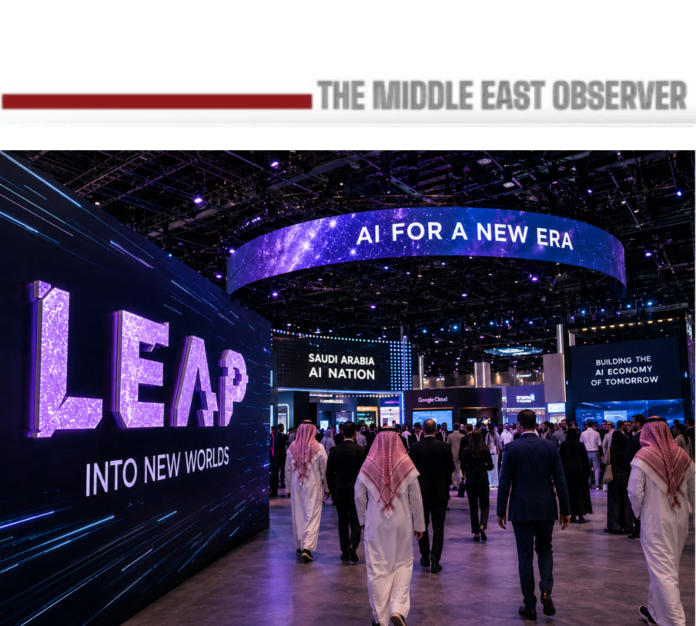
The largest number emerging from LEAP 2026 may also be the least useful for understanding what Saudi Arabia is building.
Saudi authorities said more than $15 billion in technology launches and investments were announced as the conference opened. Day two brought about $2.5 billion of further announced investments and launches, while organisers put day-three investment announcements at $857 million.
Those figures should not simply be added together.
LEAP’s headline totals span fresh investment, multi-year capital programmes, venture funds, product launches, strategic partnerships and projects announced previously but advanced or reiterated during the event. Treating them all as immediately committed new capital would exaggerate the investment actually generated during the four-day conference.
The more important story is structural.
Across LEAP, Saudi companies and government entities assembled projects covering almost every layer required for an AI economy:
power → data centres → compute → cloud → networks → applications → manufacturing → capital.
At the same time, Saudi money is beginning to move outward into foreign digital infrastructure.
The result suggests a broader ambition than attracting international technology companies to Riyadh. Saudi Arabia is attempting to move from being a major technology buyer toward owning a larger share of the infrastructure through which AI is produced, delivered and eventually exported.
Compute Becomes Infrastructure
PIF-backed HUMAIN sits at the centre of that transition.
Amazon Web Services said at LEAP that its first Saudi cloud region remains scheduled to launch in December 2026, while its expanded partnership with HUMAIN is expected to provide as much as 50MW of capacity in a Saudi AI Zone by 2028.
AMD, Cisco and HUMAIN meanwhile said production AI infrastructure using AMD processors and Cisco networking is already operating in Saudi Arabia. The partners plan to deploy up to another 250MW beginning in 2027.
There is an important qualification.
The frequently cited target of up to 1GW by 2030 is not a new LEAP commitment. AMD and Cisco announced that joint-venture ambition in November 2025. LEAP instead provided evidence of execution and an expanded next phase.
That distinction matters because announcements should not be confused with operating assets.
Yet the direction is clear: Saudi Arabia increasingly views AI computing capacity as strategic infrastructure, closer economically to electricity generation, telecom towers or ports than to conventional software.
If sufficient demand develops, that infrastructure could serve customers outside the kingdom as well as Saudi enterprises — effectively making computing power an exportable service.
The AI Strategy Starts with Power
The physical constraint behind that ambition is electricity.
AI data centres require chips, but also grid capacity, substations, transmission infrastructure, cooling, land and large amounts of capital.
That makes Saudi Arabia’s traditional strengths in energy and infrastructure relevant to its technology ambitions.
The kingdom is effectively testing whether some of the advantages that helped establish it as an energy power — scale, capital and access to energy infrastructure — can be transferred into the economics of AI.
The competitive advantage would not be creating every underlying technology domestically.
It would be building enough reliable and competitively priced infrastructure to make Saudi Arabia an attractive location in which to operate it.
The Domestic Data-Centre Build Accelerates
Day two provided some of LEAP’s clearest new investment commitments.
Saudi-listed Al Moammar Information Systems, or MIS, announced $1.2 billion for data-centre expansion, targeting total operating capacity of 192MW.
NHC Innovation announced $880 million for data centres at Khuzam Digital Valley, with scalable capacity targeted to reach 65MW by 2033.
Mobily and China-linked BytePlus announced a joint investment of more than $150 million to establish BytePlus cloud services in Saudi Arabia.
Those three projects alone illustrate how the Saudi cloud market is becoming more diversified: domestic infrastructure operators are expanding alongside American and Chinese technology platforms.
But capacity is not itself demand.
The critical commercial question is whether Saudi companies, government agencies and international customers will consume AI and cloud services quickly enough to fill the infrastructure now being developed.
From Importing Technology to Making It
The next phase of the Saudi strategy is localisation.
LEAP’s third-day announcements included a $150 million investment by Alfanar to manufacture data-centre components in Saudi Arabia. Organisers also highlighted plans by CTS Global Group and Saudi Desert Technologies to localise the design and production of data-centre systems.
HPE announced an expansion of its Saudi localisation programme, while Nokia disclosed plans for its first research-and-development centre in the kingdom.
Lenovo provided perhaps the clearest physical evidence of the localisation drive by unveiling its first laptop manufactured in Saudi Arabia. Limited-product mass production at its Riyadh facility is expected to start later in 2026.
The emerging industrial sequence is significant:
import technology → operate infrastructure → manufacture equipment → develop capabilities → potentially export production.
The economic objective is straightforward: as Saudi AI capital expenditure rises, Riyadh wants a greater share of that spending to remain inside the domestic economy through manufacturing, employment and technology transfer.
That is a more demanding target than simply hosting foreign data centres.
Foreign Technology, Saudi-Controlled Infrastructure
Saudi Arabia nevertheless remains dependent on overseas technology.
AMD and NVIDIA dominate advanced processing. AWS and other hyperscalers provide cloud architecture. Cisco and Ericsson supply network technology. Chinese companies including Huawei and BytePlus remain important partners.
That dependence does not invalidate the strategy.
Saudi Arabia does not need to manufacture every advanced semiconductor to capture economic value from AI.
It can instead attempt to control more of the assets around those chips: data centres, energy supply, distribution platforms, enterprise relationships and capital.
HUMAIN therefore represents a potentially important economic model.
The company can combine foreign processors and software with Saudi-financed infrastructure and then sell computing services to domestic and, eventually, foreign customers.
The question is whether it can do so competitively.
AI Moves Into the Existing Economy
Infrastructure alone will not determine the success of the strategy.
The larger productivity opportunity comes when AI moves into Saudi Arabia’s established industries.
Aramco and Aramco Digital used LEAP to announce agreements and MoUs spanning industrial AI, cybersecurity, localisation of critical technologies and national industrial capabilities.
Other projects extend into transportation, utilities, smart cities and government services.
This matters because the largest potential Saudi returns from AI may not come from consumer applications. They could come from improving productivity across energy, logistics, mining, utilities, manufacturing and public administration.
That would make AI less a standalone industry than a technological layer running through the wider economy.
Saudi Capital Starts Moving Outward
LEAP also revealed a potentially more consequential change in the direction of investment.
Saudi Arabia has traditionally used technology gatherings to attract foreign companies and capital.
Now Saudi capital is increasingly travelling in the opposite direction.
Vision Invest and Africa Finance Corporation signed a shareholder subscription agreement to invest a combined $300 million in WIOCC Group, which operates digital infrastructure across Africa.
Unlike many LEAP MoUs, this is a defined equity transaction. The capital is intended to support data centres, terrestrial fibre and subsea connectivity across African markets.
That makes the transaction strategically important beyond its size.
It positions Saudi capital not simply as the buyer of foreign technology, but as a financier of the infrastructure carrying digital traffic elsewhere.
Day three added another international bridge: Ula Capital and South Korea’s FuturePlay announced a $100 million deep-tech fund connecting Saudi and Korean investment opportunities.
If that pattern expands, LEAP could increasingly function as a platform connecting global technology, Saudi capital and emerging-market demand.
Reading LEAP’s Billions
That broader story requires financial discipline.
The reported LEAP numbers fall into materially different categories:
Committed investment: transactions with identified capital and counterparties.
Planned capex: spending intended over several years and subject to execution.
Funds: pools of capital whose headline size does not equal money already invested.
Strategic agreements: commercial frameworks that may lead to investment but do not necessarily represent committed capital.
MoUs: expressions of intended cooperation, sometimes explicitly non-binding.
Zain Saudi Arabia’s agreement with DataVolt, for example, was described by Saudi Press Agency as a non-binding MoU to explore data-centre development. It should therefore not be presented as a completed investment.
The same discipline should apply to projects announced before LEAP and reiterated during the conference.
For investors, the relevant questions are not merely how large the headline figures become but how much money is genuinely incremental, when it will be deployed, who finances it and what returns the assets can earn.
The Real Test Is Utilisation
Saudi Arabia has demonstrated that it can mobilise capital.
The harder test comes after the announcements.
AI infrastructure economics will depend on:
- utilisation rates;
- electricity and cooling costs;
- access to advanced semiconductors;
- technical talent;
- cloud pricing;
- customer acquisition;
- speed of construction;
- and the rate at which computing hardware depreciates.
The last point is particularly important.
AI processors are advancing rapidly. A data centre completed several years after an investment announcement must therefore generate enough utilisation and revenue to justify both infrastructure costs and increasingly fast hardware replacement cycles.
That creates a tension between strategic capacity and commercial returns.
If Saudi Arabia builds capacity faster than regional AI demand develops, expensive infrastructure risks becoming underutilised.
If demand scales alongside supply, however, Riyadh could establish something much more valuable than another technology cluster: a platform capable of selling digital infrastructure and computing power across a region spanning the Middle East, Africa and parts of Asia.
From Energy Exporter to Compute Exporter?
Saudi Arabia is unlikely to replace Silicon Valley as the source of frontier AI technology.
It does not need to.
LEAP 2026 suggests Riyadh is pursuing a different position: between the economies producing advanced technology and the markets increasingly consuming it.
The kingdom brings formidable advantages to that contest — capital, energy, infrastructure expertise, geography and a large domestic customer base.
LEAP shows how Riyadh is trying to connect them:
power into data centres; data centres into compute; compute into cloud services; cloud into industrial applications; foreign technology into local production; and Saudi capital into overseas digital infrastructure.
The central question is therefore no longer whether LEAP can produce another multibillion-dollar headline.
It is whether those commitments can become utilised assets, commercially viable services, domestic industrial capacity and eventually exports.
If Saudi Arabia succeeds, one of its next strategic exports may not travel through a pipeline or aboard a tanker.
It may travel through a data centre.
Related news:
China Dominates Global Banking While MENA Lenders Strengthen Regional Standing
The New Mining Race Is About Control, Not Just Resources
Read also:
Egypt Moves to Embed Academia in Industry with “A Professor for Every Factory” Initiative
The Maintenance Economy: The Industry Egypt’s Infrastructure Boom Is Creating