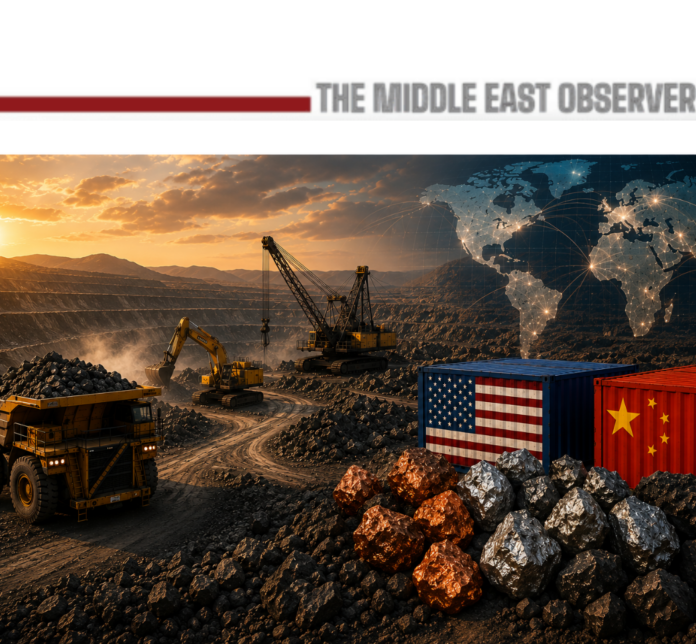
The US is putting another $500mn behind domestic critical-mineral processing as governments from Indonesia and Peru to Sudan and Egypt tighten control over minerals escaping through informal, illegal and criminal supply chains. The contest is shifting from who owns the deposits to who controls their provenance, route to market and processing value.
A new global mining race is taking shape.
Lithium, cobalt, copper, graphite, nickel and rare earths are strategic inputs for batteries, electricity networks, defence systems, data centres and advanced manufacturing. Gold occupies a different market but presents governments with a related problem: its high value, portability and ease of melting make it difficult to trace once it leaves regulated channels.
Governments are responding at both ends — securing resources while tightening control over processing, trading and exports.
Washington moves beyond the mine
The US provides the clearest example of the first strategy.
On August 20, the Department of Energy announced $500mn for seven selected projects to expand domestic critical-mineral processing, battery manufacturing and recycling. They include a $100mn federal contribution towards Lilac Solutions’ commercial lithium extraction and refining project in Utah and another $100mn towards Formation Holdings/Jervois’ battery-grade cobalt-sulphate refining project.
Two days earlier, DOE announced another $162mn for nine projects recovering materials including scandium, copper, antimony and rare earths from industrial feedstocks. These measures build on almost $1bn of prospective critical-minerals funding announced by DOE in 2025.
This is not principally a rush to open mines. Washington is rebuilding the midstream — processing, refining and recycling capacity where access to raw materials becomes industrial power.
But the mining revolution has another side.
The mineral economy governments cannot control
Across Africa, Latin America and Asia, significant quantities of gold, tin, coal, cobalt and other minerals move through artisanal, informal, unlicensed or criminal networks.
The categories matter. Artisanal mining can be legal; informal mining is not necessarily criminal. Illegal mining involves extraction or trading that breaches mining, environmental, land, tax or export rules.
Mining IQ’s World Risk Survey found Guyana and Ecuador to be the jurisdictions where artisanal and illegal mining posed the greatest perceived risk to the formal industry. Burkina Faso, Laos, Mali and Russia followed, with Papua New Guinea, Madagascar, Colombia and Nigeria completing the top ten.
The survey measures perceived industry risk, not absolute illegal production. But its geographic spread highlights a problem extending beyond mine sites into organized crime, environmental damage, revenue leakage and investment risk.
Latin America’s illegal gold economy
Ecuador increasingly treats illegal mining as an organised-crime problem. Its 2025-29 development plan acknowledges criminal involvement alongside mercury and cyanide pollution.
Enforcement has escalated. Ecuador’s Defence Ministry estimated in April that operations during 2026 had inflicted about $2bn in economic losses on illegal-mining structures — a government estimate rather than an independently audited measure.
At the same time, Quito is reopening parts of its mining cadastre and revising regulations to attract legitimate investment. The contradiction is increasingly visible: the same geological resources attracting international capital are attracting criminal organisations.
Colombia is attacking the problem further downstream. Its Ecodorado strategy aims to increase direct state purchases of legal gold from about 5 tonnes to 15 tonnes annually, while more than 60,000 people had benefited from formalization programmes by June.
The government has also introduced technology designed to track gold from extraction through commercialization or export in real time, alongside work on geoscientific fingerprints that could help establish mineral origin.
Peru, however, demonstrates how large the parallel economy can become.
An April 2026 IMF assessment describes Peru as Latin America’s largest exporter of illegal gold and says illegal gold production in 2025 had reached levels comparable with legal production.
In 2024, the difference between recorded gold exports and domestic production reached 48% of exports, although the IMF cautions that this is not itself a direct measure of illegal output. Illegal activity is also spreading into copper, where IMF staff estimate illegal production could have represented as much as 5% of exports in 2024.
The problem is beginning to affect the economics of legitimate mining. The IMF estimates illegal activity affects a roughly $12bn pipeline of mining projects.
Peru demonstrates why closing individual mines is insufficient. Illegal operators still require machinery, fuel, chemicals, processors, transporters, financiers and exporters. Each represents a potential regulatory choke point.
Africa moves to capture its gold
Across Africa, governments are increasingly trying to draw artisanal production into regulated markets rather than relying solely on enforcement.
Burkina Faso reported around 94 tonnes of gold production in 2025, up from roughly 60 tonnes a year earlier, with the government putting artisanal production at about 42 tonnes. Authorities are organizing miners into licensed cooperatives while strengthening rules covering mine security, processing and a national gold reserve.
Mali has created a state body to regulate artisanal gold trading after discrepancies emerged between declared exports and volumes recorded by importing countries. Its wider mining reforms have also increased state participation and tightened tax enforcement.
Both are shifting government intervention towards the point where gold enters the commercial system.
Ghana is taking the model further. Its artisanal and small-scale sector produced a record 104 tonnes in 2025 and generated almost $11bn in foreign exchange, according to GoldBod. Its 2026 strategy targets 127 tonnes annually through formal channels.
From September 1, self-financing aggregators will no longer be permitted to export unrefined artisanal gold doré. It must instead be refined domestically.
The objective has moved beyond stopping smuggling. Ghana wants to capture the mineral, the foreign exchange and more of the refining margin.
There is execution risk. Buyers have reported financing delays as GoldBod changes its funding arrangements, although the agency disputes that it faces a funding shortage. Formalisation works only if the regulated buyer remains competitive, liquid and accessible.
Sudan: when gold finances war
Sudan represents the extreme consequence of losing control over a mineral economy.
Official production reached about 70 tonnes in 2025, predominantly from artisanal mining involving an estimated 2mn people. But that figure excludes production in territories controlled by the Rapid Support Forces and other armed movements.
Only around 14 tonnes were officially exported.
The gap cannot simply be classified as smuggling — inventories and domestic flows also matter — while estimates cited by Sudanese authorities put the proportion of production moving through informal channels at 48-60%.
Official gold exports nevertheless generated about $1.54bn and more than 58% of Sudan’s total exports, illustrating the metal’s importance to a war-damaged economy.
More seriously, gold produced outside government control can generate hard currency for armed actors, transforming mineral leakage into a war-financing problem.
Khartoum has tightened central-bank and mining-company oversight, revised pricing mechanisms and established dedicated gold-smuggling courts. Officials said by August that six months of formal exports had already matched the total officially exported during 2025.
International policy has also moved from sanctioning individual actors towards targeting the economics of gold production itself. The EU says gold has become a key source of revenue sustaining Sudan’s conflict and in July prohibited purchases, imports and transfers of Sudanese gold while restricting mercury and cyanide supplies used in extraction. The UK has separately sanctioned mining and procurement networks accused of helping finance the war.
Sudan shows how mineral production can move from informal livelihoods into smuggling, parallel foreign-exchange markets and armed-conflict financing.
Congo turns cobalt dominance into market power
The Democratic Republic of Congo moves the argument beyond gold.
Congo supplies about 70% of global cobalt, giving Kinshasa unusual leverage over a mineral critical to batteries, electronics and defence supply chains.
The government is increasingly using that position not simply to regulate production but to influence exports, prices and domestic processing.
After restricting cobalt exports, Congo introduced a quota system capping exports at 96,600 tonnes annually in 2026 and 2027. In June, its strategic-minerals regulator said unused allocations would be withdrawn and transferred to a state-controlled quota supporting projects of national importance, including domestic processing and value addition.
Kinshasa has since gone further. A government order signed on June 29 prohibits exports of copper and cobalt concentrates, subject to possible strategic waivers, explicitly seeking to encourage more domestic processing.
The immediate impact may be limited because much of Congo’s copper and cobalt is already processed domestically. But the policy signal is significant.
Congo is attempting to convert geological dominance into market power, processing capacity and greater domestic value capture.
Indonesia turns enforcement into industrial policy
Indonesia represents the harder enforcement model.
Authorities are targeting illegal mining across around 190,000 hectares of forest land, while the Attorney-General has proposed penalties of approximately Rp32.6tn against companies associated with unlawful activity in forest areas.
The Indonesian navy separately says it has intercepted 514.1 tonnes of illegally mined minerals worth about $656mn in 2026, including tin and coal. Authorities have also moved against roughly 1,000 illegal tin mines in Bangka Belitung.
These are government enforcement figures and should not be read as estimates of Indonesia’s total illegal-mining economy.
The economic rationale goes beyond policing. Jakarta has spent years pushing minerals into domestic processing and manufacturing. Material leaving through illegal channels represents not only lost royalties and taxes but lost feedstock for its downstream industrial strategy.
Enforcement and processing policy are therefore two sides of the same objective: retaining more mineral value inside Indonesia.
Formalisation becomes economic policy
Other governments are targeting different points along the mineral chain.
Guyana’s large artisanal gold industry provided more than 20,000 direct jobs in 2025. Its challenge centres on mercury, deforestation, safety and traceability, making cleaner technology and formal oversight more relevant than prohibition.
In Papua New Guinea, government policy documents estimate that more than 80,000 people participate in alluvial mining but only about 10% hold appropriate mining leases, making formalisation and licensing the priority.
Madagascar is developing formal gold collection, domestic assay and traceable transport while attracting strategic investment into rare earths.
Nigeria’s vice-president said in May that mining reforms had attracted more than $2.6bn in foreign direct investment over the previous 30 months, including investment in lithium processing, gold refining and mineral-tracking capacity. The government is linking licensing and formalisation with greater domestic beneficiation.
Malawi has identified more than 80 gold-mining hotspots and plans official purchasing channels. State-backed MAMICO estimates that more than $700mn of gold may leave the country annually outside official channels, although that figure has not been independently established.
The commercial challenge is straightforward: informal buyers often reach remote miners, pay immediately and require little paperwork. State purchasing systems therefore have to compete on price, liquidity and accessibility.
Elsewhere, Laos is tightening enforcement and reviewing mineral legislation and raw-material exports, while Russia is strengthening refinery-level traceability rules designed to prevent acceptance of precious metals whose lawful origin cannot be verified.
The approaches differ, but the intervention points are increasingly clear: mine, buyer, processor, refinery and exporter.
Egypt opens the mining economy
Egypt’s strategy combines formalisation with a wider effort to attract investment and build domestic mineral industries.
Historically informal Eastern Desert gold production has increasingly been channelled through the state-backed Shalateen Mineral Resources Company. Its figures show gold production rising from 9kg in 2016 to 950kg in 2025, while net profit increased from EGP48mn in 2020 to EGP1.4bn in 2025.
But Shalateen is now only one part of a broader mining overhaul.
The government has transformed the regulator into the Mineral Resources and Mining Industries Authority, amended executive regulations, introduced a one-stop-shop model and aims to reduce licensing cycles towards approximately 75 days.
Egypt has also introduced an open-block system allowing investors to apply continuously for available mineral areas covering gold, phosphate and other resources. A nationwide airborne geophysical programme is intended to improve knowledge of gold, critical minerals and rare elements.
Foreign investor interest is responding. Cyprus-based FMC has indicated plans for around $20mn of exploration investment over two to three years, while Barrick and other international groups are evaluating Eastern Desert opportunities.
Egypt is simultaneously encouraging phosphate processing and other downstream industries.
The strategy therefore combines formalising artisanal production, accelerating exploration, improving geological data and increasing domestic value addition.
The risk map moves beyond geology
The evidence points to six increasingly connected strategies: security enforcement, formalisation, regulated purchasing, traceability, domestic processing and strategic public investment.
For mining companies, refiners, traders and investors, this changes the economics of resource development.
Geological quality remains fundamental, but it no longer determines the investment case alone. Permitting timelines, processing requirements, export quotas and bans, state purchasing systems, royalty and tax regimes, traceability costs, sanctions and security can increasingly determine whether reserves translate into returns.
The policies can cut both ways.
Formalisation can increase official production and reduce smuggling, but state purchasing can create working-capital bottlenecks. Domestic-refining requirements can retain more value locally, but raise costs if processing capacity is inadequate. Export restrictions can support downstream investment while disrupting contracts and global supply.
In concentrated markets, policy can also move global prices. Congo’s cobalt restrictions have tightened supply and contributed to sharply higher prices, illustrating how mineral policy can become not merely a country-level operating risk but a global pricing variable.
For investors, the question is therefore no longer simply whether a country has the mineral. It is who controls the route from extraction to sale — and on what terms.
Control becomes the new mining premium
The mining revolution now has two fronts.
Importing economies are spending public money to secure mineral supply chains. Producing economies are trying to stop those chains leaking through smuggling, informality and raw-material exports.
Washington’s $500mn programme sits at one end. At the other are Peru confronting illegal gold on a potentially macroeconomic scale; Sudan trying to prevent gold financing war; Ghana pushing artisanal production through domestic refining; Congo managing cobalt supply and processing; Indonesia closing illegal routes; and Egypt opening exploration while drawing informal production into regulated channels.
The next mining winners may therefore not be those with the largest reserves, but those able to convert geological advantage into processing capacity, traceable supply and higher domestic value capture.
For investors, that shifts the decisive risks beyond geology towards regulation, security, sanctions, state intervention and control of the supply chain.
The global mining race is moving through three stages: control the resource, control the route to market, and control the processing margin.
Related news:
Afreximbank Plans Egypt’s First Gold Refinery to Support Continental Gold Hub
Behind Washington’s Yen Intervention: Why Currency Support Cannot Fix the Rate Gap
Read also: