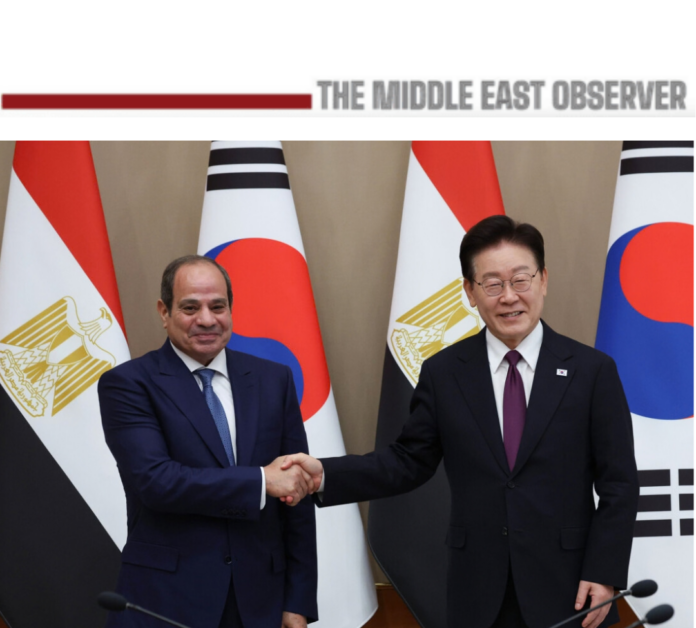
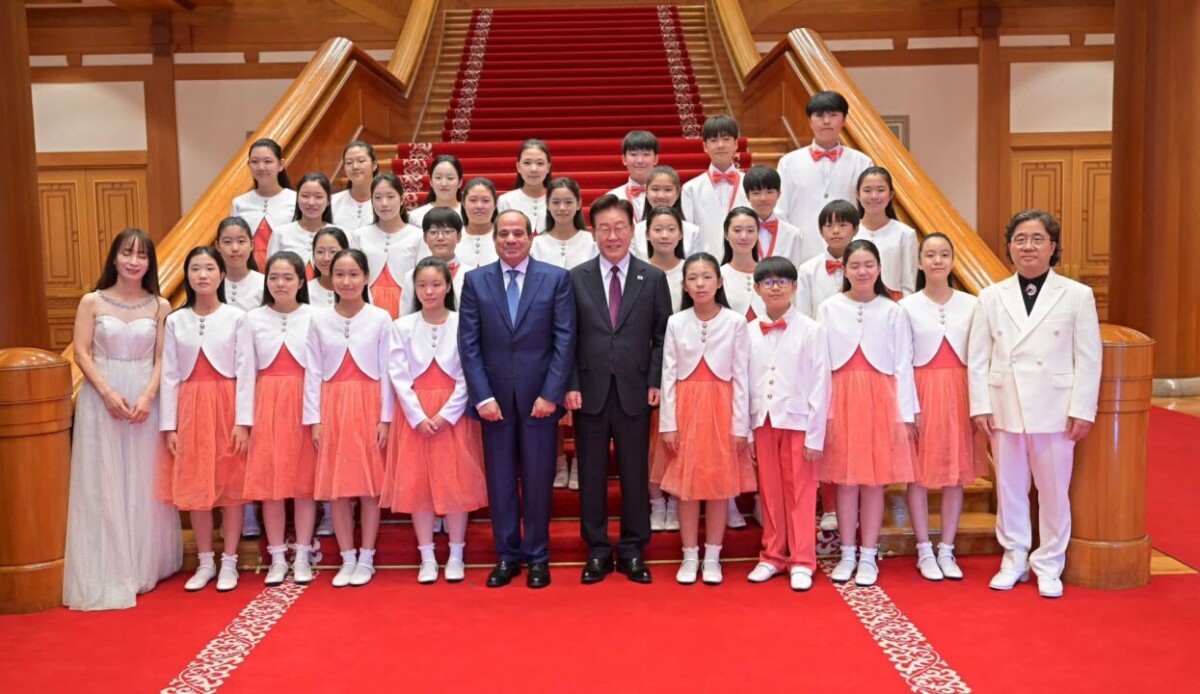
Egypt and South Korea elevated relations to a strategic partnership during President Abdel Fattah El-Sisi’s state visit to Seoul on 7–9 October 2026, signing/updating 12 bilateral instruments and formally launching negotiations towards a Comprehensive Economic Partnership Agreement (CEPA). The visit, hosted by President Lee Jae Myung, also produced a separate agreement to examine the introduction of hydrogen-powered trams in Egypt and renewed discussions towards Korean manufacturing investments into the Suez Canal Economic Zone.
The agreements cover trade, industrial development, shipbuilding, maritime transport, clean energy, electricity infrastructure, digital technology, education, social security and cultural cooperation.
The Seoul summit followed Lee’s November 2025 visit to Cairo, which marked 30 years of diplomatic relations and established the basis for a more ambitious economic partnership.
Industrial Investment Takes Centre Stage
El-Sisi began the visit’s commercial programme on 7 October with a roundtable attended by representatives of 23 leading South Korean companies, presenting Egypt as a manufacturing and export platform serving a wide regional market.
According to the Egyptian Presidency, the President revealed the strategic importance & benefits of establishing an integrated Korean industrial zone within the Suez Canal Economic Zone (SCZONE), offering manufacturers access to industrial land, transport infrastructure and Egypt’s regional trade agreements.
The investment agenda extended to automotive manufacturing, electronics, shipbuilding, pharmaceuticals, petrochemicals, artificial intelligence, data centres, food processing and tourism. El-Sisi also encouraged Korean participation in oil, gas, mining, renewable energy and infrastructure projects across Egypt and neighbouring markets.
Hydrogen Trams Offer First Identifiable Project
One of the visit’s most specific commercial outcomes emerged from the business roundtable, where South Korea’s Hyundai Rotem signed a memorandum of understanding with Egypt’s National Authority for Tunnels concerning a hydrogen-powered tram system for the New Administrative Capital.
The proposed project involves 44 hydrogen-powered tram train sets and potential cooperation in railway systems, operations and maintenance.
Hyundai Rotem’s 8 October announcement confirmed that the project remains at the preliminary feasibility stage. No final supply contract, investment value or delivery schedule has been established.
The initiative nevertheless gives the wider technology-transfer agenda a defined potential application in Egypt’s urban transport network.
Summit Establishes Twelve Cooperation Instruments
At their 8 October summit, El-Sisi and Lee oversaw the signing of six documents, while the full package of agreements and instruments signed or revised in connection with the visit totalled 12.
The industrial component included a shipbuilding memorandum covering environmentally sustainable vessel repair, technical training and liquefied natural gas bunkering. A separate maritime agreement addressed ports, shipping, information exchanges and maritime research.
The shipbuilding framework could support Egypt’s ambition to expand marine manufacturing and servicing around the Suez Canal, drawing on South Korea’s established capabilities in commercial shipbuilding and specialised maritime equipment.
Energy cooperation was addressed through two separate memoranda. The first covered solar, wind, biomass, waste-to-energy and peaceful nuclear-energy applications. The second concerned electricity transmission and distribution, rehabilitation of ageing infrastructure, high-voltage direct-current technology and energy-storage systems.
These agreements could help connect Egypt’s expanding renewable-energy sector with the grid infrastructure required to absorb additional generation.
In technology, the two governments signed an ICT cooperation memorandum covering artificial intelligence, cybersecurity, high-speed connectivity, digital transformation and joint research.
An additional exchange of notes established cooperation on a risk-based digital inspection and cargo-tracking platform intended to improve trade facilitation.
Trade Agreement Could Reshape Bilateral Investment
The most consequential long-term economic initiative was the joint declaration launching CEPA negotiations, with the first formal round targeted for the first half of 2027.
The proposed agreement would extend beyond conventional tariff reductions to address trade in goods and services, investment-related cooperation and supply-chain resilience.
South Korea identified Egypt as the first North African country with which it had formally announced CEPA negotiations.
For Korean manufacturers, an eventual agreement could strengthen the commercial case for producing in Egypt, rather than serving its domestic market exclusively through imports. For Egyptian producers, it could create additional export opportunities and deeper participation in Korean industrial supply chains.
The benefits will depend on the negotiated terms, particularly market access, rules of origin, customs arrangements and the competitive position of domestic industries. No preferential tariff changes arise automatically from the declaration.
Social Security, Education and Cultural Agreements
The wider package included a bilateral social security agreement designed to reduce duplicate contributions for eligible workers temporarily posted between the two countries, generally for periods of up to five years. The agreement also provides mechanisms for coordinating insurance periods when determining benefit eligibility.
Egypt and South Korea additionally updated their higher-education cooperation framework, expanding its scope to artificial intelligence education, digital transformation, joint academic programmes, curriculum development and institutional research.
Three cultural instruments completed the package. The governments designated 2027 as the Year of Mutual Cultural Exchanges, while the Grand Egyptian Museum concluded separate cooperation arrangements with South Korea’s National Museum and National Agricultural Museum.
These agreements broaden the partnership’s institutional reach, complementing the commercial and technological agenda.
Defence Cooperation Builds on Existing Production
The two presidents also reaffirmed cooperation in defence manufacturing, citing the existing K9 self-propelled howitzer programme as an example of industrial collaboration.
The programme provides an established foundation for technical cooperation and domestic manufacturing, reinforcing Egypt’s wider objective of acquiring production capabilities alongside imported technology.
From Agreements to Implementation
The joint strategic-partnership declaration also envisages cooperation on electric vehicles, advanced industries and joint projects in third-country markets, particularly in Africa.
For Egypt, the commercial significance extends beyond the number of agreements signed. Korean investment could strengthen local supplier networks, expand manufacturing capacity, introduce advanced technologies and generate foreign-currency earnings through exports.
With decisive high-level follow-up and swift conversion of agreements into binding investments, the Seoul partnership could become a major catalyst for Egypt’s industrial transformation. Korean capital, advanced technology and manufacturing expertise offer a significant opportunity to expand domestic production, deepen industrial localization, strengthen supply chains and accelerate export growth. Turning the proposed Korean industrial zone and wider cooperation frameworks into operational projects would not only generate skilled employment and foreign-currency earnings but also position Egypt as a strategic production and export base for Korean industries serving Africa, Europe and the Middle East. The decisive test now is execution: converting diplomatic momentum into factories, investment flows and sustained export revenues.
Related news:
Egypt and Lebanon Sign Broad Cooperation Pact Spanning 15 Sectors
Egypt Launches its First locally developed industrial robot
Read also:
Tatweer Medical Plans $100m Investment to Expand Egypt’s Medical Technology Manufacturing
Oman Advances $1bn Solar Expansion with Adam and Sinaw Projects