Egypt’s next generation of economic power brokers may not be the companies that own the products, capital or physical assets. Increasingly, they may be the digital platforms that control access to customers.
Egypt’s digital transformation is creating a new layer between businesses and the people they serve. Banks still provide capital, brokers execute trades and merchants own their products. But customers increasingly reach them through digital platforms.
The shift is not that platforms are replacing traditional businesses. It is that they are gaining influence over the relationship between businesses and customers. Whoever controls that gateway can shape how products are discovered, how services are purchased and, ultimately, where demand flows.
Finance: When the Gateway Becomes the Business
Finance offers one of the clearest examples.
Egypt’s digital-payment infrastructure has expanded rapidly. InstaPay has surpassed 16 million users, while the number of mobile wallets has reached about 55.5 million, reflecting the broader migration towards digital financial services.
Banks remain the backbone of the financial system, but digital platforms increasingly shape how customers interact with it. A platform does not need to replace a bank to gain influence; it needs to become the place where customers first encounter payments, savings, investment products or other financial services.
The Egyptian Exchange illustrates what can happen when that gateway shifts.
During the first four months of 2026, Thndr accounted for 12.9% of the value traded on the exchange, according to data cited by the Financial Times. The investment platform had about 700,000 funded accounts and roughly $1 billion in assets under custody. Thndr chief executive and co-founder Ahmad Hammouda said about 80% of its customers were first-time investors.
Wael Ziada, founder of investment bank Zilla Capital, told the Financial Times that platforms such as Thndr were reaching a generation traditional investment banks had “ignored or failed to attract”.
The significance goes beyond trading volumes. Thndr is not merely providing another route into the stock market; it is helping broaden the pool of people entering it.
Regulation is adapting to the same shift. In February 2026, Egypt’s Financial Regulatory Authority allowed brokerage companies to market their services through accredited digital platforms and receive securities orders electronically. FRA chairman Mohamed Farid described the initiative as part of efforts to broaden access to capital markets.
The broker still executes the transaction. Increasingly, however, the platform can control discovery and the route to the customer.
Commerce: Owning the Product Is No Longer Enough
The same economics are spreading through commerce.
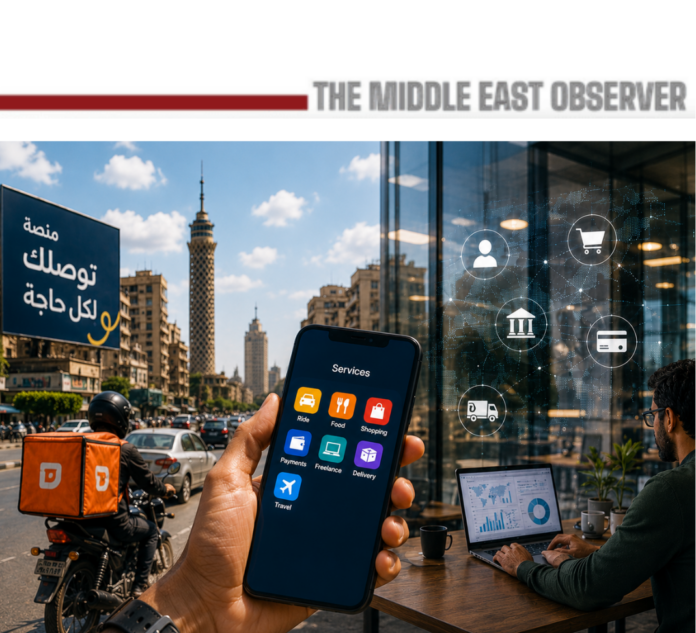
Egypt’s expanding e-commerce, marketplace and delivery ecosystem gives businesses — particularly smaller merchants — access to customers without requiring them to build their own large distribution or digital-sales networks. Platforms can aggregate merchants, payments, logistics and consumers within a single interface.
The OECD has identified digitalisation as an important avenue for Egyptian SMEs to expand markets, lower transaction costs and improve competitiveness.
But greater access can also create dependency.
A merchant may own the product and determine its price, while a marketplace or delivery platform can influence whether customers see it through search rankings, recommendations, advertising, ratings and commission structures.
The platform therefore does not need to own inventory to influence a seller’s economics. At sufficient scale, controlling access to demand can shift bargaining power towards the intermediary connecting merchants with customers.
That distinction matters. Digital platforms can lower barriers to entry for thousands of businesses while simultaneously creating new forms of dependence on the infrastructure through which those businesses reach the market.
The State Is Building Its Own Digital Layer
A related transformation is occurring between businesses and government, although for a different purpose.
In January 2026, the FRA and eFinance launched an integrated digital-payment network for non-bank financial institutions. The following month, the regulator introduced a digital reporting platform enabling supervised companies to submit regulatory filings electronically using digital signatures and automated verification.
These systems do not perform the same commercial role as a marketplace or investment app. Instead, they represent the institutional counterpart to private-sector platformisation: government is standardising the digital channels through which regulated businesses interact with the state.
The result is an economy in which an increasing number of relationships — commercial, financial and regulatory — are being mediated through digital infrastructure.
The Real Advantage Is the Relationship
A platform’s most valuable asset may ultimately be neither the transaction nor the technology. It may be the relationship surrounding them.
A marketplace can reveal what consumers are searching for. An investment platform can observe how first-time investors enter markets and which products attract them. A payment platform generates information about how and when customers transact.
More users generate more interactions. Those interactions produce more data, which can improve matching, targeting and service design. Better services can attract still more users.
This combination of network effects, data and customer access can become a formidable competitive advantage.
It is also what distinguishes the digital middleman from its traditional predecessor. The old intermediary primarily facilitated a transaction. A platform can facilitate the transaction while continuously learning from the market around it.
When Does a Platform Become an Economic Gatekeeper?
Platforms can create substantial economic value. They reduce search costs, connect fragmented supply and demand, expand financial access and lower barriers to market entry.
For Egypt, where policymakers are seeking to deepen financial inclusion, formalise economic activity and expand SME participation, those benefits can be significant.
The more difficult question is what happens when an intermediary becomes difficult to avoid.
In this context, “gatekeeper” is an economic rather than a formal regulatory designation. A platform begins to acquire gatekeeper characteristics when businesses, investors or consumers depend on it for meaningful market access and its decisions over rankings, commissions, data or participation can materially affect their economic opportunities.
This does not mean Egypt’s emerging platforms are monopolies, nor does their growth demonstrate market dominance. Rather, network effects mean that successful platforms can potentially accumulate influence as customers, merchants, transactions and data become concentrated within their ecosystems.
Switching costs then matter. A merchant leaving a major marketplace may lose access to customers; an investor moving between financial platforms may have to rebuild familiarity and services elsewhere. The stronger the network, the more valuable participation can become — and potentially the more costly departure becomes.
From Financial Regulation to Competition Policy
Egyptian regulators are beginning to address parts of this challenge.
The FRA’s 2026 framework for digital brokerage platforms establishes requirements covering accreditation, technical infrastructure, encryption, complaints procedures and data protection. It also places restrictions on the use of artificial intelligence to generate investment advice or influence investor decisions through such platforms.
But investor protection and cybersecurity address only part of the longer-term policy question.
If digital platforms become sufficiently important to determine meaningful access to customers or markets, policymakers may increasingly have to consider issues traditionally associated with competition policy: interoperability, data portability, switching costs, access to commercially valuable data and whether platforms can favor particular products or participants within their own ecosystems.
Financial regulators can govern how platforms operate within regulated markets. Competition authorities face a different question: what happens when the scale of an intermediary itself begins to affect the competitive structure of the market?
The objective should not be to constrain platforms simply because they become successful. It is to preserve the efficiencies, innovation and market access they create while ensuring that digital gateways do not become unnecessary barriers to competition.
The Economy Behind the Interface
Egypt is not simply putting its existing economy online. It is gradually rebuilding the layer that connects its participants.
Banks will continue to provide capital. Manufacturers will produce. Merchants will own their goods. Brokers will execute trades. But increasingly, the route connecting these businesses with customers runs through digital platforms.
That does not mean platforms have replaced the companies behind them, nor does the available evidence establish that they possess greater economic power than Egypt’s traditional institutions. Their growing importance comes from something more subtle: influence over the customer relationship.
A platform can affect who gets discovered, who gains access, what information is generated and how that information is used. At sufficient scale, those functions can become economically consequential.
Egypt’s next digital-economy question is therefore not simply how quickly the country can digitize, but who controls the gateways through which its digital economy operates — and how the value, data and market power generated there should be distributed.
The new middleman does not necessarily own the product, the capital or the infrastructure.
Increasingly, it owns the relationship — and that is where a growing share of economic power may lie.
Related news:
Egypt Offers Concessional Financing to SMEs Joining Simplified Tax System
Read also:
Water Innovation Becomes Agriculture’s New Competitive Advantage
The Funeral of Khamenei: A Reading in Political Sociology and Mass Mobilization