
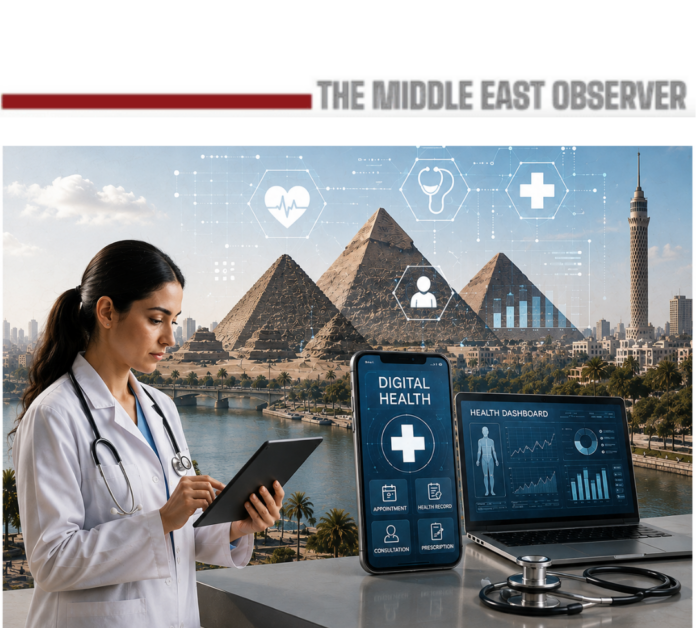
Access to specialist healthcare in Egypt has long been influenced by geography. For many patients living in remote governorates, obtaining expert medical care can still require travelling hundreds of kilometres to Cairo or another major medical centre. Digital health is beginning to change that equation.
Rather than requiring patients to travel to specialists, telemedicine enables specialist expertise to reach patients through secure digital networks linking primary healthcare units, regional hospitals and specialised medical centres. Local physicians can consult remotely with experts, share diagnostic images and laboratory results, and determine whether patients require referral or can continue treatment closer to home.
As Egypt modernises its healthcare system under the Universal Health Insurance programme, telemedicine has evolved from an experimental technology into an increasingly important component of healthcare reform. Its significance extends beyond improving access to care, encompassing healthcare efficiency, digital infrastructure, investment and long-term system resilience.
From Pilot Projects to National Strategy
Egypt has already demonstrated that telemedicine can operate beyond small-scale pilot programmes. Under the Digital Transformation for Sustainable Development in Egypt initiative, healthcare practitioners using telemedicine kits in remote communities have provided diagnoses for 90,976 patients, according to Egypt’s submission to the International Telecommunication Union’s WSIS Prizes 2026.
Although this represents a cumulative project outcome rather than nationwide annual activity, it illustrates that telemedicine is becoming a practical clinical service capable of extending specialist expertise into underserved communities where access has traditionally been constrained by distance, travel time and cost.
The initiative also highlights an important lesson: successful telemedicine depends not only on digital platforms, but equally on trained healthcare professionals, reliable connectivity, standardised clinical protocols and secure management of patient information.
Building the Digital Health Ecosystem
Telemedicine forms part of Egypt’s broader National Digital Health Strategy 2025–2029, which seeks to create an integrated, patient-centred healthcare system supported by interoperable electronic health records, secure information exchange and data-driven clinical decision-making.
The strategy complements the country’s ongoing rollout of Universal Health Insurance, where digital technologies are expected to improve coordination across primary, secondary and tertiary care while helping manage rising demand for healthcare services.
The World Health Organization has likewise identified digital health as a strategic priority for Egypt, emphasising stronger governance, interoperability, cybersecurity and regulatory oversight. Together, these initiatives recognise that digital transformation requires institutional reform as much as technological investment.
Expanding Telemedicine
Momentum accelerated in July 2026 when Deputy Prime Minister for Human Development and Minister of Health and Population Khaled Abdel Ghaffar met representatives of the Specialized Medical Councils, Novartis and healthcare technology company TeleMed to discuss expanding remote consultations across Egypt.
The discussions focused on improving communications infrastructure, strengthening physician collaboration, reducing administrative paperwork, enhancing patient-satisfaction monitoring and expanding home healthcare for elderly patients and those with limited mobility.
While the meeting demonstrated clear policy commitment, implementation timelines, funding mechanisms and nationwide deployment targets have yet to be announced.
The Economics of Digital Healthcare
Telemedicine is increasingly becoming an economic as well as a healthcare priority.
Remote consultations can reduce unnecessary referrals, lower patient travel costs, shorten waiting times and improve utilisation of specialist expertise. As Universal Health Insurance expands coverage, these efficiencies could help accommodate growing healthcare demand without proportionate increases in physical infrastructure.
Egypt’s strategy reflects a broader international shift towards digitally enabled healthcare. Governments worldwide are integrating telemedicine into routine clinical practice to address physician shortages, ageing populations, rising healthcare expenditure and unequal access to specialist services. Rather than replacing conventional medicine, digital platforms are becoming an additional layer that improves the efficiency and reach of existing healthcare systems.
A Growing Digital Health Market
Telemedicine is also creating opportunities across Egypt’s digital economy.
Expanding remote healthcare requires investment in broadband infrastructure, cloud computing, cybersecurity, electronic health records, artificial intelligence, diagnostic technologies and remote-monitoring devices. These developments create commercial opportunities for telecommunications companies, software developers, healthcare technology providers, medical-device manufacturers and cloud-service operators.
Private hospital groups and diagnostic centres are likewise expected to accelerate digital-health adoption through integrated medical records, online consultations and AI-assisted diagnostic tools, complementing public-sector healthcare modernisation.
Adoption Challenges
Professional support for digital healthcare continues to grow, but implementation remains uneven.
A 2025 study of physicians working in eight Universal Health Insurance hospitals in Port Said found that 74.6% considered telemedicine particularly valuable for underserved communities, while 80.6% reported using electronic health records. However, telemedicine services themselves had not yet been widely deployed across the surveyed hospitals, highlighting the gap between acceptance and operational readiness.
The research identified implementation costs, technical support, staff training, cybersecurity, privacy concerns and additional administrative workload as the principal barriers to wider adoption. Although the survey reflects experiences within Port Said rather than the national healthcare workforce, it provides useful insight into the practical challenges facing broader implementation.
AI and the Next Phase of Digital Healthcare
Artificial intelligence is expected to become the next stage of Egypt’s digital-health transformation. Internationally, AI is increasingly supporting radiology, pathology, ECG interpretation, clinical documentation and clinical decision support, enabling specialists to review larger numbers of cases more efficiently.
However, AI should complement—not replace—clinical judgement. Its successful adoption will depend on high-quality health data, transparent regulation, cybersecurity and robust medical governance.
Digital inclusion will be equally important. Older adults, patients with limited digital literacy and communities with weaker internet connectivity risk benefiting less from telemedicine unless investments in communications infrastructure and digital skills accompany technological expansion.
The Road Ahead
Telemedicine will never replace every clinical examination or hospital visit. Its greatest value lies in connecting patients with specialist expertise more quickly while ensuring that hospitals can focus resources on cases requiring in-person treatment.
Ultimately, Egypt’s digital-health strategy will be judged not by the number of virtual consultations conducted, but by whether it delivers earlier diagnoses, better clinical outcomes, more efficient use of healthcare resources and more equitable access to specialist care.
If these objectives are achieved, digital health will represent far more than a technological upgrade. It will mark a structural transformation in how healthcare is organised, enabling expertise and medical knowledge to move more efficiently across the country while reducing the extent to which geography determines access to quality care. As Egypt continues expanding Universal Health Insurance and investing in healthcare modernisation, digital health is positioned to become both a cornerstone of healthcare reform and an increasingly important pillar of the country’s digital economy.
Related news:
El-Sisi Advances Human Capital Strategy Through Health, Education, Research and Innovation
Egypt Prepares to Launch Its First Virtual Hospital in Ismailia
Read also:
Egypt launches diaspora-doctor telemedicine push under UHIS
From Diagnostic Imaging to Precision Medicine: How MRI Is Reshaping Healthcare in Egypt