As governments worldwide confront rising healthcare costs, ageing populations and growing demand for universal coverage, healthcare has become as much an economic policy priority as a social one. Countries that invest in accessible, high-quality healthcare generally benefit from healthier workforces, stronger productivity and greater long-term economic resilience. Against this backdrop, Egypt’s Universal Health Insurance System (UHIS) represents one of the country’s most ambitious structural reforms, positioning healthcare as a cornerstone of sustainable development under Egypt Vision 2030.
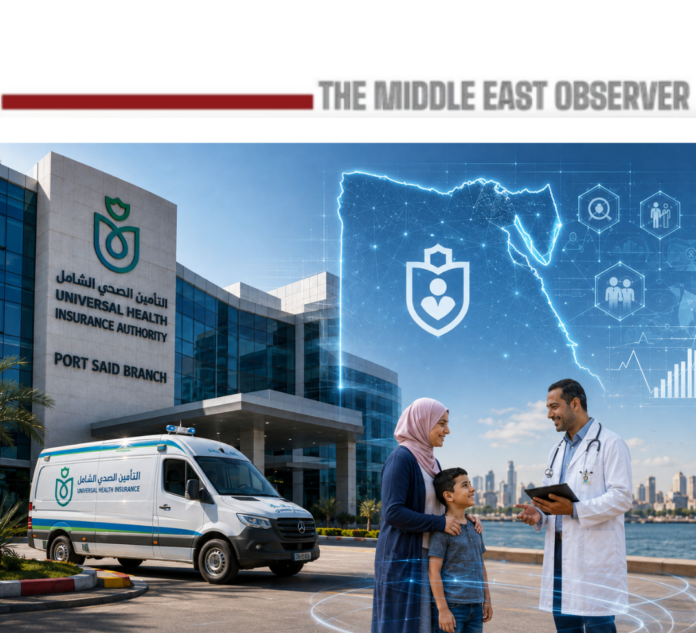
Established under Law No. 2 of 2018, the system is based on the principle of social solidarity, with families serving as the primary unit of coverage while the state finances insurance contributions for citizens unable to afford them. The first phase now covers six governorates—Port Said, Ismailia, Luxor, South Sinai, Suez and Aswan—with more than six million citizens enrolled and well over 117 million healthcare services delivered. Beyond expanding access to medical care, the programme aims to reduce out-of-pocket healthcare spending, improve service quality and establish a financially sustainable healthcare model.
Egypt adopted a phased implementation strategy, selecting Port Said as the country’s first fully operational governorate under the new system. Chosen for its relatively advanced healthcare infrastructure and manageable population, the governorate became the national pilot for evaluating operational performance before wider expansion. According to Dr Ahmed El Sobky, Chairman of the Egyptian Healthcare Authority, the project has transformed hospitals and primary healthcare centres through infrastructure upgrades, electronic medical records and integrated digital healthcare systems.
The programme provides a comprehensive package of healthcare services, including family medicine, specialist consultations, hospital treatment, complex surgeries, diagnostic imaging, laboratory testing, rehabilitation, pharmaceuticals, home healthcare and treatment for chronic diseases and cancer. By substantially reducing direct household healthcare expenditure, the system strengthens financial protection while improving equitable access to quality healthcare.
One of the programme’s most significant achievements has been expanding access to highly specialized treatments that were previously beyond the financial reach of many families. According to the Universal Health Insurance Authority and the Egyptian Healthcare Authority, hospitals operating under the scheme have successfully performed advanced cardiac surgery, complex reconstructive procedures, minimally invasive Mitral Clip (TEER) interventions, bone marrow transplantation and other specialized procedures across participating governorates. These examples demonstrate the programme’s evolution from providing essential healthcare to delivering advanced tertiary medical services.
Digital transformation has become another cornerstone of the reform. Integrated electronic medical records, digital referral systems and unified healthcare platforms have improved coordination between primary and specialist care, while reducing duplication of medical procedures and strengthening health data for clinical decision-making and public policy. Authorities also plan to expand the use of artificial intelligence in clinical decision support, predictive analytics, diagnostic assistance and telemedicine, further improving efficiency and expanding access to specialized care, particularly in underserved areas.
The reform aligns with the United Nations Sustainable Development Goals, which identify universal health coverage as a key pillar of sustainable development. Like many middle-income economies, Egypt faces the challenge of expanding healthcare access while preserving fiscal sustainability. Its phased implementation—combining insurance financing, institutional reform and digital transformation—offers a distinctive model for balancing broader healthcare coverage with long-term financial resilience.
The programme’s significance extends well beyond healthcare delivery. International evidence consistently links universal healthcare coverage with higher labour productivity, improved workforce participation and lower rates of catastrophic household healthcare expenditure. By reducing families’ medical costs, the system enables greater household spending on education, housing and consumption, while lowering the risk of poverty caused by unexpected healthcare expenses and supporting more sustainable long-term economic growth.
The expanding healthcare sector is also expected to stimulate investment in pharmaceuticals, biotechnology, medical devices and digital health technologies. Continued improvements in healthcare infrastructure and internationally accredited facilities could strengthen Egypt’s competitiveness as a regional destination for specialised medical tourism, particularly in cardiology, oncology and orthopaedic care, serving patients from across Africa and the Middle East.
Despite encouraging progress, important challenges remain. Nationwide implementation will require sustained public investment, continued expansion of healthcare infrastructure, recruitment and retention of qualified medical professionals, and consistent quality standards across all governorates. Maintaining financial sustainability as beneficiary numbers continue to grow will remain one of the programme’s principal long-term policy tests.
From a regional perspective, Egypt’s experience offers a practical model for countries seeking to expand universal healthcare while balancing social protection with fiscal responsibility. Unlike many regional reforms focused primarily on expanding public hospital capacity, Egypt combines healthcare financing, institutional governance, digital transformation and phased implementation within a single integrated framework.
Ultimately, Egypt’s Universal Health Insurance System represents far more than healthcare reform. It is a long-term investment in human capital, economic resilience and sustainable development. The Port Said experience demonstrates how universal healthcare can strengthen not only medical outcomes but also workforce productivity, investor confidence and social stability. The programme’s long-term success, however, will ultimately be measured by its ability to maintain financial sustainability, preserve service quality and improve health outcomes as nationwide implementation progresses. If these objectives are achieved, Egypt’s Universal Health Insurance System could become one of the Middle East’s most significant models for modern healthcare reform and one of the country’s most enduring structural investments in its future.
Related news:
Egypt, IFAD Expand $1.1bn Rural Development Partnership
Egypt’s Liquidity Boom Tests Financial Infrastructure Capacity
Read also:
Europe Tests AI Alternative to Palantir’s Battlefield System
Saudi-US Partnership Targets $500m to Advance Kingdom’s Biotechnology Ambitions