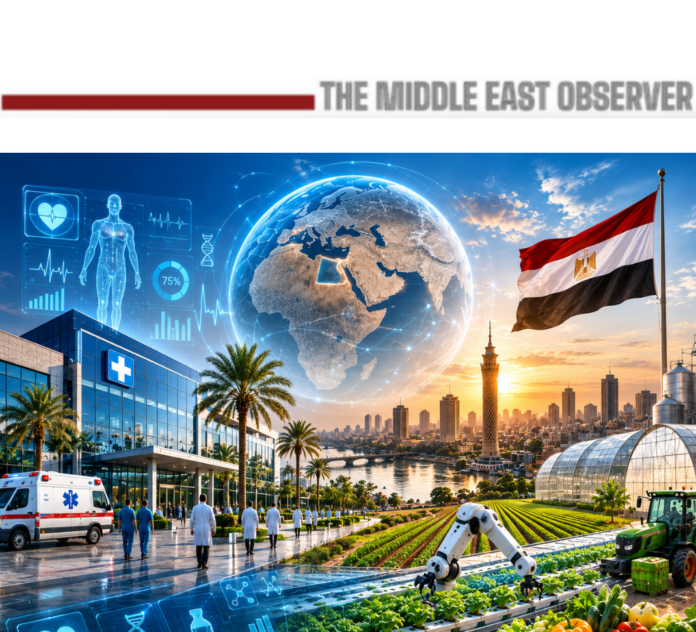
Egypt is positioning itself as one of the Middle East and Africa’s most promising destinations for healthcare investment, pharmaceutical manufacturing and food production. Backed by ambitious government reforms, rising private-sector investment and large-scale national development projects, the country is steadily integrating healthcare, agriculture and advanced manufacturing into a broader economic growth strategy. As Egypt advances toward its Vision 2030 objectives and looks ahead to 2035, this convergence could strengthen its role as a regional hub for medical services, pharmaceuticals, biotechnology and food security.
One of the strongest foundations of this transformation is sustained investment in healthcare. Egypt’s FY 2025/26 state budget allocated EGP 617.9 billion to healthcare and related services, reflecting one of the largest public investments in the sector’s history. Alongside increased spending, the government’s Universal Health Insurance (UHI) programme is being implemented in successive phases, with nationwide coverage planned as the system expands across governorates. Beyond improving access to healthcare, the reform is expected to stimulate long-term investment opportunities across hospitals, diagnostics, medical technology, health insurance and private healthcare services.
Preventive medicine has become another defining feature of Egypt’s healthcare strategy. The internationally recognised 100 Million Healthy Lives initiative screened more than 60 million citizens for hepatitis C, diabetes, hypertension and obesity, making it one of the world’s largest population health programmes. The campaign significantly reduced hepatitis C prevalence while demonstrating Egypt’s ability to implement healthcare initiatives at national scale. It has since been complemented by nationwide programmes focusing on women’s health, breast cancer screening, maternal healthcare and early diagnosis of chronic diseases, reinforcing a shift from treating illness to managing population health through prevention and early intervention.
Healthcare and Food: Two Industries Driving Future Growth
The pharmaceutical industry has become one of Egypt’s fastest-growing strategic sectors. According to the Egyptian Drug Authority (EDA), Egypt’s pharmaceutical market reached approximately EGP 422 billion (around US$8.5 billion) in 2025, representing annual growth of around 37%. Domestic manufacturers now supply approximately 91% of medicines consumed locally, while the government is accelerating the localisation of active pharmaceutical ingredients (APIs), expanding vaccine production and encouraging investment in biologics and other high-value medicines. Today, Egypt is widely recognised as one of Africa’s largest pharmaceutical markets and among the region’s leading pharmaceutical manufacturing centres, serving both domestic demand and export markets.
The sector is also evolving beyond conventional pharmaceuticals. New investments in biotechnology, vaccine manufacturing and biosimilars are positioning Egypt higher within the pharmaceutical value chain. Facilities such as GENNVAX and ongoing expansion by VACSERA and private-sector manufacturers reflect a broader strategy to develop advanced biological medicines capable of serving both Egyptian patients and rapidly growing healthcare markets across Africa and the Middle East.
Digital transformation is reinforcing these developments. Artificial intelligence is increasingly supporting medical imaging, diagnostics and clinical decision-making, while telemedicine is improving access to specialist care in underserved governorates. Continued investment in digital hospitals, electronic health records and connected healthcare infrastructure is expected to improve efficiency while creating new opportunities for health technology companies.
Food production represents the second pillar of Egypt’s long-term strategy. Large-scale agricultural developments—including the New Delta Project, Mostakbal Misr and Toshka—are collectively expanding Egypt’s cultivated land by well over two million feddans through modern irrigation, treated wastewater reuse, mechanised farming and precision agriculture. These projects aim to strengthen food security, increase domestic production of strategic crops, reduce import dependence and improve resilience against climate-related challenges.
The agricultural transformation increasingly supports broader public health objectives. Greater production of fruit, vegetables, dairy products and higher-value crops is strengthening domestic food availability while supporting a growing food processing industry. At the same time, rising consumer demand for healthier diets is encouraging manufacturers to invest in functional foods, high-protein products, sugar-reduced beverages and nutritionally enhanced processed foods, creating new commercial opportunities where agriculture, nutrition and healthcare intersect.
Egypt’s expanding food manufacturing industry is already demonstrating increasing international competitiveness. According to the Food Export Council, processed food exports reached US$2.43 billion during January-April 2026, up 7.1% from the same period in 2025. The sector’s top fifteen export products generated US$1.72 billion, accounting for 71% of total processed food exports, led by frozen strawberries, cola concentrates, chocolate and edible oils. Continued investment in quality standards, food safety, cold-chain logistics and export infrastructure is expected to further strengthen Egypt’s position in regional and international markets.
Healthcare and food production are becoming increasingly interconnected through shared investments in logistics, cold storage, laboratory testing, biotechnology, quality assurance and digital traceability systems. These integrated supply chains are improving both pharmaceutical distribution and food exports while supporting Egypt’s ambition to become a regional manufacturing and logistics gateway linking Africa, the Middle East and Europe.
Significant challenges remain. Expanding universal healthcare will require sustained public financing, continued private-sector participation and ongoing improvements in healthcare workforce capacity. Agricultural growth must contend with water scarcity, climate change and the need to improve productivity through innovation and efficient resource management. Pharmaceutical manufacturers also face increasing international competition and must continue investing in research, biotechnology and advanced manufacturing to remain globally competitive.
Nevertheless, Egypt possesses several structural advantages that few regional competitors can match: a population exceeding 100 million, one of Africa’s largest pharmaceutical manufacturing bases, expanding healthcare infrastructure, strategic access to regional export markets, and ambitious agricultural modernisation programmes. Supported by continued regulatory reform and investment, these advantages provide a strong platform for long-term growth.
By integrating healthcare reform, pharmaceutical manufacturing, biotechnology, agricultural innovation and value-added food processing into a unified national development strategy, Egypt is building a more diversified and resilient economy. If current reforms continue, 2035 could mark Egypt’s emergence as one of the Middle East and Africa’s leading healthcare and food production hubs—supplying medicines, biotechnology products, advanced medical services and high-value food exports to rapidly growing regional and international markets while strengthening both economic competitiveness and national food security.
Related news:
Morocco Overtakes South Africa in Industrial Competitiveness Ranking
Alkan Joins Egypt’s Drive to Build a Regional Auto Hub
Read also:
Egypt Expands Capital Market Reform with 10 New Non-Banking Financial Licences
Egypt’s New Delta Megaproject Signals Strategic Shift in Food Security and National Development