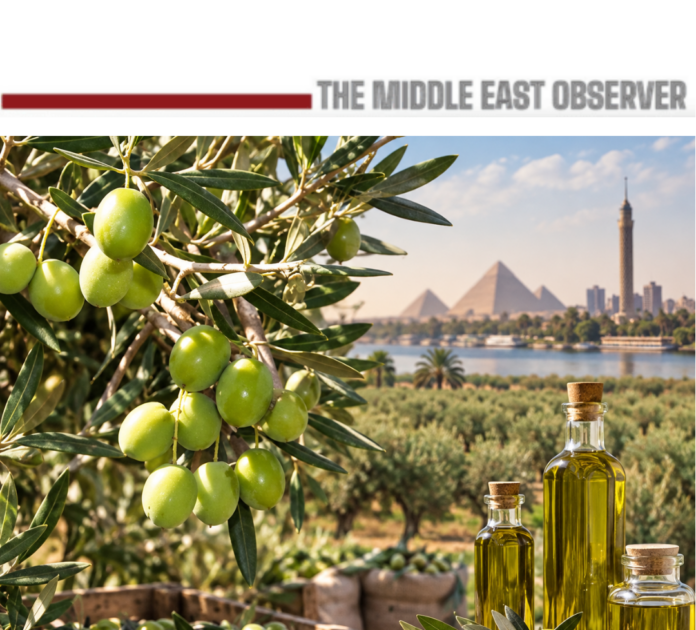
Egypt and the UN Food and Agriculture Organization are preparing a strategic framework for the country’s olive industry as Cairo seeks to convert its position among the world’s largest table-olive producers into greater processing, export and foreign-currency returns.
Agriculture Minister Alaa Farouk and FAO regional representative AbdulHakim Elwaer witnessed the signing on September 10 of two memoranda of understanding. One will prepare a master plan for agricultural and rural development in South Sinai; the other will assess Egypt’s olive value chain from production through processing and marketing. No investment, acreage or export targets have yet been disclosed.
The commercial case is substantial. Egypt accounted for 18% of global table-olive production in 2024/25, equivalent to almost 600,000 tonnes based on International Olive Council figures. Domestic consumption reached about 540,000 tonnes, underlining the scale of the industry but also the large share absorbed by the local market.
Exports already generate significant revenue. Egypt’s Food Export Council says prepared and preserved olives under the main HS 200570 category earned $184mn in 2024, accounting for more than 81% of the country’s olive exports.
But French trade data illustrate the unit-value gap. Egypt supplied about 6,000 tonnes of table olives to France in 2023 at an average import value of €1,136 a tonne, compared with €1,757 for Morocco, €2,000 for Spain and €3,650 for Greece. CBI says most Egyptian olives entered France in bulk packaging and were subsequently repacked there.
The comparison does not establish profit margins—the products, varieties and packaging differ—but it highlights where Egypt could capture more value. Greater returns can come from grading, fermentation, stuffing, marinating, retail packaging, certification, geographical indications and branding rather than simply increasing bulk volumes.
Olive oil offers another route to value addition, but also illustrates the competitive challenge. IOC data put Tunisia’s 2024/25 olive-oil output at 340,000 tonnes and Spain’s at about 1.42mn tonnes, while IOC figures cited for Egypt put production at around 40,000 tonnes. Egypt would therefore be competing against Mediterranean producers with much deeper milling capacity, established export networks and stronger international brands.
South Sinai could serve as a practical test of the model. The governorate already contains seven of Sinai’s 18 agricultural clusters, while the integrated agricultural centre at El-Qaa includes an olive press, storage facilities and water-treatment infrastructure. The issue is whether such infrastructure can connect small producers to processing, tourism demand and higher-value markets rather than function principally as isolated land-development projects.
Water makes that test more demanding. FAO-linked research says farmers use about 85% of Egypt’s Nile water allocation for irrigation, making water productivity central to any expansion strategy. The relevant measures should therefore extend beyond tonnes per feddan to export value per tonne—and ultimately economic value generated per cubic metre of water.
The success of the FAO framework should therefore be judged not by the number of additional olive trees planted, but by whether Egypt raises processing investment, export unit values and foreign-currency earnings while improving water efficiency. Production scale gives Egypt an advantage; converting that scale into higher domestic value capture is the unfinished part of the strategy.
Related news:
Egypt’s Food Export Growth Shifts From Volume to Value as Europe Gains Ground
Made in Lebanon: How Crisis Is Rebuilding the Productive Economy
Read also:
Tunisia: A Nation Balancing Heritage, Reform and Regional Partnership