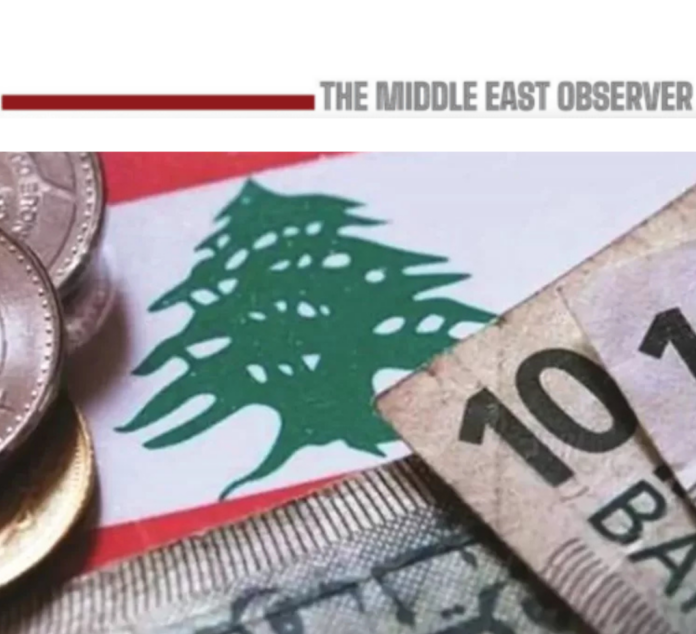
Currency collapse, conflict and import disruption have pushed Lebanese businesses towards local production. From food processing to manufacturing and renewable energy, SMEs are testing whether survival strategies can become the foundations of a more productive economy.
Lebanon entered its economic collapse with longstanding structural weaknesses: a narrow productive base, heavy dependence on imports, chronic fiscal imbalances and an oversized financial sector. The crisis that erupted in 2019 was compounded by sovereign default, the banking system’s breakdown, the 2020 Beirut port explosion and successive regional conflicts.
The collapse forced businesses to adapt. Companies shifted towards market-based pricing, private-sector wages became increasingly dollarised, remittances supplied households with foreign currency and producers sought to reduce exposure to expensive imported inputs.
Those adjustments helped restore a degree of commercial functionality. The World Bank estimates that real GDP expanded 3.5 per cent in 2025 after years of contraction and projected growth of about 4 per cent in 2026, conditional on political stability, reforms and reconstruction investment.
But recovery remains fragile. Regional instability, damaged infrastructure and Lebanon’s unresolved financial crisis continue to constrain investment, while disruption to energy and shipping markets has reinforced the vulnerability of an economy dependent on imported fuel and intermediate goods.
SMEs Move to the Centre
Small and medium-sized enterprises are central to rebuilding Lebanon’s productive base. They account for about 95 per cent of registered businesses and more than half of formal-sector employment, according to the Ministry of Economy and Trade.
The currency collapse also changed their competitive environment. As imported products became more expensive, locally produced alternatives gained space. Businesses able to source inputs domestically, limit foreign-currency costs or target export markets acquired advantages that mattered less under Lebanon’s previous import-heavy model.
Agrifood provides one of the clearest examples. Lebanon retains established capabilities in processed foods, olive oil, wine, confectionery, dairy products and fruit and vegetable production.
Companies such as DEL LIBANO, The Good Thymme, DOODA, AGREEN Selection and Agrifresh illustrate attempts to connect Lebanese agricultural resources with processing, branding and higher-value products. The significance extends beyond individual businesses: linking farms with processors and exporters allows more of the value generated by domestic production to remain within the economy.
Industry Finds an Export Route
The shift is not confined to food.
Lebanon’s industrial sector spans pharmaceuticals, chemicals, metals, electrical equipment, construction materials, furniture and other specialised manufacturing. Official investment data put industry’s contribution at roughly 7.5 per cent of national output and employment at about 140,000.
More importantly, there are signs that parts of the sector are recovering their external competitiveness. Lebanese industrial exports rose 15.35 per cent to $2.9bn in 2025, their highest level in a decade, according to Ministry of Industry figures. The performance suggests that local manufacturing is doing more than filling gaps left by expensive imports: parts of the sector are again generating foreign-currency earnings.
Pharmaceutical production offers another strategic example. Lebanese manufacturers produce a range of medicines domestically, retaining industrial expertise in a sector where foreign-currency shortages and supply disruptions have demonstrated the risks of excessive dependence on imported finished products.
The opportunity is therefore not conventional import substitution, but selective expansion in industries where Lebanon can combine skills, established businesses and access to regional markets.
Energy Crisis Drives a Solar Economy
Energy provides perhaps the clearest illustration of crisis-induced adaptation.
Lebanon’s chronic electricity shortages and reliance on costly private diesel generators triggered a remarkable expansion of decentralised solar power. Installed solar capacity had already risen above 690MW by 2022, as households and businesses sought alternatives to an unreliable national grid.
For companies, solar power became less an environmental choice than an operating necessity.
The expansion supported an ecosystem of engineers, installers and manufacturers. Lebanese companies such as DAWTEC manufacture solar-energy products domestically, while NetLife produces solar water-heating systems. Electricity-system weakness has therefore generated demand for private energy solutions and, with it, opportunities for local production and technical services.
This is not industrialisation in the conventional sense. But it demonstrates how crisis can alter investment incentives, creating markets for capabilities that struggled to compete under the previous economic model.
Import Substitution Has Limits
Lebanon remains far from economic self-sufficiency. It continues to depend heavily on imported fuel, machinery, food inputs and intermediate goods, while domestic producers face expensive energy, inadequate infrastructure, constrained financing and weakened purchasing power.
The social picture remains equally difficult. Around 1.24mn people are projected to face Crisis-level or worse acute food insecurity between April and August 2026, demonstrating that increased domestic production cannot by itself overcome conflict, displacement and income losses.
Nor can entrepreneurial resilience repair the financial system. Unresolved banking losses and Lebanon’s exclusion from international capital markets continue to restrict investment.
The objective should therefore not be to replace imports indiscriminately, but to identify sectors where Lebanon possesses genuine productive capabilities — including agrifood, pharmaceuticals, specialised manufacturing and renewable-energy technologies — and connect them more effectively to export markets.
Recent developments offer an opening. Saudi Arabia’s decision to lift its five-year ban on Lebanese imports potentially restores access to an important Gulf market for Lebanese producers. Lebanon is also seeking to reset its economic relationship with neighbouring Syria, where bilateral trade had fallen to about $250mn from a previous peak near $800mn.
From Survival to Strategy
The larger question is whether adaptations born from crisis can become an economic strategy.
Since 2019, currency depreciation encouraged dollarisation; expensive imports encouraged local sourcing; banking restrictions forced alternative financing; electricity shortages accelerated decentralised energy; and supply disruptions pushed businesses to diversify.
Turning those defensive responses into sustainable growth will require reliable infrastructure, access to finance, stronger commercial institutions and policies that encourage investment in higher-value production.
Lebanon’s diaspora could provide part of that bridge. Remittances have already sustained consumption and supplied the dollarised economy with foreign currency. Directing more diaspora capital towards productive, export-oriented businesses could help shift the economy from survival towards investment.
Regional integration offers another route. Egypt illustrates the potential. Egyptian exports to Lebanon reached about $970mn in 2025, while Lebanese exports to Egypt were roughly $245mn, putting two-way merchandise trade above $1.2bn. The relationship already encompasses fuels, metals, agricultural products, machinery and electrical equipment, providing an existing base for deeper production and supply-chain links.
Lebanon’s private sector cannot indefinitely compensate for dysfunctional institutions, damaged infrastructure or unresolved financial losses. But the experience since 2019 has demonstrated an important shift: as the country’s old import- and finance-dependent model broke down, parts of its private sector began rebuilding from the production side.
“Made in Lebanon” is therefore becoming more than a label. Across agriculture, manufacturing and energy, it represents an effort to retain more value within the economy, reduce external vulnerability and turn local capabilities into tradable products.
The $2.9bn rebound in industrial exports suggests that this transition is no longer confined to crisis-driven substitution at home. The more important test is whether Lebanon can turn that resilience into sustained investment, productivity and export growth.
Whether it succeeds will depend less on the ability of Lebanese businesses to survive another crisis than on whether the country can finally create the conditions that allow them to grow beyond one.
Related news:
New Clay Technology Challenges Traditional Cement Production
Egypt’s Private Sector Strained by Cost Pressures as Stabilisation Becomes Imperative
Read also:
Europe Under Fire: Wildfires Scorch an Area the Size of Luxembourg
Madbouly Pushes Industrial Expansion as Egypt Targets $100bn Exports by 2030