With Africa’s largest district-cooling plant operating in the New Administrative Capital, Egypt has examined whether seawater could offer a lower-carbon way to cool its expanding coastal cities.
As Egypt develops a new generation of cities, particularly along its Mediterranean and Red Sea coastlines, an increasingly important infrastructure question is emerging: how to keep buildings cool without adding disproportionately to summer electricity demand.
Egypt already has experience with one solution. District cooling replaces individual building chillers with central plants that produce chilled water and distribute it through insulated underground networks. Heat exchanges transfer the cooling to individual buildings without mixing the two water systems.
At sufficient scale, the technology can improve efficiency and reduce peak electricity demand, turning cooling from a building-level service into a form of urban energy infrastructure.
Egypt builds district cooling at scale
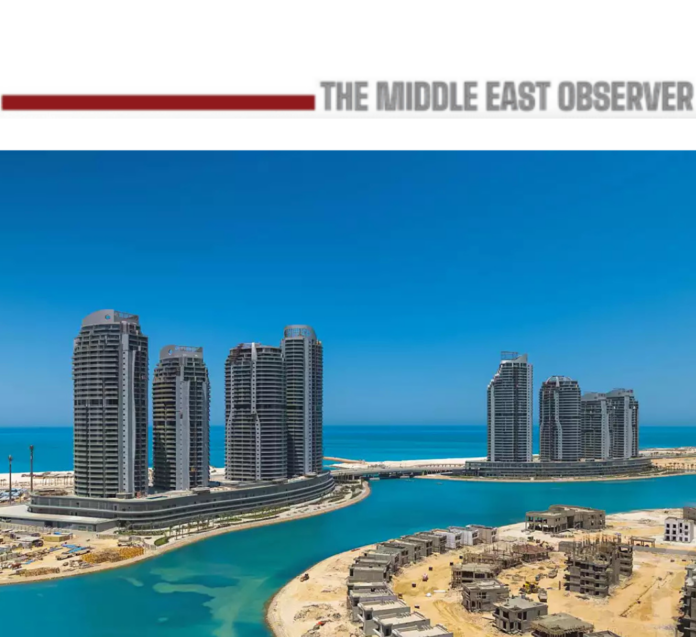
The New Administrative Capital provides Egypt’s largest test case.
Its district-cooling system has an initial capacity of about 64,000 refrigeration tonnes (RT), with plans to expand capacity towards 300,000 RT. The first phase serves the Government and Financial districts and other strategic buildings, using a combination of electricity, natural gas and thermal-energy storage.
In June, the capital’s DCP-1 plant was named MEP Project of the Year at the 2026 Big 5 Egypt Impact Awards.
Egypt’s experience predates the New Capital. Gascool developed a 17,000-RT district-cooling project at Smart Village in 2004 and later a 5,500-RT system serving the American University in Cairo’s New Cairo campus.
The New Capital represents a significant increase in scale, demonstrating how cooling can be planned as urban infrastructure rather than installed building by building.
The Gulf demonstrates the model
Across the Gulf, district cooling has developed into a sizable utility business.
Dubai’s Empower operates about 90 plants with 1.66mn RT of connected capacity, supplying more than 1,700 buildings. Qatar and Saudi Arabia have similarly deployed large systems across commercial, residential and infrastructure developments.
Qatar Cool illustrates the potential efficiencies. United Development Company’s 2025 annual report said the operator had cumulatively saved about 4.6bn kWh of electricity and avoided approximately 2.5mn tonnes of CO₂ emissions.
For Egypt, the Gulf demonstrates both the potential scale of district cooling and an investment model based on long-lived infrastructure serving dense urban developments.
Could the Mediterranean provide the cooling?
Egypt’s more distinctive opportunity lies in combining district cooling with Seawater Air-Conditioning (SWAC).
SWAC uses naturally cold water from deep below the sea surface rather than relying principally on electrically powered chillers. The seawater is pumped ashore and passed through heat exchangers, cooling a separate freshwater circuit supplying buildings before being returned to the sea.
Pumping still requires electricity and deep-water pipelines involve significant capital expenditure. But where cold water can be accessed economically, SWAC can sharply reduce the mechanical refrigeration required.
That possibility has already been studied in Egypt.
New Alamein as a potential test case
The UN Environment Programme examined a SWAC system for New Alamein City, using deep Mediterranean water to supply a central cooling network.
The concept envisaged a 30,000-RT plant, requiring estimated investment of about $117mn for production facilities and another $20mn-$25mn for distribution.
UNEP projected approximately a 99 per cent reduction in refrigerant emissions and a 40 per cent reduction in CO₂ emissions compared with conventional air-conditioning.
The figures are significant, but the distinction between feasibility and implementation is important. The study demonstrates the technology’s potential rather than confirming that a commercial SWAC system will be built at New Alamein.
Cooling becomes an energy-security question
For Egypt, the significance extends beyond emissions.
The country’s long coastlines coincide with expanding urban and tourism developments, while new cities provide an opportunity to install district-energy networks before construction density makes such infrastructure more difficult and expensive.
More importantly, cooling is increasingly intertwined with Egypt’s summer electricity challenge. Peak power demand reached 39,300MW in July 2026, about 2,000MW above the comparable level a year earlier, as high temperatures pushed consumption higher. The government had already been preparing for an 8 per cent increase in summer electricity demand, prompting closer coordination between the electricity and petroleum ministries over fuel supplies for power generation.
Buildings are central to that pressure. Research estimates that residential and commercial properties account for almost half of Egypt’s electricity consumption, with air-conditioning representing a major component of building demand.
The implications extend into the gas market. Reducing peak cooling requirements can potentially ease pressure not only on the electricity network but also on the fuel required to operate thermal generating capacity during periods of highest demand.
Cooling efficiency is therefore no longer simply a sustainability question. For Egypt, it increasingly intersects with power-sector investment, natural-gas demand and energy security.
The economics, however, are not automatic. District cooling requires substantial upfront capital and works best where developments have sufficient density and predictable long-term demand. SWAC adds further requirements involving water depth, seabed conditions, pipelines and marine safeguards.
Investors also require clarity over concessions, tariffs, connection rules and long-term demand before committing capital to infrastructure designed to operate for decades. The Gulf experience suggests these commercial arrangements can be as important as the engineering itself.
For decades, air-conditioning has largely been treated as a building-level decision. Rising temperatures, urbanization and pressure on electricity systems are increasingly turning it into an infrastructure question.
The New Administrative Capital has demonstrated that Egypt can operate district cooling at a substantial scale. New Alamein raises a more ambitious possibility: whether the country’s geography could eventually become part of the infrastructure used to cool its coastal cities.
The Mediterranean will not provide a universal solution. But where the engineering and economics align, Egypt’s coastline could become part of the infrastructure supporting its expanding coastal cities.
It could also help reduce the energy required to keep the country’s next generation of cities cool.
Related news:
Australia’s Social Media Law Could Rewrite the Rules of the Digital Economy
Beyond Hormuz: Route Diversification Becomes Critical for Gulf Export Security
Read also:
District Cooling Gains Ground as Singapore Seeks Climate Resilience