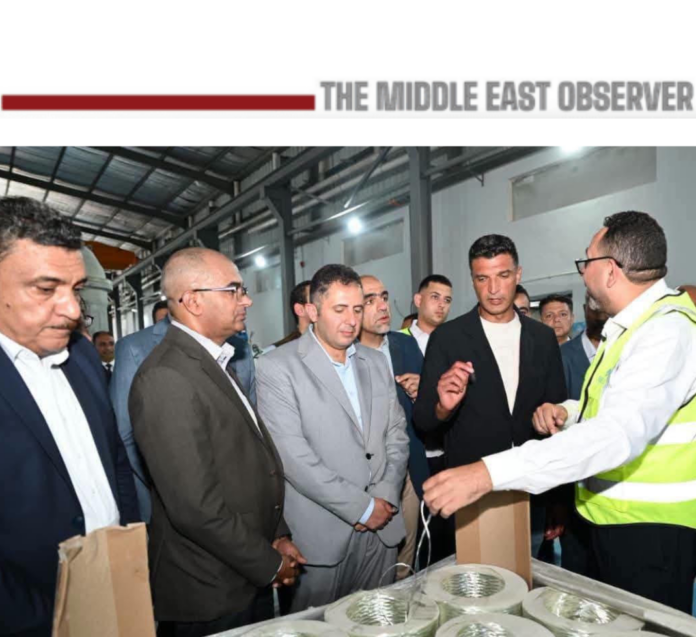
Egypt’s Industry Minister Khaled Hashem inspected major manufacturers in Damietta on Sunday, August 23, as Cairo seeks to increase industrial exports, deepen domestic manufacturing and draw more investment into export-oriented production. Accompanied by Damietta Governor Hossam El-Din Fawzi, Hashem toured the General Free Zone and Damietta Furniture City, reviewing operations spanning fertilizers, textiles, water-treatment equipment and furniture.
At the General Free Zone, MOPCO operates a 400,000-square-metre fertilizer complex representing about EGP53 billion in investment. According to figures presented during the visit, the complex has annual capacity of about 1.8 million tonnes of urea and 1.2 million tonnes of ammonia, while MOPCO says roughly 45% of its output is exported to European markets.
Egypt’s chemicals and fertilizers exports reached approximately $9.4 billion in 2025, up 7% year on year, with fertilizers accounting for close to one-third of the total, according to figures cited by Hashem.
Textile producer DNM, meanwhile, is targeting a 50% increase in annual exports to $180 million from about $120 million currently. Its Damietta operation represents around $170 million in investment, has annual production capacity of 48 million square metres and employs approximately 2,400 people.
Pure Life represents the import-substitution side of the industrial strategy. The EGP500 million manufacturer produces filtration, water-treatment and desalination equipment with reported local content of 60%-100%, exports to 53 countries and has annual capacity of about 3 million micron filters.
The wider tour included Damietta Furniture City, where Hashem inaugurated Mix Door’s EGP100 million interior-door factory. The facility has annual capacity of 100,000 doors and exports around a quarter of its production to Saudi Arabia and Iraq.
Together, the projects illustrate Egypt’s effort to broaden its manufacturing base: fertilizers generate foreign-currency export revenues, textiles and furniture add labour-intensive export capacity, while locally manufactured water-treatment equipment supports import substitution. Egypt’s 2026-2030 industrial strategy targets $100 billion in annual non-oil exports by 2030, alongside higher domestic manufacturing and investment.
Related news:
Foreign Buying Gives Way to Domestic Buying as (EGX) Ends Week Higher
Delta Fertilizers to Reignite Egypt’s Chemical Industry with €100 Million Investment
Read also:
Exports and Local Demand Fuel Methanex Expansion Plans
Madbouly Pushes Industrial Expansion as Egypt Targets $100bn Exports by 2030