A newly discovered Roman-era tomb in Egypt’s Dakhla Oasis has brought together Egyptian funerary religion, Greek literary culture and Roman imperial rule in a single burial complex dating back roughly 1,700 years.
The pyramid-shaped mudbrick tomb, uncovered at Bir Al-Shaghala by an Egyptian archaeological mission affiliated with the Supreme Council of Antiquities, is believed to have been used for the burial of a man and his wife.
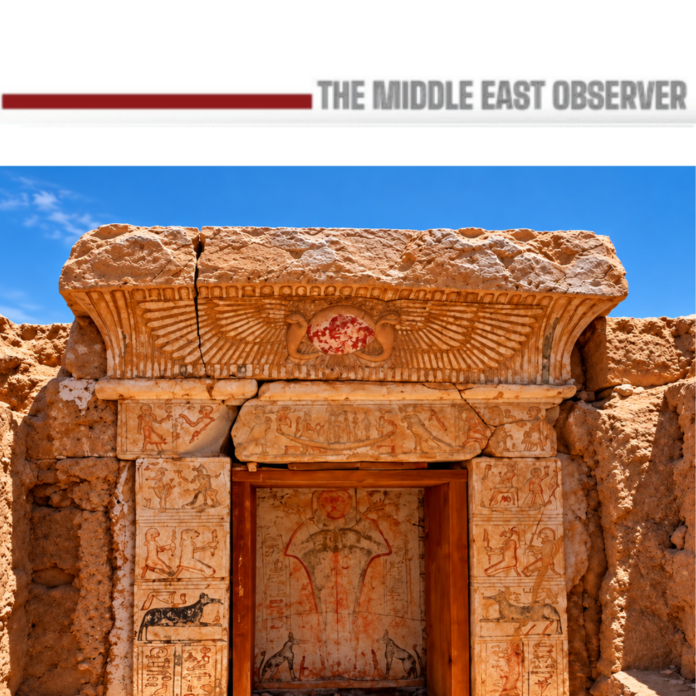
Fourteen steps lead down to its sandstone entrance, where a winged sun disk rises above two cobras and hieroglyphic funerary texts cover the doorway.
On the lintel, archaeologists identified a scene from the seventh hour of the Amduat, depicting the sun god’s journey through the underworld. According to the Supreme Council of Antiquities, it is the first documented example of this scene found among the tombs of the Bir Al-Shaghala necropolis.
The complex dates to the late third or early fourth century AD, when Egypt formed part of the Roman Empire.
Beyond the entrance, archaeologists uncovered a vaulted mudbrick hall and two burial chambers. A stone blocking slab bearing an image of Osiris and funerary spells had sealed the passage.
But the most personal find came in another language.
A Greek Voice Inside an Egyptian Tomb
Set into the southern wall of the tomb, archaeologists discovered a rectangular stone funerary stele carrying a 19-line elegy written in Ancient Greek in red ink.
The poem commemorates a man named Psychtis. Preliminary studies suggest that he may have served as a judge, although his profession has not yet been conclusively established.
The inscription does not determine Psychtis’s ethnic identity. It does, however, show that Greek remained a language of literary and funerary expression in Roman-period Egypt, even deep in the Western Desert.
The juxtaposition captures the tomb’s historical significance: Egyptian theology framed a personal memorial written in Greek.
A Roman Coin Adds a Third Dimension
Roman imperial rule is represented by a far smaller find: a bronze coin bearing the image of Emperor Constantine.
Archaeologists also recovered pottery vessels, a sandstone offering table and a sandstone purification basin.
The coin connects activity at the burial complex to the wider monetary and political system of the Roman Empire, although its presence alone cannot establish the precise date when the tomb was first constructed.
Taken together, the finds suggest not three separate cultural worlds, but one Roman-period Egyptian society in which local religion, Greek literary traditions and imperial institutions overlapped.
A Tomb With a Possible Second Life
The tomb may also have remained in use after its original burial.
Archaeologists found a mudbrick chapel above the main entrance and a funerary shrine in front of it, supported by four square mudbrick columns.
The arrangement suggests that the complex may have been reused or modified at a later date, although its chronology and purpose remain uncertain.
Further excavation may clarify who returned to the site and how the complex evolved.
Why Dakhla Matters
Bir Al-Shaghala forms part of the necropolis associated with ancient Mut, the principal settlement of Dakhla Oasis during the Ptolemaic and Roman periods.
Excavations at the site began in 2002 and have since uncovered tombs of different architectural forms, gradually expanding the archaeological record of one of Egypt’s major Western Desert settlements.
Although geographically remote, Dakhla was not culturally isolated. Its communities remained connected to the broader economic, linguistic and political networks of Roman Egypt and the Mediterranean world.
The latest discovery makes that connection unusually visible.
Its hieroglyphs preserve Egyptian religious traditions. Its Greek elegy preserves the memory of an individual. Its Roman coin places the burial complex within the political and monetary system of the empire.
Nearly 1,700 years later, the tomb offers more than a burial record. It preserves evidence of a Roman-period Egypt in which ancient Egyptian religion remained active, Greek continued to carry personal memory and Rome provided the political framework around both.
The name Psychtis, written in red ink inside a Western Desert tomb, has survived them all.
Related News :Tourism in Egypt
This is how Pharaohs made it !
Read also : North Sinai Unearths Temple Linking Pharaonic, Greek, and Roman Traditions
New Roman Tomb Discovery in Minya Reveals Ancient Burial Rituals