How Nature’s Pharmacy Is Becoming a Multi-Billion-Dollar Industry
For millennia, medicinal plants have served as humanity’s first pharmacy. Today, they are entering a new scientific era as artificial intelligence (AI), genomics and advanced analytical technologies transform traditional herbal remedies into evidence-based therapeutics. Rather than competing with conventional pharmaceuticals, medicinal plants are increasingly providing the foundation for discovering new bioactive compounds that could address chronic diseases, antimicrobial resistance and the growing demand for preventive healthcare.
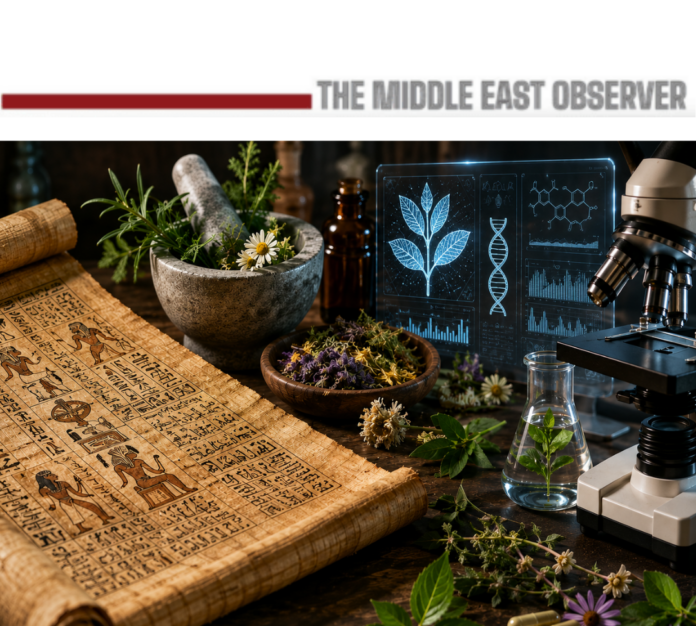
Ancient Egypt occupies a unique place in this evolution. The Ebers Papyrus, dating to around 1550 BC, is among the world’s oldest surviving medical texts, documenting hundreds of herbal preparations derived from garlic, aloe vera, myrrh and fenugreek. While the ancient Egyptians did not invent herbal medicine, they were among the first civilizations to systematically record, classify and standardize medicinal plants—creating a knowledge base that continues to inspire biomedical research more than 3,500 years later.
Today, science is revealing why many traditional remedies endured for centuries. Unlike conventional medicines, which generally rely on a single active ingredient, medicinal plants contain dozens or even hundreds of naturally occurring compounds that may interact across multiple biological pathways. AI is enabling researchers to analyse these complex molecular networks, predict therapeutic activity, identify potential toxicities and screen thousands of plant-derived compounds in a fraction of the time required by traditional drug discovery. Complementary technologies—including DNA barcoding, metabolomics and systems biology—are also improving quality control by authenticating plant species, standardizing herbal extracts and ensuring pharmaceutical-grade consistency.
Several medicinal plants remain at the forefront of research. Curcumin from turmeric continues to be investigated for anti-inflammatory applications, ginger for digestive disorders and nausea, chamomile for sleep and anxiety, and ashwagandha for stress management. While laboratory and early clinical findings are encouraging, researchers emphasise that larger, well-controlled clinical trials remain essential before many botanical therapies can be incorporated into mainstream medical practice.
The scientific renaissance is also creating a rapidly expanding global industry. The herbal medicine market is estimated at approximately US$271 billion in 2026 and is projected to exceed US$515 billion by 2034, supported by rising consumer interest in preventive healthcare, natural therapeutics and wellness products. Europe accounts for the largest regional share, while the Middle East and Africa represent a market worth around US$8.5 billion, with demand expected to grow alongside expanding retail, digital health and pharmaceutical manufacturing capabilities. According to the World Health Organization, 75–80% of the global population continues to rely on traditional medicine, including herbal remedies, for at least part of their primary healthcare needs.
For the Middle East and North Africa, the opportunity extends well beyond retail herbal products. Governments across the region are encouraging pharmaceutical localisation, investment in active pharmaceutical ingredients (APIs), botanical extracts and nutraceutical manufacturing to reduce dependence on imports and strengthen healthcare resilience. Higher-value processing—including essential oils, standardised botanical extracts and pharmaceutical-grade ingredients—is increasingly replacing the export of unprocessed medicinal plants. Egypt, already recognised as one of the world’s leading exporters of medicinal and aromatic plants, is well positioned to capture greater value by integrating biotechnology, pharmaceutical manufacturing and AI-enabled research with its established agricultural base.
Private-sector investment is already reflecting this shift. Egyptian companies are expanding production of medicinal herbs, nutritional supplements and botanical ingredients, while new processing facilities for dried herbs, essential oils and pharmaceutical raw materials are supporting export diversification. Long-established businesses such as Harraz, founded in Cairo in 1939, demonstrate how traditional herbal expertise can evolve into modern manufacturing through quality assurance, product standardisation and international distribution. Across the Gulf, regulatory reforms are also encouraging the development of clinically validated herbal medicines and complementary healthcare products.
The World Health Organization’s Traditional Medicine Strategy 2025–2034 reflects this broader transformation, advocating evidence-based integration of traditional medicine while emphasising rigorous standards for safety, efficacy and quality. The future of herbal medicine therefore lies not in validating every traditional remedy, but in applying the same scientific scrutiny expected of modern pharmaceuticals. As artificial intelligence, molecular biology and precision medicine continue to converge, nature’s pharmacy is evolving from a repository of ancient knowledge into a strategic platform for pharmaceutical innovation, industrial investment and sustainable healthcare development.
Related news:
Cairo University Enters Top 10% Globally in SCImago 2026 Ranking
Aquaculture: Balancing the Benefits and Risks of Fish Farming
Read also:
El-Sisi Advances Human Capital Strategy Through Health, Education, Research and Innovation