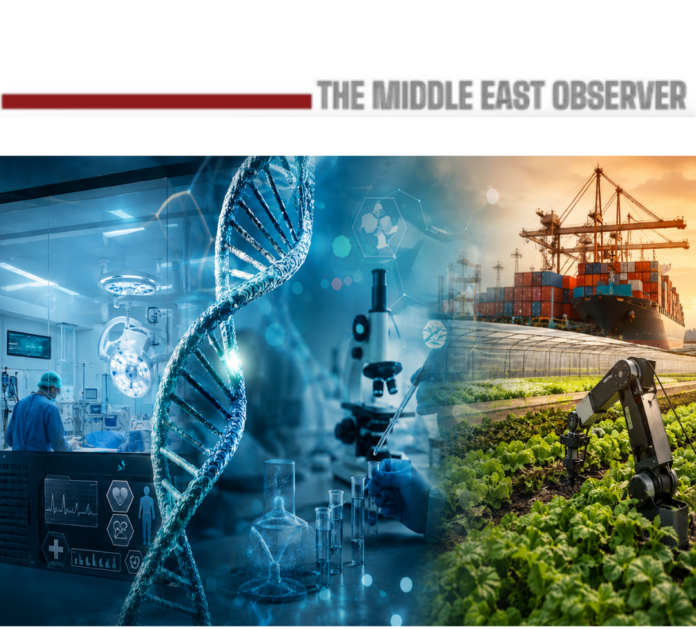
Egypt, Saudi Arabia, the United Arab Emirates, Morocco and Jordan are developing complementary strengths in healthcare, biotechnology and sustainable food production, creating one of the world’s fastest-evolving regional investment ecosystems.
The Middle East and North Africa (MENA) region is emerging as one of the world’s most dynamic markets for healthcare, biotechnology, pharmaceutical manufacturing, agriculture and food security. Faced with common challenges—including rapid population growth, rising healthcare demand, climate change and water scarcity—governments are investing in innovation, industrial capacity and advanced technologies to strengthen economic resilience and reduce dependence on imports.
Rather than pursuing identical development models, Egypt, Saudi Arabia, the United Arab Emirates (UAE), Morocco and Jordan have each built competitive advantages aligned with their economic priorities and natural resources. Together, these complementary strengths are transforming MENA into an increasingly integrated ecosystem for healthcare innovation, life sciences and sustainable food production.
Egypt: Manufacturing Scale and Strategic Market Access
Egypt has developed one of the region’s most diversified healthcare and food production sectors. The FY2025/2026 state budget allocates EGP 617.9 billion to healthcare, while the Universal Health Insurance programme continues expanding towards nationwide coverage. According to the Egyptian Drug Authority (EDA), the pharmaceutical market reached EGP 422 billion (approximately US$8.5 billion) in 2025, increasing by around 37% year-on-year, while domestic manufacturers supply approximately 91% of medicines consumed locally.
The country’s ambitions now extend beyond generic medicines. Investment in biologics, vaccine manufacturing, active pharmaceutical ingredients (APIs), biosimilars and biotechnology is strengthening higher-value pharmaceutical production and reducing reliance on imported medicines.
Egypt also benefits from a unique geographic position linking Africa, the Middle East and Europe through multiple trade agreements and established logistics corridors, making it an attractive manufacturing and export platform for multinational pharmaceutical and food companies.
Food security represents another strategic priority. National agricultural projects—including New Delta, Mostakbal Misr and Toshka—are expanding cultivated land using precision agriculture, modern irrigation and water-efficient farming technologies. Meanwhile, processed food exports reached US$2.43 billion during the first four months of 2026, reflecting the growing international competitiveness of Egypt’s food industry.
Saudi Arabia: Investing in a Knowledge-Based Health Economy
Saudi Arabia is transforming healthcare into a cornerstone of Vision 2030, deploying substantial investment across hospital infrastructure, biotechnology, pharmaceutical localization, genomics, digital health and medical research. The Kingdom is simultaneously encouraging private-sector participation to build a globally competitive life sciences industry.
Food security is advancing alongside healthcare transformation. According to the Ministry of Environment, Water and Agriculture, agricultural production exceeded 16 million tonnes in 2024, while modern irrigation initiatives have reduced reliance on non-renewable groundwater by approximately 52% compared with 2016. Together, these reforms are improving agricultural productivity while conserving scarce water resources.
United Arab Emirates: Innovation-Led Healthcare and Biotechnology
The UAE has established itself as one of the region’s foremost centres for biotechnology, precision medicine and digital healthcare. Long-term investment in artificial intelligence, genomics, advanced diagnostics and clinical research has attracted leading international pharmaceutical companies, biotechnology firms and research institutions.
Complementing its healthcare ambitions, the National Food Security Strategy 2051 promotes vertical farming, hydroponics, controlled-environment agriculture and smart water management. These technologies are enabling greater domestic food production despite limited arable land and challenging climatic conditions.
The UAE’s emphasis on innovation, research partnerships and regulatory agility continues to reinforce its role as a regional hub for advanced healthcare and life sciences.
Morocco: Climate-Smart Agriculture and Industrial Growth
Morocco has become a regional leader in climate-resilient agriculture through sustained investment in irrigation modernisation, water conservation and sustainable farming. Programmes such as Generation Green 2020–2030 are enhancing agricultural productivity while strengthening resilience against prolonged drought and climate change.
Alongside agriculture, Morocco continues expanding pharmaceutical manufacturing and healthcare reform, while its proximity to European markets has supported growth in agribusiness, food exports and industrial production.
Jordan: Resource Efficiency as a Competitive Advantage
Jordan demonstrates how resource scarcity can encourage innovation. Despite being among the world’s most water-stressed countries, it has become a regional benchmark for efficient water management through widespread adoption of drip irrigation, treated wastewater reuse and advanced irrigation technologies.
Jordan also maintains one of the Middle East’s strongest pharmaceutical export industries relative to the size of its economy. Supported by internationally recognised manufacturing standards, a highly skilled workforce and strong medical education, the country exports medicines across the Middle East, Africa and international markets.
Different Strategies, Shared Objectives
Although each country has adopted a distinct development model, their strategies increasingly complement one another.
| Country | Primary Competitive Advantage |
|---|---|
| Egypt | Pharmaceutical manufacturing, biologics, food processing, agricultural expansion and regional exports |
| Saudi Arabia | Healthcare investment, biotechnology, pharmaceutical localization and food security |
| United Arab Emirates | Artificial intelligence, genomics, precision medicine and biotechnology innovation |
| Morocco | Climate-smart agriculture, irrigation, agribusiness and pharmaceutical manufacturing |
| Jordan | Pharmaceutical exports, water efficiency, specialised healthcare and advanced irrigation |
Increasingly, multinational companies are viewing MENA as a regional production ecosystem rather than a collection of individual markets. Manufacturing, research, logistics and commercial operations are being distributed across countries according to their comparative strengths, improving supply-chain resilience while reducing dependence on external suppliers.
Biotechnology Becomes the Region’s Next Growth Engine
Biotechnology is emerging as one of MENA’s fastest-growing strategic industries. Saudi Arabia is expanding investment in genomics, vaccine manufacturing and life sciences research under Vision 2030. The UAE continues advancing precision medicine, genomic sequencing and AI-enabled healthcare, while Egypt is accelerating biologics manufacturing, vaccine production, biosimilars and pharmaceutical localization.
Morocco and Jordan are strengthening pharmaceutical research, advanced manufacturing and export capabilities, contributing to the region’s transition from conventional generic medicines toward biologics, personalized medicine and next-generation therapeutics.
Demographics Are Driving Long-Term Demand
Behind these investments are powerful structural trends. MENA’s population continues to grow, urbanisation is increasing, life expectancy is improving and chronic diseases such as diabetes, cardiovascular disorders and cancer are placing greater demands on healthcare systems. At the same time, climate change and water scarcity are making food security and agricultural productivity national strategic priorities.
These long-term demographic and environmental pressures ensure sustained investment in healthcare infrastructure, pharmaceutical manufacturing, biotechnology and climate-smart agriculture across the region.
Outlook
Healthcare, biotechnology, pharmaceuticals, agriculture and food security are no longer separate policy priorities in MENA. Increasingly, they form an integrated economic strategy centred on innovation, advanced manufacturing and sustainable resource management.
Each country contributes a distinct competitive advantage. Egypt combines one of the region’s largest pharmaceutical manufacturing industries with expanding food production and strategic access to African, Middle Eastern and European markets. Saudi Arabia is deploying unprecedented investment into healthcare infrastructure and biotechnology under Vision 2030. The UAE has established itself as a regional leader in digital health, genomics and life sciences innovation. Morocco continues strengthening sustainable agriculture and climate resilience, while Jordan combines globally competitive pharmaceutical exports with world-class water management expertise.
Collectively, these complementary capabilities are transforming MENA into an increasingly important hub for healthcare, biotechnology, pharmaceutical manufacturing and sustainable food production. As governments deepen public-private partnerships and attract international investment, the region is well positioned to play a larger role in global life sciences, architect and food security over the coming decade.
Related news:
Global Risks Report 2026: Key Findings and Regional Outlook
Egypt Signs $3.38m Agreement with WHO and Japan to Strengthen Emergency Healthcare
Read also:
Elsewedy Electric Invests $200m to Build an Integrated Metals Manufacturing Hub
Saudi-US Partnership Targets $500m to Advance Kingdom’s Biotechnology Ambitions